
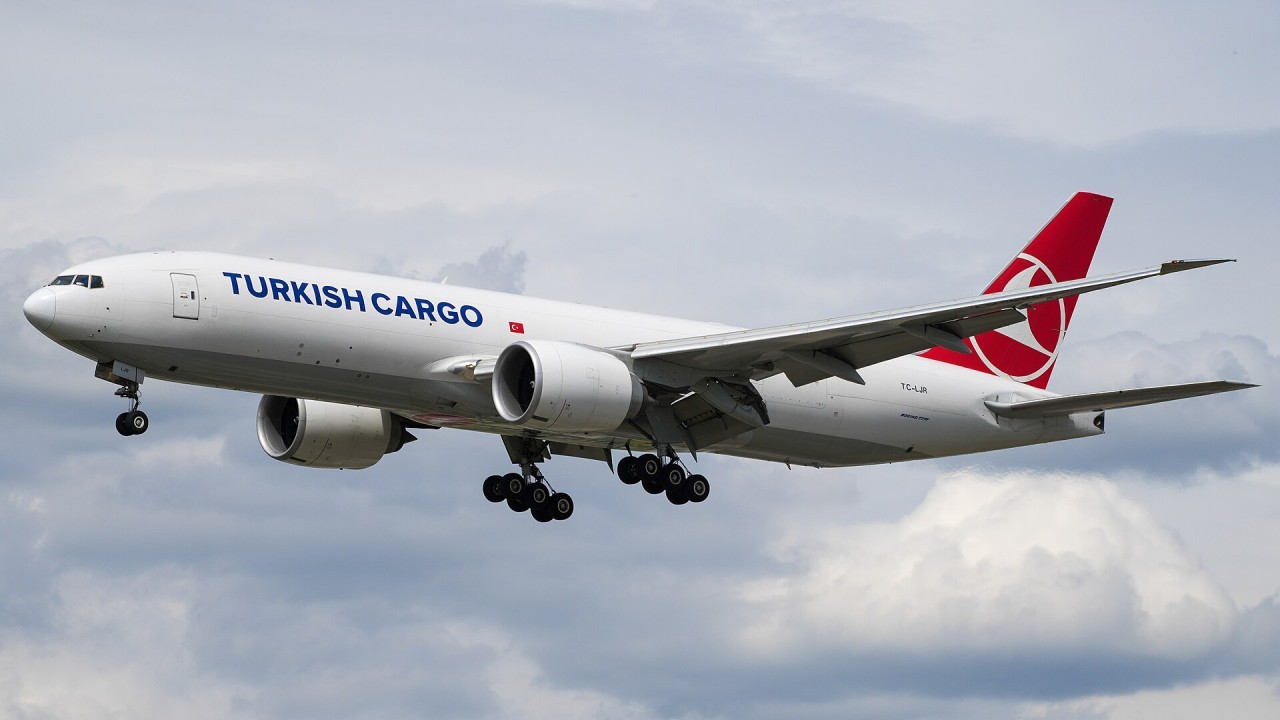
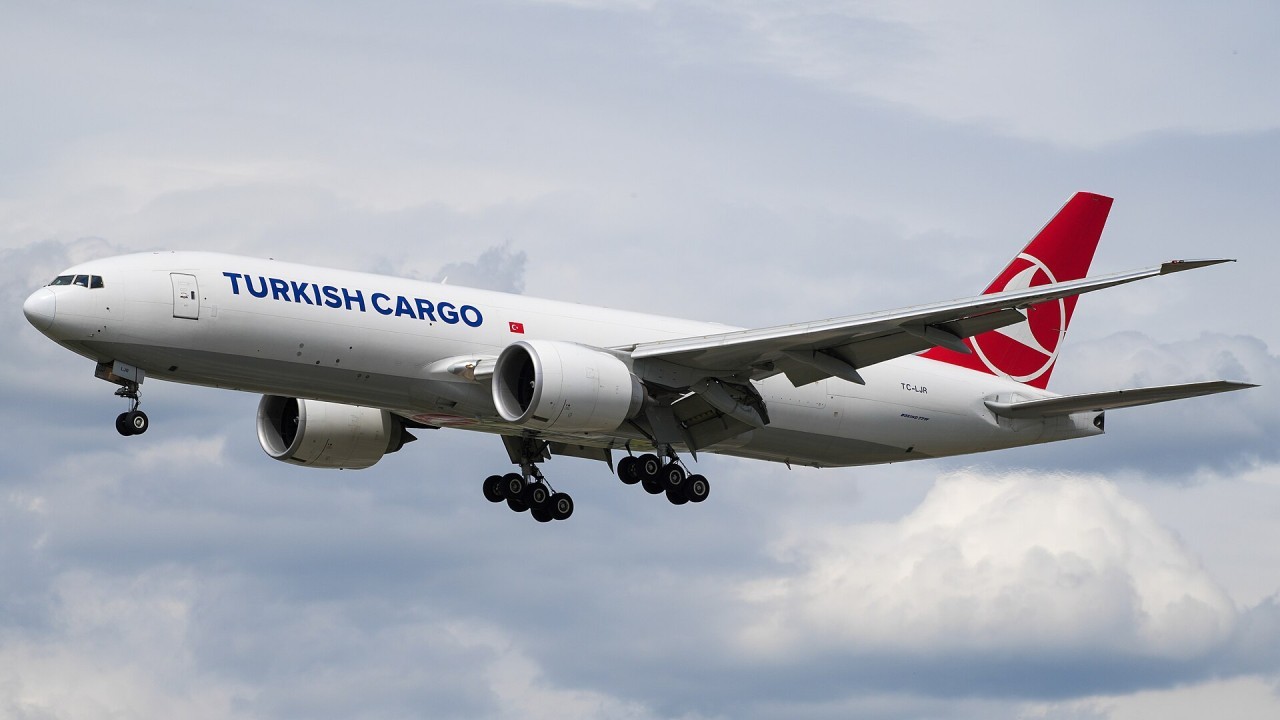
Turkish Cargo Boeing 777F (TC-LJR) im Anflug auf Frankfurt. Foto: MarcelX42, lizenziert unter CC BY-SA 4.0
Air freight via Cairo: When every hour counts – but only if you plan your chargeable weight, customs and delivery correctly
 Raphael Defaudais
When is air freight (CAI → EU/DE) really recommended?
Air freight from Cairo (CAI) is the right route if you treat time as a critical resource—i.e., if a delay costs more than the transport itself.
Typical situations:
- Preventing a production stoppage (spare parts, tools, components for line ramp-up)
- Launch/SOP material (shortly before series start, pilot run, rework parts)
- Prototypes / samples / initial sampling, where speed matters more than €/kg
- High-value goods (electronics, medtech, small high value-density parts), where the risk of long sea lead times + tied-up capital hurts
- Short delivery windows / hard deadlines (trade fairs, project milestones)
Why it is not suitable as a standard: globally, air freight moves a very large share of value (around one third of world trade by value), but only a tiny share by volume—precisely because it is expensive.
Core logic: what makes air freight so fast (and where it still loses time)
In air freight, the flight is often not the bottleneck. The critical time blocks are:
- Pick-up / delivery to the CAI cargo terminal (incl. cut-off)
- Security screening + warehouse processes (build-up on ULDs/pallets)
- Flight + hub connection (direct or via Istanbul/Doha etc.)
- Import handling at the EU airport (warehouse, documents, customs release)
- Last mile (delivery or self-pickup at the terminal)
For express shipments, the “time lever” is strong: DHL Express often markets worldwide delivery within 2–3 working days (depending on lane). For classic airfreight (airline + forwarder), airport-to-airport is often very fast; “door-to-door” then depends on pick-up, customs, and the delivery chain.
From a Damietta perspective: how air freight is set up in practice
Even if your supply chain starts with “Damietta ↔ Europe”: operationally, air freight almost always runs via Cairo (CAI) (warehouse/cargo handling, airline network, frequencies). Lufthansa Cargo, for example, lists CAI as a station and works via a hub system (incl. Frankfurt/Munich/Vienna).
1. Typical process (Door → CAI → EU → Door)
A) Pre-carriage (factory → CAI)
Goods are picked up or delivered in Cairo/Delta.
Important: air freight needs exact dimensions + weight (for chargeable weight), otherwise you get billing surprises.
B) Export process & warehouse
Documents are checked (commercial invoice, packing list, possibly certificates of origin).
Goods may be built up on an airfreight pallet/ULD, secured, and screened.
Time killer: missing or inconsistent details (weight/HS code/goods description) → the warehouse holds the shipment back.
C) Flight
Direct flight or via a hub (e.g., Istanbul/Doha).
Realistically: the flight is fast, but cut-off + available capacity determine the true start.
D) Import (EU airport)
Unloading, import handling, customs release.
After that either:
- delivery by truck/courier, or
- pickup (often cheaper)
The core of air-freight costs: “Chargeable Weight” and density (why “€2/kg” only sometimes holds true)
In air freight you do not always pay by actual weight, but by Chargeable Weight = the higher value of:
- actual weight (gross/actual weight)
- volumetric weight (volumetric/dimensional weight)
DHL Global Forwarding describes the standard formula (in cm) very clearly: Volumetric weight (kg) = L × W × H / 6,000
And that’s where the familiar conversion comes from: 1 m³ ≈ 167 kg (1:6 ratio).
1. What does “the right density” mean?
- High density (e.g., metal parts, machine components, compact goods): actual weight > volumetric weight → you pay by real kg. Then a statement like “€2/kg” can make sense as a rough rule of thumb (depending on lane/season/minima).
- Low density (e.g., plastic parts, bulky packaging, light assemblies): volumetric weight > actual weight → your effective €/kg increases massively because you are paying for “air.”
2. Two mini examples
Example 1: “density fits” (kg dominates)
Box: 60 × 40 × 40 cm
Volumetric weight: 60×40×40 / 6000 = 16 kg
Actual weight: 25 kg → chargeable = 25 kg → €2/kg looks like ~€50 (plus surcharges)
Example 2: “density doesn’t fit” (volume dominates)
Box: 120 × 80 × 80 cm
Volumetric weight: 120×80×80 / 6000 = 128 kg
Actual weight: 40 kg → chargeable = 128 kg → at €2/kg that would be €256 (for 40 kg of actual goods!)
3. Express vs. “classic” air freight: DIM factor can differ
For courier/parcel services, different DIM factors can apply (often, for example, 5,000 instead of 6,000). That changes costs for light goods again.
Price logic vs. sea freight: why air “always feels expensive”—and when it is still cheaper
IATA gives a rough framework that international air-freight costs can be around ~0.50–5.00 USD/kg or more—depending on cargo/route/market.
Sea freight (for FCL) is often orders of magnitude cheaper—but:
- sea freight ties up time + inventory (working capital).
- if your downtime costs €10,000 per day, then €2,000–4,000 of air freight suddenly becomes “cheap.”
A practical decision filter
You should answer these questions:
- What does 1 day of delay cost? (production downtime, contractual penalties, customer loss)
- Is the cargo value-dense enough? (so that chargeable weight doesn’t explode)
- Are the documents “first time right”? (otherwise customs/warehouse eats your time advantage)
Maximum dimensions & weights: what you can realistically move as a standard (ULDs & pallets)
“Maximum size” in air freight is not one single number—it depends on:
- belly cargo (passenger aircraft) vs. freighter (cargo aircraft)
- ULD type (container vs. pallet)
- airline-specific limits & handling equipment
1. Standard air-freight pallet (PMC / P6P) – the most common “build”
DSV lists, among other things, the following values for the P6P/PMC pallet:
- Base / footprint: 317.5 × 242.8 cm (125 × 96 in)
- Max. gross weight: depending on deck/aircraft e.g. 4,626 kg or 5,035 kg (lower deck) and up to 6,800 kg (main deck)
What does this mean for you?
- heavy industrial components are generally possible,
- but “main deck vs. lower deck” can be decisive.
2. Pallet height: why passenger belly often ends around ~160 cm, and freighters can do much more
Cathay Cargo lists typical height profiles for ULDs/pallets:
- 64” (passenger flight)
- 96” (contour)
- 118” (contour)
Converted roughly:
- 64” ≈ 162.6 cm
- 96” ≈ 243.8 cm
- 118” ≈ 299.7 cm
A practical rule you can formulate from this:
- Belly cargo is often “lower” → ideal for cartons/crates/Euro-pallet-like builds up to ~1.6 m
- Freighter allows significantly more height/outsize (but costs more and needs capacity)
Important in practice: “max height” is a booking and capacity criterion—ignore it and you lose time.
5.3 Outsize / overlength / heavy pieces
If a package doesn’t fit standard ULD/door logic:
- you need freighter capacity or special handling, or
- you must repack (e.g., disassemble, adapt crate design).
Outsize is possible, but always case-by-case (door size, handling, ramp equipment).

ULC Loader hebt ein Unit Load Device (ULD) an die Cargo-Bay-Höhe. Foto: Jamesshliu, lizenziert unter CC BY-SA 3.0
Customs & documents in air freight: what is “typical”—and what kills your time advantage
1. Standard documents (airfreight)
For smooth import clearance you typically need (at least):
- Commercial invoice (clean goods description, HS code, values, Incoterm)
- Packing list (packages, weights, dimensions)
- Air waybill (AWB) as the air-transport document
- possibly proof of origin (e.g., EUR.1 or origin declaration) if you want to use preferences → important: not “because air freight,” but because of customs preference/agreements.
2. Typical customs processing (EU)
In practice, air freight is usually released into free circulation at the arrival airport (classic “import”). The big lever is not the procedure itself, but:
- whether you have customs broker and processes under control,
- whether you have cash flow (import VAT/VAT) set up cleanly.
Optional cash-flow hack via NL: If you route via Amsterdam/Schiphol (happens depending on network), the Dutch Article 23 mechanism can matter: the Dutch tax authority explains that you don’t have to pay import VAT immediately, but account for it via the VAT return—this requires an Article 23 permit (usually via tax representation).
“Air is fast—but if you have to pre-finance VAT and documents get stuck, it becomes twice as expensive.”
Risks & practical tips
Risk 1: cut-off & capacity (most common reason why 2 days become 4 days)
Air freight lives on cut-off times.
If goods/docs arrive after cut-off → next flight/standby → time advantage gone.
Practical tip:
- finalize booking + pre-alert no later than when goods are pickup-ready,
- provide dimensions/weights as “final,” don’t estimate.
Risk 2: chargeable-weight shock for light goods
This is the classic. Therefore always:
- check volume, not only kg,
- optimize packaging (oversized cartons = burning money).
Risk 3: DDP / “to the shelf” can become absurdly expensive
DHL is strong in home delivery, but DDP can be costly.
Express door delivery is convenient—but you pay for “comfort + delivery network + risk assumption.”
For recurring B2B shipments, it is often worth doing: airport/terminal pickup + own broker + own truck (more controlled, cheaper).
Risk 4: unclear goods description / HS code → customs stop
In air freight, every mistake hits harder because time is the main reason for the mode.
Practical tip:
- HS code, goods description, values, Incoterm = “first time right”
- otherwise the shipment sits in the warehouse and you pay storage/handling.
How often is air freight actually used—and which sectors use it (German–Egypt context)?
Globally, air cargo is extremely relevant by value, even though it carries little volume. ICAO explicitly states: ~35% of world trade by value with <1% by volume.
IATA formulates similarly and quantifies the trade value moved in the trillions.
Sectors that (in practice) use air more frequently:
- automotive (spare parts/line stop, SOP ramp-ups)
- electronics / electrical components (value-dense, time-critical)
- pharma / medtech (depending on temperature requirements and compliance)
- fashion / retail (season windows, but usually only for high-margin items)
- e-commerce (time promises, often via integrators)
Sectors that tend to avoid air:
- heavy, low value density (construction materials, basic metal semi-finished products)
- large volumes without time pressure (classic: sea freight/containers)
Decision aid: “Air or sea?” – a short checklist
- What does 1 day of delay cost?
- Is the cargo value-dense (Actual ≥ Volumetric)?
- Do we have final dimensions/weights?
- Are export/import documents error-free?
- Who does customs and who handles delivery?
- Is terminal pickup worth it instead of DDP?
- Are there alternatives (RoRo/Adria/Rotterdam) that are “fast enough”?
Sources:
(1) ICAO – ICAO Global Air Cargo Summit (35% value / <1% volume): https://www.icao.tv/icao-global-air-cargo-summit
(2) IATA – Value of Air Cargo (value dimension & importance): https://www.iata.org/en/programs/cargo/sustainability/benefits/
(3) IATA – Air Cargo Tariffs and Rules (cost range, influencing factors): https://www.iata.org/en/publications/newsletters/iata-knowledge-hub/air-cargo-tariffs-and-rules-what-you-need-to-know/
(4) DHL Global Forwarding – Calculating Chargeable Weights (formula /6000, mode comparison): https://www.dhl.com/tr-en/home/global-forwarding/freight-forwarding-education-center/calculating-chargeable-weights.html
(5) Incodocs – CBM Calculator for Airfreight (DIM factor 6000; note courier 5000): https://incodocs.com/tools/cbm-calculator-airfreight
(6) DHL Express – Express International (typically 2–3 business days, product description): https://www.dhl.de/en/privatkunden/pakete-versenden/weltweit-versenden/express-easy.html
(7) DHL Express – Transit Times and Zones Worldwide 2025 (PDF, note on typical transit times): https://www.dhl.de/dam/jcr:c5b2db52-8850-4f98-916c-7162ab79e5fb/dhl-express-zonen-laufzeiten-weltweit-012025-en.pdf
(8) Lufthansa Cargo – Station CAIRO (CAI) (station reference): https://www.lufthansa-cargo.com/de/network/maps/stations/details/CAI
(9) Lufthansa Cargo – Our stations / hubs (Frankfurt, Munich, Vienna): https://www.lufthansa-cargo.com/en/network/maps/stations
(10) DSV – P6P/PMC Pallet Dimensions (base dimensions & max gross weight): https://www.dsv.com/en/our-solutions/modes-of-transport/air-freight/unit-load-devices/p6p-pmc-pallet
(11) Cathay Cargo – ULD Specifications (typical pallet heights/weights, e.g., 64”/96”/118”): https://www.cathaycargo.com/en-us/help-and-support/uld-specifications.html
(12) Dutch Tax Administration – Article 23 (import VAT reverse charge, permit logic): https://www.belastingdienst.nl/wps/wcm/connect/bldcontenten/belastingdienst/business/vat/vat_in_the_netherlands/vat_relating_to_purchase_and_sale_of_goods/import_from_non-_eu_countries_to_the_netherlands/reverse-charge_mechanism_on_import_article_23