© 2026 Gemp Holding . All rights reserved.
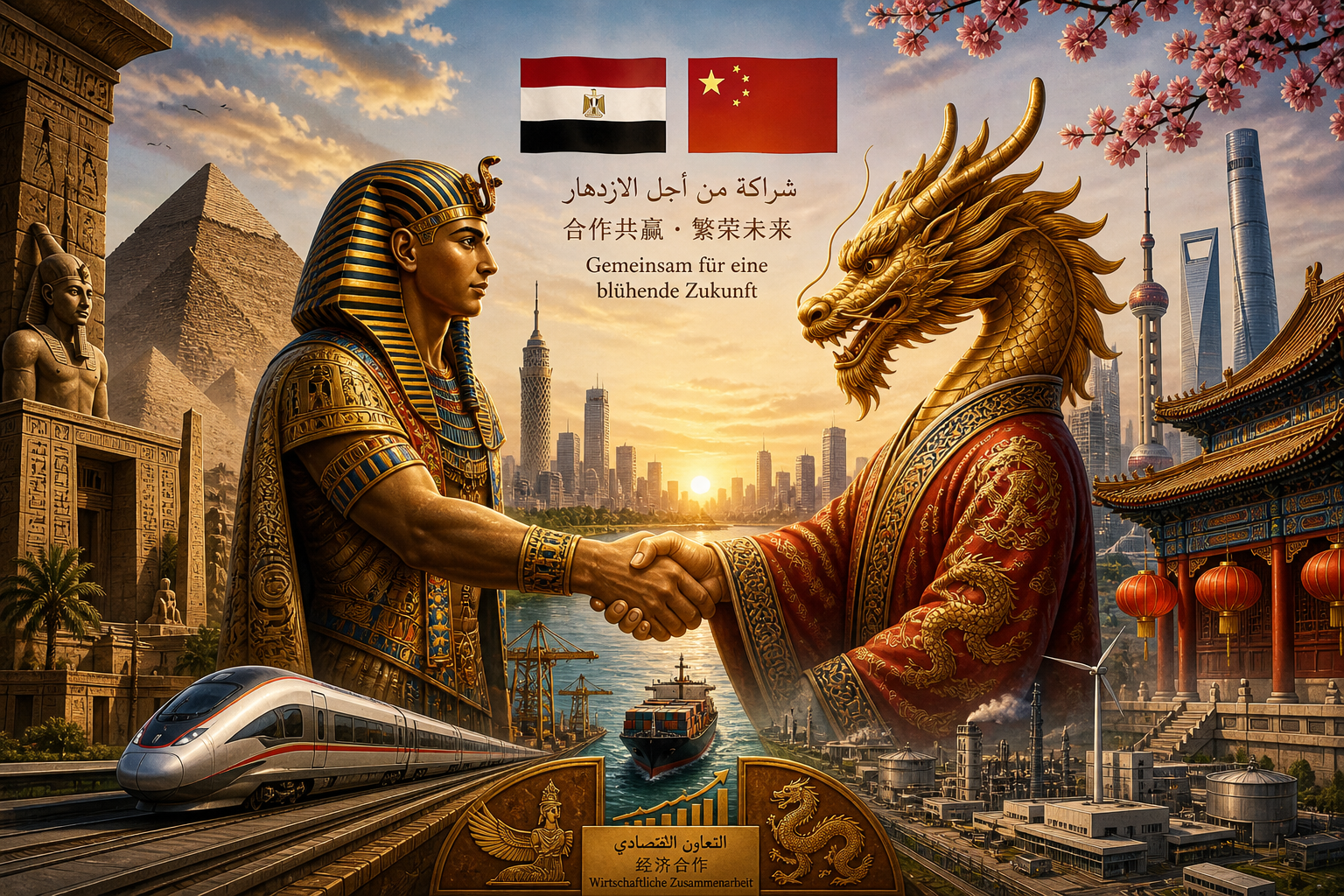
This image is a digitally generated illustration for conceptual and marketing purposes only. Any resemblance to real entities, projects, or agreements is purely coincidental. No political or governmental representation is intended or implied.
China, Africa and Egypt: why Beijing’s new zero-tariff push matters for Cairo — but does not give China a free hand
The debate around China’s new Africa trade move is often told too simply: Beijing opens its market, Africa exports more to China, everyone wins. That is not wrong, but it is incomplete. China has said that from 1 May 2026 it will grant zero-tariff access to imports from 53 African countries that have diplomatic ties with Beijing, excluding Eswatini because it recognizes Taiwan. At the same time, the broader trade backdrop remains highly asymmetrical: China-Africa trade reached about $348 billion in 2025, of which $225 billion were Chinese exports to Africa and only $123 billion were Chinese imports from Africa. So the measure is economically relevant, but it is also geopolitically legible: China is deepening access to African markets while presenting itself as a more open partner than Western economies that have moved in a more protectionist direction. For Egypt, this is a real opportunity — but only if Cairo manages the relationship actively rather than simply absorbing more Chinese goods and capital.
In Egypt’s case, the relationship is already deep. According to China’s foreign ministry, bilateral trade between the two countries reached $17.378 billion in 2024. Of that, $16.8 billion were Chinese exports to Egypt, while China imported only $578 million from Egypt. That makes the imbalance explicit: Egypt is an important market and manufacturing base for Chinese firms, but it is still a relatively small supplier into China. This is exactly why the new tariff-free access matters. It does not automatically rebalance the relationship, but it does create a more credible opening for Egyptian exports.
What is actually traded between China and Africa
At a broad level, Africa-China trade is still shaped by a familiar pattern: Africa exports primary commodities and agricultural goods, while China exports manufactured products. Rhodium Group describes the relationship in exactly those terms — an exchange of primary commodities for finished manufactured goods. Recent AP reporting on the zero-tariff initiative pointed to likely beneficiaries on the African side such as cocoa, coffee, citrus and wine. On the other side of the trade equation, Chinese exports into African markets increasingly include not only consumer goods but also industrial and clean-tech products. Reuters reported, for example, that African countries bought a record $2 billion worth of Chinese solar modules in 2025. That is a useful reminder that Beijing’s Africa strategy is no longer just about securing raw materials; it is also about finding demand for Chinese industrial output, technology and overcapacity.
Egypt follows the same broad pattern, but with its own specifics. According to OEC/UN Comtrade data for 2024, China’s top exports to Egypt were telephones, non-retail synthetic filament yarn, and cars. Egypt’s top exports to China were petroleum gas, flax fibres, and calcium phosphates. Egyptian trade voices have also argued that, if zero-tariff treatment is effectively used, sectors such as food products, fruit and vegetables, leather, marble and granite could gain more traction in China. In other words, the relationship still leans heavily toward Chinese industry and Egyptian base goods — but there is now a clearer policy incentive to broaden Egypt’s export basket.
Chinese factories in Egypt are already a fact, not a future scenario
One of the biggest differences between Egypt and many other African countries is that China in Egypt is not only selling or financing — it is also manufacturing. According to GAFI chief Hossam Heiba, more than 2,800 Chinese companies were operating in Egypt by May 2025, with combined investments of more than $8 billion. The list of major names includes OPPO, Haier, Jushi, Midea, TEDA, Huawei and Brilliance Auto. That matters because it means Egypt is not just a buyer in the China relationship; it is also becoming a platform for Chinese industrial production.
A strong example is Haier. The company officially inaugurated its Egypt Ecological Park in the 10th of Ramadan City in 2024. According to Haier, the site covers 200,000 square metres, is designed for a total capacity of more than 1.5 million units, and is expected to create over 3,000 jobs. Haier explicitly frames the site as a platform for the broader Middle East and Africa. That is exactly the model that makes Egypt attractive: a large domestic market, proximity to Europe, access to the Gulf and Africa, and a state that actively promotes industrial localization.
OPPO is another clear case. In 2025, the Chinese smartphone company opened a manufacturing plant in the 10th of Ramadan City. Xinhua reported that the facility covers 24,000 square metres, has 17 production lines, employs around 2,000 Egyptian workers, and initially produces about 400,000 units per month, with local value-added already above 42%. From Egypt’s perspective, that local content figure is crucial: the objective is not just assembly, but deeper domestic value creation.
The Suez Canal Economic Zone provides a second major cluster. Jushi Egypt, a subsidiary of China’s CNBM/Jushi group, began pilot operation of a new fiberglass line in Sokhna in 2022. SCZONE said the line had an annual capacity of 200,000 tonnes. Midea has also built out production in Sokhna through TEDA Egypt. SCZONE describes a 60,000-square-metre site, a $25 million investment for one production line, and eventual employment potential reaching 1,500 jobs through future expansions. These are no longer symbolic projects. They are building blocks of a real China-Egypt industrial corridor.
Why Egypt matters so much to China
From Beijing’s perspective, Egypt is simultaneously a market, a factory base and a logistics platform. It sits on the Suez Canal, connects Africa, Europe and the Gulf, and offers a state-backed industrial platform through SCZONE. Politically, the relationship is also deep: China’s foreign ministry describes Egypt as part of a comprehensive strategic partnership since 2014, upgraded further in 2024. That depth gives Chinese firms confidence that industrial, logistics and infrastructure projects can be pursued with long-term political backing.
At the same time, Egypt is useful to China for more than market access. It gives Chinese firms a way to transform export dependence into regional production for third markets — including Africa, the Middle East and, in some sectors, Europe. That is why the relationship increasingly revolves not only around Chinese exports into Egypt, but around Chinese production inside Egypt.
How Egypt pushes back against excessive Chinese influence — without open confrontation
The more interesting question, then, is not whether China is gaining influence in Egypt. It is. The more useful question is how Egypt is trying to avoid becoming overly dependent. The answer is: not through direct confrontation, but through guardrails.
First, Egypt is pursuing diversification rather than exclusivity. While Chinese investment is rising, Cairo has simultaneously secured the $35 billion Ras El Hekma deal with the UAE and negotiated a broader €7.4 billion package with the EU, including a planned €4 billion macro-financial component. In practice, that means China is important, but never the only option. Egypt is deliberately building several investment and financing pillars at once.
Second, Egypt is tying access to performance conditions. In 2026, the government warned investors holding industrial land that they must start construction or risk losing those plots. The rule is not directed at China specifically, but in a context of high foreign demand it clearly limits speculative land-holding and forces real implementation. Cairo is effectively saying: investors are welcome, but only if they build.
Third, Egypt is trying to bind Chinese investment to local production, jobs and technology transfer. GAFI has openly stated that Egypt prioritizes Chinese investments because they can generate employment and transfer technology. That is an industrial-policy filter, not a passive opening. It means Cairo is trying to shape the terms of the relationship rather than simply accept capital inflows on any basis.
Fourth, strategically sensitive sectors remain politically sensitive. Reuters showed in 2025, through its investigation into Egypt’s space cooperation with China, that Chinese technology and personnel presence in sectors such as satellite infrastructure has raised concern in Western security circles. That is precisely why Egypt’s broader posture matters: it is deepening ties with China, but it is also maintaining strong links with Western and Gulf partners and keeping its options open. This is not an anti-China policy. It is a classic hedging strategy.
Conclusion
China’s zero-tariff offer to Africa is a real opportunity for Egypt, but it is not an automatic turning point. It may help broaden Egyptian exports into China, yet the structural imbalance remains severe: China sells industrial goods, while Egypt still exports mostly lower-value or commodity-linked products. At the same time, China in Egypt is no longer just a trader or financier; it is already a serious manufacturing actor in electronics, home appliances, fiberglass and potentially automotive. That means Egypt’s real challenge is not to keep China out, but to structure the relationship so that it produces more local value-added, more export capability and more technological depth. In that sense, Egypt does not “stand up to China” through rhetoric. It does so through rules: diversified partners, land withdrawal for non-performance, insistence on jobs and localization, and a refusal to depend on a single external power. That is where Cairo’s leverage lies