
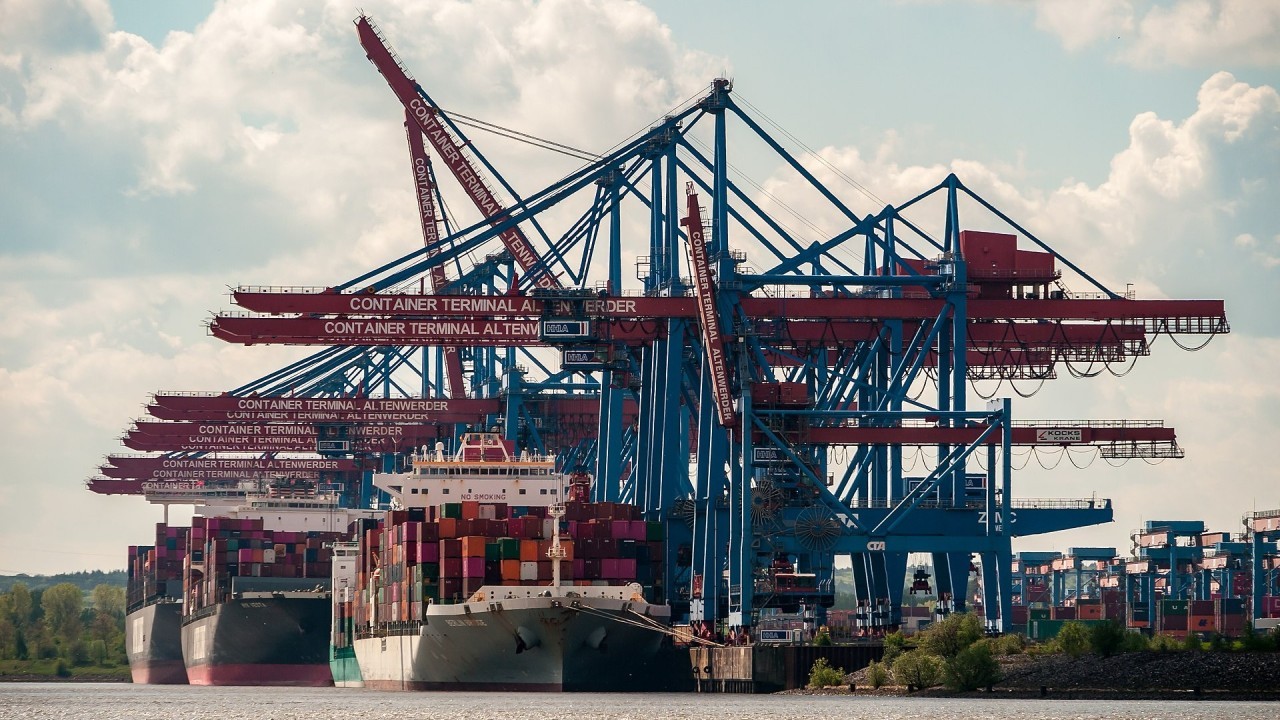
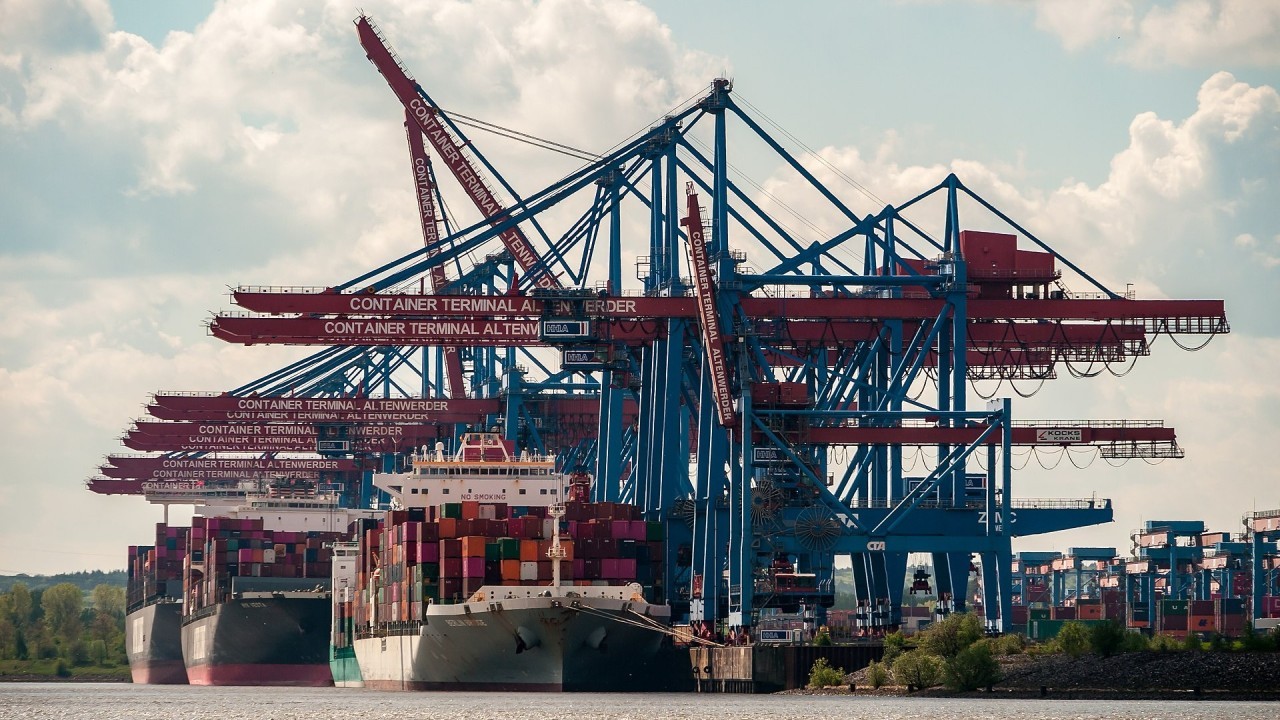
Containerschiffe am Container Terminal Altenwerder (Hamburg). Foto: Matti Blume, Lizenz: CC BY‑SA 4.0.
Containers via Hamburg: If you want to clear customs in Germany – maximum control over EUSt, compliance and special equipment
 Raphael Defaudais
When this route is recommended (and when you
are better off choosing another one)
The route Alexandria/Damietta → Hamburg is not automatically the fastest and it is not always the “cheapest ocean-freight option”. But it is one of the most process-robust routes – and that is exactly why it becomes extremely attractive for many German companies as soon as it’s not just about transport, but about tax compliance, central clearance, cashflow predictability and internal control.
This route is particularly recommended if:
· you want to clear customs for import in Germany on purpose, because your customs/tax setup is based there (broker, compliance, EORI master data, internal approvals, audit trail),
· you use (or want to use) a deferment account/payment deferment in order to pay import charges later (instead of immediately upon import),
· you would rather handle import VAT (EUSt) via the German VAT logic (input VAT deduction) instead of being dependent on refunds/registrations abroad,
· you supply Northern Germany or are building nationwide distribution and want to use Hamburg as a rail hub/gateway,
· you ship special equipment (flat rack, open top, tank, reefer, OOG) and the route therefore often becomes more economical door-to-door, because the equipment logic, depots, repair and return paths in Hamburg are very good and the inland distance in DE is often shorter.
Hamburg is less recommended if:
· you need maximum speed (Adria or RoRo can be faster depending on the setup),
· you do not want to build any German customs process and instead deliberately use VAT levers such as NL Article 23 or standardized 4200/42 in other countries,
· you do not have the resources to actively manage pick-ups/slots/documents (Hamburg moves fast, but “process gaps” become expensive via storage/demurrage/detention).
Route overview: Alexandria/Damietta →
Hamburg as the “control route”
For this lane, Hamburg is less a “trick route” and more a route with a clear strategic promise:
You import where you have the greatest internal control – in Germany.
1. Typical transport chain (starting from Damietta)
1. Pick-up/delivery in Damietta (FCL, usually a 40’ standard container; special equipment depending on the goods).
2. Export clearance in Egypt (documents, inspections if applicable, product category).
3. VGM (Verified Gross Mass) / SOLAS: The shipper is responsible for determining and documenting the VGM; in principle, containers without VGM must not be loaded.
4. Ocean transport towards the North Range (depending on the carrier with/without transshipment; transit times vary widely).
5. Arrival in Hamburg: terminal handling, unloading.
6. Import clearance in Germany (typically: procedure 40/4000 or “release for free circulation” in DE; details below).
7. On-carriage: truck, rail or combinations (e.g. rail to the south + short final leg).
8. Empty return/depot: return of empty containers or return/handling for special equipment (Hamburg can be very strong here if distances are short and depots/services are available).
2. Why Hamburg works as a starting point for a “clean SOP”
Hamburg rewards companies that treat their import as a repeatable process:
· fixed broker routines,
· a clear document timeline,
· defined pick-up windows,
· and a clear concept for how your EUSt cashflow is handled (deferment account vs. immediate payment).
If you have that discipline, Hamburg is not just “a port”, but an industrial system (rail, terminals, depots, repair services, routine with authorities).
Hamburg as a gateway: rail power, terminals,
hinterland – why that matters for DE imports
Hamburg is often described as “Germany’s gateway to the world” – but for your setup the key question is: How quickly can you get from the terminal into the hinterland, and how stable is the system?
1. Hamburg is Europe’s largest rail port – and that is a real lever
for imports
The Port of Hamburg presentation describes Hamburg as “Europe’s largest rail port” and gives concrete figures: a rail network of around 300 km, about 200 freight trains with more than 5,500 wagons daily, and 45.6 million tonnes by rail in 2024.
That’s not just “nice to know”. For you, it means:
· Predictability: When truck capacity is tight, you have real alternatives.
· Scalability: When you go from “a few containers” to “regular”, you need a system that doesn’t collapse in every peak season.
· Southern connection: For long distances (Southern Germany, CZ, AT, PL etc.), rail can become very competitive because you reduce the road leg to the last mile.
2. Terminals + rail = “But you do have to stay on top of it”
In practice, both are true at the same time:
· Yes, rail connectivity is available and can work extremely well.
· But: rail is a product that requires active steering (slots, cut-offs, documents, wagon availability, parking areas).
This is not a Hamburg problem, it’s rail reality. That’s why the Hamburg route always needs a communication and escalation plan: Who calls if the train wasn’t loaded? Who has the booking numbers? Who has the terminal contacts?
DB Cargo emphasizes, for example, that every container terminal in the port has an integrated rail terminal and that CTA (Altenwerder) is a very large facility for combined transport.
Customs & tax in Hamburg: the core advantage is not
transit time – but control and cashflow
This is why companies choose Hamburg despite potentially longer sea transits:
You import within your own legal and process environment.
1. Typical customs procedure in Hamburg: import in Germany
(instead of 42/4200 abroad)
The typical case looks like this:
· Goods arrive from a non-EU country (Egypt) into the EU,
· you do import clearance in Germany,
· you may pay duty + EUSt (or defer payment via payment deferment),
· you treat EUSt under German VAT as input tax, if you are entitled to deduct input VAT.
The key practical argument: Hamburg makes sense if you deliberately want to clear customs in Germany – because that’s where you can centralize brokers, processes, compliance and payment flows.
2. Input VAT deduction: EUSt can be claimed as input tax
in Germany (if the setup fits)
The Federal Ministry of Finance (UStH, section 15.8) states the principle clearly: a business can deduct the incurred import VAT as input tax if the goods were imported domestically for the business – and the incurrence must be proven.
Customs also explains on its page about input tax deduction that EUSt for goods imported for the business can be claimed as input tax.
Important note: This is the mechanical lever that reduces the “cashflow pain” – but it does not automatically eliminate it. You can only truly eliminate it once you also control the payment timing (deferment account / payment deferment).
3. Payment deferment / deferment account: the “cashflow turbo”
for imports into Germany
If customs grants you payment facilitation/payment deferment, import VAT is not due immediately, but on the 26th of the second month following the clearance (§ 21 (3a) UStG).
What that means in practice:
· Without a deferment account: EUSt can become due immediately/soon → liquidity is tied up.
· With a deferment account/payment deferment: EUSt becomes due later → you gain time, sometimes several weeks, and can synchronize the payment flow better with your VAT advance return/financial planning.
How to remember it: Hamburg + a German deferment account = you run imports like a “domestic process” rather than as a foreign VAT risk.
4. What this means in practice compared to importing abroad
(without country-bashing)
If you import in another EU country (e.g. Italy/Slovenia/NL) and EUSt is incurred there, it can – depending on the setup – lead to longer refund paths, registration requirements or liability questions. That’s not “worse”, but more complex if your company primarily operates in Germany.
Hamburg is therefore the route if you say:
· “We do not want to build tax setups abroad first.”
· “We do not want to depend on an importer/tax rep abroad.”
· “We want a German audit trail.”
The downside: Hamburg can create cashflow problems
– if you import without deferment
1. Without a deferment account, EUSt can tie up liquidity
If you do not have payment deferment, you must pay EUSt (and possibly duty) in the import process. EUSt can generally be deducted as input tax for businesses entitled to deduct input VAT – but that does not change the fact that you are paying cash out upfront.
· The exact timing depends on the declaration logic, the evidence (import document) and your tax advisor. But the underlying mechanism is the input VAT deduction – we are happy to advise you further here.
2. With a deferment account, the “liquidity peak” becomes much smaller
This is where the circle closes: customs explicitly describes the later due date of EUSt when payment deferment is approved.
Practical effect: You get goods released for free circulation (you can dispose of them), but the payment runs with a time lag. That is exactly what makes Hamburg so attractive for many import-intensive companies.
Port costs & risk levers: storage, demurrage,
detention – Hamburg moves fast, but dwell time is
expensive
A common misconception when clearing customs in Germany is:
“If we import in Germany, everything is automatically straightforward and cheap.”
That’s not entirely correct. What is true, though:
· legally/tax-wise it is often cleaner,
· operationally it is extremely capable.
What is also true:
· If you don’t manage the pick-up, you pay.
1. HHLA Quay Tariff: an example of how quickly storage costs can rise
HHLA publishes a quay tariff (e.g. as of 1 Dec 2024) which lists, among other things, storage fees per container/day, and also describes that rates can double or triple after certain days (depending on import/export, free time, etc.).
What that means for you:
· “Short delays” cost little.
· “A week of paperwork chaos” can cost serious money – especially with big boxes, reefers or special equipment.
2. Demurrage vs. detention
Industry-style explanation:
· Detention = the container is kept outside the terminal for too long (not returned empty to the depot in time)
· Demurrage = the container stays in the port/terminal for too long after discharge (not picked up in time)
Why this matters for Hamburg: Hamburg is operationally so strong that there are “no excuses”: processes are designed for throughput – if you don’t keep up, you get “corrected” via D&D/storage.

Hamburg’s trump card for door-to-door: special
equipment and why Hamburg often wins economically
here
With special equipment, Hamburg is often by far the most cost-effective option for door-to-door shipments because the inland leg is short.
1. What “Special Equipment” typically means in Egypt–DE practice
· Flat rack: machinery/overwidth cargo, not stowable/liftable as standard.
· Open top: tall cargo, loading from above.
· Reefer: temperature-controlled.
· Tank container: liquids/chemical products (additional regulations).
· OOG (out of gauge): oversize in height/width/length.
Compared to standard dry containers, these shipments have two cost drivers:
- More handling effort at the terminal (inspections, securing, measuring, special pier if applicable).
- Equipment costs (free days, return locations, repair/inspection, positioning).
HHLA lists special services for container terminals (e.g. VGM weighing, inspections by customs/authorities, cargo securing, measuring, degassing/gassing).
HHLA also describes a depot in the port (“M&R depot”) for repair, cleaning and storage of “specials, reefer, tank” as well, including large parking areas and direct terminal access.
Why this matters economically: If you have special equipment in a port where you get repair/depot/handling “on site” and with short distances, the risk drops that you accumulate expensive detours and dwell days for small topics (inspection, gasket, CSC check, cleaning).
2. The “short inland leg” is doubly valuable for special equipment
With standard boxes, “a few hundred kilometers more” is annoying. With special equipment, “a few hundred kilometers more” can be catastrophic, because:
· you have more waiting time/organization,
· you often have stricter return requirements,
· you frequently have fewer depot options,
· and in case of problems (e.g. repair needed) you have to go back “into the port world” again.
Hamburg is often cheaper here because:
· for Northern/Western Germany, the truck final leg is often shorter,
· you get empties back faster,
· and you have a high density of depot/service infrastructure.
3. Empty-return logic: why the “wrong depot” or the “wrong port” quickly triggers extra charges
In a notice about German ports, Maersk explains that pick-up/drop-off charges can apply if empty containers are returned to a different location/depot than specified for the booked load/discharge port (example: pick-up Hamburg – load port Bremerhaven).
What that means in practice:
· Special equipment costs strongly depend on the equipment chain and port selection fitting together.
· Hamburg can become “systemically” cheaper here if your door-to-door setup is Germany-centered anyway.
The broker’s role in Hamburg: “a good broker is a
must” – and why
1. Why the broker matters more in route 2.4 than in some 42/4200 setups
If you import in Hamburg, the full responsibility for:
· correct customs classification (HS codes),
· correct duty calculation,
· preference proofs (EUR.1 / origin),
· requirements/prohibitions/restrictions,
· and the entire document chain
… sits directly in your German import process.
That is good (for more control), but it also means: any ambiguity lands with you – not in an “intermediate-country setup”.
2. Practical SOP: what your broker collaboration should look like
· Pre-alert: Send documents to the broker early (invoice, packing list, B/L draft, HS codes).
· Pre-check: Plausibility check (goods description, value, Incoterms, origin).
· Payment flow: The broker must know whether you use a deferment account, who the duty debtor is, and which evidence is needed for input VAT deduction (import document).
· Fallback: What happens in case of customs inspection? Who organizes appointments? (HHLA lists inspections/official visits as a service item in the terminal context.)
Documents: what you need to have under control for Damietta → Hamburg
1. Minimum set per container (FCL)
· Commercial invoice (clean: seller/buyer, Incoterms, currency, goods value, HS code, country of origin)
· Packing list (packages, net/gross, dimensions)
· Bill of lading / sea waybill
· Export documents Egypt (depending on product group)
· EORI + powers of attorney if applicable
· VGM (SOLAS)
2. Preference (EUR.1) – not mandatory for the process, but often for the cost
Importing via Hamburg means: you pay duty under German procedure – unless you have a preference (e.g. EUR.1) or other duty exemptions. Therefore:
· If EUR.1 is possible, it can bring real duty advantages.
· But: EUR.1 must be provided organizationally as an original document – meaning you have to plan it in early.
Route risks – and our concrete practical tips
Risk 1: EUSt cashflow eats liquidity (if without a deferment account)
Symptom: Goods arrive, clearance runs – but finance “feels” the import as a liquidity peak. Countermeasures:
· Check a deferment account/payment deferment (EUSt due on the 26th of the second following month).
· Keep processes for input VAT deductibility clean (import document/evidence).
Risk 2: Document gaps lead to delays and storage costs
Symptom: Customs cannot release (HS code unclear, invoice inconsistent, origin unclear, B/L data wrong). Countermeasures:
· Document gate: “No go without final invoice/packing list.”
· Broker pre-check.
· Early coordination for special goods (chemicals, food contact, dual use, etc.).
Risk 3: Dwell time/storage + D&D escalate costs
Symptom: Container sits at the terminal or at the consignee, free time runs out. Countermeasures:
· Secure pick-up slots before ETA.
· Think about empty return immediately.
· Train the team on the D&D mechanics (demurrage/detention definitions).
· Understand terminal tariffs: storage fees can increase significantly after a number of days.
Risk 4: Rail works – but only if you “lead” it
Symptom: Train booking exists, but wagon/slot is missing or documents are not at the terminal in time. Countermeasures:
· Rail SOP with fixed responsibilities.
· Escalation paths (terminal/operator).
· For critical shipments: truck fallback.
Risk 5: Special equipment becomes expensive if return/depot logic is not planned cleanly
Symptom: Flat rack/open top stays out too long, return location is wrong, repair/inspection is delayed. Countermeasures:
· Use depot/repair options in Hamburg (M&R depot/services).
· Define the return location contractually/operationally cleanly (otherwise extra charges are possible).
Realistic cost and transit time expectations
A commonly cited figure is around EUR 2,500–3,000 door-to-door as a typical order of magnitude (depending on inland leg, season, carrier, THC/D&D, equipment). That can fit many setups – but:
· With standard dry containers, Hamburg can look more expensive in some weeks than alternatives if local charges/slots/dwell times run poorly.
· Hamburg can still win overall with special equipment or a German customs/deferment account because you reduce the real cost drivers (D&D, compliance, finance friction).
We do not assess the Hamburg route only as a “price per container”, but as a route by Total Landed Cost = ocean + local charges + D&D + duty/VAT cashflow + risk surcharges.
Conclusion: Hamburg is the route for companies that run imports as a controlled process
If you are “just looking for cheap”, Hamburg may not be the first reflex in every week. But if you:
· want to centralize your setup in Germany,
· want to manage EUSt cashflow via a deferment account,
· want to map input VAT deduction cleanly,
· and don’t want surprises with special equipment,
… then Damietta to Hamburg is one of the best “knowledge routes”, because it not only transports, but delivers process reliability.
Sources:
1) Port of Hamburg – Europe's largest rail port (figures on rail network, trains/day, rail tonnage 2024)
https://www.hafen-hamburg.de/en/hinterland/rail/
2) Hamburg Port Authority – Port Railway (role of the port railway / infrastructure)
https://www.hamburg-port-authority.de/en/port-railway
3) HHLA – Railway Port Hamburg (rail network, freight trains/day, relevance)
https://hhla.de/en/the-power-of-networks/intermodal-logistics/railway-port-hamburg
4) DB Cargo – Hamburg in combined transport (note on integrated rail terminals/CTA)
https://www.dbcargo.com/rail-de-en/logistics-news/cities-countries-oceans-hamburg-with-a-click-transfracht-forto-10042572
5) Zoll.de – With payment facilitation (payment deferment; EUSt due on the 26th of the second following month)
https://www.zoll.de/DE/Fachthemen/Zoelle/Abgabenerhebung/Zahlung-der-Abgaben/Mit-Zahlungserleichterung/mit-zahlungserleichterung_node.html
6) Federal Ministry of Finance (UStH) – 15.8 Deduction of import VAT as input VAT
https://usth.bundesfinanzministerium.de/usth/2023/A-Umsatzsteuergesetz/IV-Steuer-und-Vorsteuer/Paragraf-15/ae-15-8.html
7) Zoll.de – Input VAT deduction (claim EUSt as input VAT)
https://www.zoll.de/DE/Fachthemen/Steuern/Einfuhrumsatzsteuer/Vorsteuerabzug/vorsteuerabzug_node.html
8) Chamber of Industry and Commerce Stuttgart – Structuring deferment accounts (practical overview: EUSt due later)
https://www.ihk.de/stuttgart/fuer-unternehmen/international/import-export/import/aufschubkonto-einfuhr-5570686
9) IMO – Verification of the gross mass of a packed container (VGM; shipper responsibility)
https://www.imo.org/en/OurWork/Safety/Pages/Verification-of-the-gross-mass.aspx
10) HHLA – Container special services (incl. inspections, cargo securing, measuring, VGM)
https://hhla.de/en/customers/services/container-services/container-special-services
11) HHLA – M&R depot in the port of Hamburg (repair/cleaning/storage also for specials/reefer/tank)
https://hhla.de/en/customers/services/container-services/mr-depot-in-the-port-of-hamburg
12) HHLA – Quay tariff (example for storage mechanics / dwell-time costs)
https://hhla.de/fileadmin/download/HHLA_Kaitarif_2024_12_01_en.pdf
13) Hapag-Lloyd – Detention & Demurrage explained (definitions, free time)
https://www.hapag-lloyd.com/en/online-business/digital-insights-dock/insights/2024/06/detention-and-demurrage--what-is-the-d-d-charge-in-shipping---.html
14) Maersk – Empty containers at German port locations (notes on pick-up/drop-off charges)
https://www.maersk.com/news/articles/2020/03/15/empty-containers-at-german-port-locations