
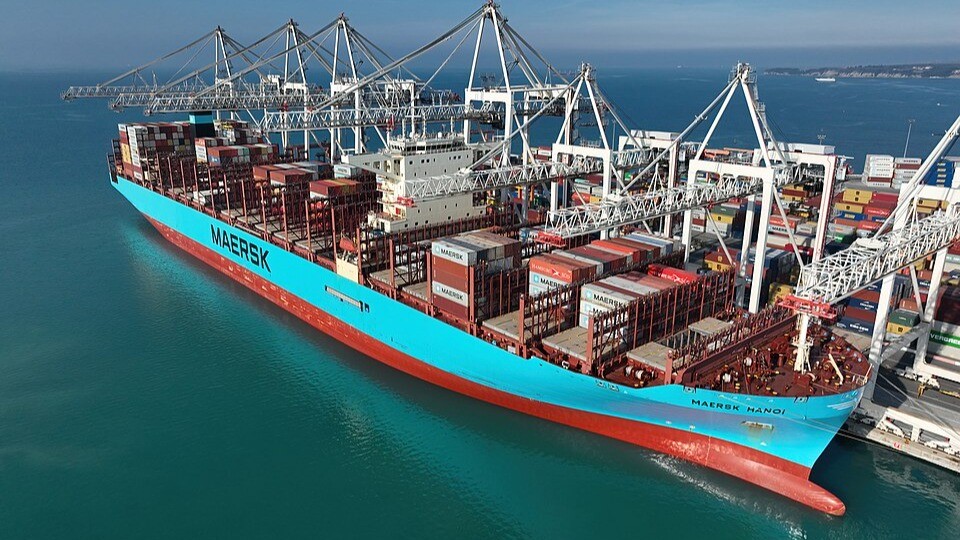
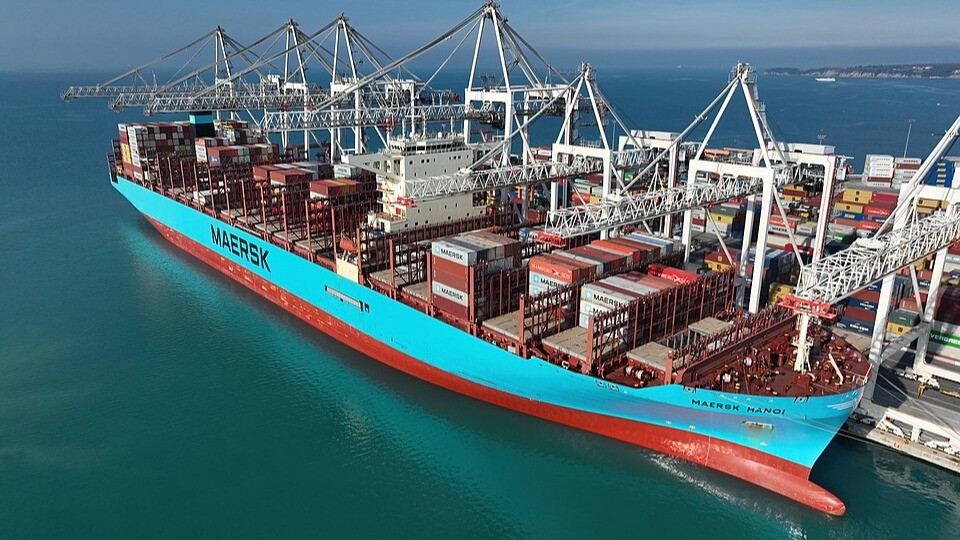
Containerschiff im Hafen Koper – Seeseite der Lieferkette (Beispielmotiv). Foto: © Petar Milošević, CC BY-SA 4.0.“
Containers via Koper (Slovenia): The Adriatic corridor from Damietta to southern Germany – and often the fastest route to the north
 Raphael Defaudais
When Is the Route via Koper Recommended?
If you regularly move goods from Egypt to Germany (or are just starting to build a setup) and want to optimize speed, reliability, and cash flow at the same time, the FCL container route Damietta → Koper is one of the strongest standard solutions.
This route is particularly recommended if:
- you supply Southern Germany (Bavaria/Baden-Württemberg) and want to keep the inland leg short,
- you want to use EU import procedure 42/4200 (import with subsequent intra-EU supply/transfer) in order not to pre-finance import VAT (EUSt),
- you need cross-docking (unloading the container and reloading onto curtain-sider trucks or other equipment types) as an operational lever – e.g. for multiple consignees, weight/height limits, “special equipment,” or to minimize container dwell time,
- you want a route that can often be faster than the North Range, because the sea leg is short and the hinterland network toward DACH/CEE is very strong.
On the route via Koper, it is not only the ocean transit that matters – but above all how cleanly you set up the import chain (importer role, VAT IDs, evidence, original documents, pickup/slots).
If this is in place, Koper is often “simply fast” in practice. If it is not, the combination of document lead times, port storage, and detention/demurrage will eat you alive.
When Is the Route via Koper Recommended?
If you regularly move goods from Egypt to Germany (or are just starting to build a setup) and want to optimize speed, reliability, and cash flow at the same time, the FCL container route Damietta → Koper is one of the strongest standard solutions.
This route is particularly recommended if:
- you supply Southern Germany (Bavaria/Baden-Württemberg) and want to keep the inland leg short,
- you want to use EU import procedure 42/4200 (import with subsequent intra-EU supply/transfer) in order not to pre-finance import VAT (EUSt),
- you need cross-docking (unloading the container and reloading onto curtain-sider trucks or other equipment types) as an operational lever – e.g. for multiple consignees, weight/height limits, “special equipment,” or to minimize container dwell time,
- you want a route that can often be faster than the North Range, because the sea leg is short and the hinterland network toward DACH/CEE is very strong.
On the route via Koper, it is not only the ocean transit that matters – but above all how cleanly you set up the import chain (importer role, VAT IDs, evidence, original documents, pickup/slots).
If this is in place, Koper is often “simply fast” in practice. If it is not, the combination of document lead times, port storage, and detention/demurrage will eat you alive.
The Damietta → Koper Route Explained
You ship an FCL container from Egypt to Koper, ideally use procedure 42/4200 there, and then move the goods quickly into the DACH region by truck or rail – with the option to cross-dock directly at the port to reduce dwell times and equipment costs.
Typical process chain (starting in Damietta):
- Production/pickup in the Cairo area (or Delta): goods reported ready, packing list finalized.
- Container provision (carrier/freight forwarder): 40’ HC is often standard; 20’ is economically less attractive if volume is available (rule of thumb from practice – market conditions vary).
- Stuffing & cargo securing: blocking/bracing, edge protection, moisture protection – “fast” in port does not mean “robust” in the container.
- VGM (Verified Gross Mass) determination and submission (SOLAS): without VGM, a container is generally not reliably loaded. The IMO defines VGM as a prerequisite for loading; responsibility lies with the shipper. Koper has its own information/weighing logic for this.
- Egypt export clearance (declaration, inspections, permits depending on commodity).
- Gate-in Damietta: cutoff, document handover, security/terminal processes if applicable.
- Sea transport Damietta → Koper: direct or via intermediate ports depending on service.
- Pre-alert to EU broker: finalize import strategy already while the cargo is on the water (42/4200 vs. 40/4000 vs. transit/T1).
- Arrival in Koper & discharge: terminal handling, release, pickup slots.
- Customs clearance (ideally procedure 42/4200): release into free circulation + clean VAT logic (details below).
- On-carriage to Germany (truck or rail + final leg).
- Secure proofs & evidence: transport/shipping proofs, CMR/rail docs, Intrastat/recap statement (depending on setup), so the tax chain remains auditable.
Why Koper? The Strategic Logic for German Companies
1. Geography That Pays Off in Days (Not Just Kilometers)
For Southern Germany, the Adriatic logic is simple: a short inland leg instead of going north first and then back south. But the point is bigger: Koper is not just a “Southern Germany port,” it is a gateway for Central and Eastern Europe with very strong hinterland connectivity.
- Koper describes itself as an EU core port of the TEN-T network.
- In port presentations, a total modal split of ~58 % rail / 42 % road is cited (all cargo).
- For containers, block train volumes are explicitly shown (example figures: ~22–24 block trains/day on average in 2020, expansion capacity up to ~30–32/day) and a container terminal rail share of ~47–50 % (2020/2021).
Why this matters: rail options are not a “nice to have” but a real buffer against:
- driver/working-time constraints,
- weekend/holiday driving bans (relevant toward AT/DE corridors),
- peak periods when you cannot get a truck slot.
2. Hinterland = Competitive Advantage (Not Just “Transport Afterward”)
Koper communicates strong port connections with daily services to industrial/logistics centers. ESPO (European Sea Ports Organisation) also describes Koper as a rail-strong port embedded in EU corridors, highlighting that central destinations are reachable by road within 24 h and by rail to core markets in very short times (older source).
Practical translation for German companies:
- Bavaria/Baden-Württemberg: truck on-carriage often feasible within one day.
- NRW/North: depending on timing, Koper + truck/rail can be competitive (sometimes faster) than the North Range, because you are less exposed to major North Range congestion effects and can time the route more flexibly (cross-docking, rail options).
Sea Side: Frequency, Transit – What Actually Makes It “Fast”
1. Direct Adriatic Service as Reference (ONE AD1)
A frequently cited example for short transit times is ONE Adriatic Service 1 (AD1). In the AD1 service overview, rotation/transit times are shown in tables; Damietta ↔ Koper appears as a short transit.
Important: schedules change. ONE publishes customer advisories on service updates (e.g. rotation changes from February 2026).
Operational takeaway:
- “3–4 days port-to-port” is achievable if you are on the right service window.
- What really matters is not only the sea leg, but also:
2. What Eats Time in Practice (Despite Short Transit)
- Document timing: if the cargo is on the vessel Monday but the original EUR.1 is stuck somewhere until Friday, your “fast route” suddenly becomes slow.
- Missing/incorrect VGM: without VGM, reliable loading does not happen. The IMO defines verified gross mass as a loading condition; responsibility lies with the shipper.
- Dwell times: with short sea transits, two days of paperwork chaos hit hard, immediately affecting:
- storage/THC follow-up costs,
- truck waiting times,
- detention (container at consignee) and demurrage (container at terminal).
Rule of thumb: with short sea transits, you must pull documents forward, not chase them afterward.

Port of Koper: Operational Essentials (Without a Port Manual)
1. What Organizationally Distinguishes Koper
Koper is structured as a multi-purpose port with specialized terminals; presentations highlight container and automotive throughput and its role as an Adriatic hub.
For your Egypt containers, what matters in practice:
- Slot/pickup discipline: fix pickups and appointments early.
- Broker integration: prepare clearance before the vessel berths.
- Plan rail and truck options in parallel, not “only when truck capacity is missing.
2. SOLAS/VGM as a “Small Point” That Prevents Big Delays
Koper has clearly communicated SOLAS/VGM implementation for years and also offers/organizes weighing services if the shipper cannot provide VGM.
The IMO is clear: without verified gross mass, loading a packed container is not intended; the shipper is responsible.
Practical tips:
- Treat VGM not as a document, but as a time-critical cutoff item.
- If you have LCL portions or last-minute packing list changes: define the VGM correction process in advance.
Hinterland to Germany: Truck vs. Rail – and Why Cross-Docking Is Gold
1. Truck On-Carriage: Fast, but EU Realities Apply
- Driving/rest times: the EU Commission summarizes the rules (e.g. daily driving time usually 9 h, twice a week 10 h; daily rest usually 11 h, reducible under conditions).
- AT weekend driving ban: described by ASFINAG (Sat 15:00 – Sun 22:00, public holidays 00:00–22:00, depending on vehicle category).
Why this is sometimes called the “Weißwurst equator effect”: once you move far north from the Adriatic (or through AT corridors), time-law and ban logic can easily add forced breaks. Not dramatic – but it must be planned, otherwise ETAs become shaky.
2. Rail Option: Often Underestimated – Structurally Strong in Koper
Koper does not treat rail as a side option but as a core mode: port presentations show rail modal split and block train capacity; ESPO also classifies Koper as rail-strong in the EU corridor network.
Practical meaning (even if you have little rail experience so far):
- For regular flows (e.g. weekly 3–10 containers), rail from Koper can become a stability anchor.
- For spontaneous single containers, truck is usually simpler – rail still works as a backup.
3. Cross-Docking in Koper: Often Better Than “Container to Factory Gate”
Cross-docking means: the container is picked up (or delivered), unloaded in a warehouse near the port, and the goods are reloaded onto curtain-siders, other containers, or split across vehicles.
When cross-docking is especially useful:
- Multiple consignees (multi-drop): one container for three customers → cross-dock and split, instead of three detours/idle times at the first unloading point.
- Weight/height & securing: re-palletize/rebuild cleanly to comply with EU road restrictions.
- Special equipment (Open Top / Flat Rack / Reefer / Tank / OOG): stricter return rules and higher detention costs. The faster the equipment is returned to depot, the lower the risk. Cross-docking “buys time” by emptying the container quickly.
- 20’ containers & depot logic (practical argument): if empty equipment cannot easily be returned to a suitable depot at destination, the last leg becomes disproportionately expensive. Cross-docking in Koper simplifies returns: empty back to port depot, cargo continues separately.
- Customs strategy: procedure 42/4200 can work with a cross-dock setup (with clean documentation), as long as proofs of dispatch/transport are properly maintained (CMR, warehouse records, tracking, etc.). Core requirements remain VAT IDs and proof of intent/actual movement.
Customs & Import VAT: Why Koper Is Attractive – and where the Traps are
1. The Three Relevant Base Models (Damietta → Koper → Germany)
Procedure 42/4200 (typical in Koper, cash-flow friendly)
What it is: import into EU country 1 (here: Slovenia) with subsequent intra-EU supply/transfer to EU country 2 (e.g. Germany). Result: no import VAT payment at import, VAT handled in the destination country under intra-EU rules.
EU logic/requirements: under Art. 143(1)(d) VAT Directive, conditions include:
- subsequent supply/transfer qualifies as VAT-exempt intra-EU transaction,
- importer can state VAT IDs at import (own or representative VAT ID + customer VAT ID),
- proof of intent to move the goods to another Member State.
Very important practical interpretation:
- Many forwarders can implement 42/4200 “technically” – but you must be able to prove the chain fiscally: CMR, tracking, POD, warehouse/cross-dock records.
- Failure in evidence can trigger reassessments/audits.
Why it massively improves cash flow: you do not tie up tens of thousands of euros in import VAT liquidity “at the port,” but keep capital for production/purchasing.
Important: procedure 42 is VAT logic, not customs duty exemption. Customs duty may still apply unless preference (EUR.1, etc.) is used.
Procedure 40/4000 (import in the entry country, pre-finance VAT)
What it is: release into free circulation in Koper with payment of duty + VAT in Slovenia. VAT is later reclaimed via VAT mechanisms – often taking 6–18 months and requiring VAT registration.
When it still makes sense:
- if 42/4200 is not feasible (no clean importer/VAT chain, goods stay in SI, evidence not achievable),
- or if you deliberately store/distribute in Slovenia.
Downside: cash-flow burden (significant with high goods value).
Transit / T1 (import later, e.g. in Germany)
What it is: goods arrive in Koper under external transit and are moved to Germany, where final import clearance takes place.
Trade-off: you often lose the “fast 42 advantage” at port, need guarantees/processes for transit, and must time everything very cleanly to avoid delays.
2. Why 42/4200 Is So Often Mentioned in Koper
Two levels:
- Regulatory level: procedure 42 is EU-wide when conditions are met.
- Operational level: Adriatic ports with strong DACH/CEE hinterland have forwarders/brokers experienced in organizing the evidence chain – if you deliver data on time.
Core truth: the port does not “do 42” – your setup does. Koper is a good place to implement it, but it does not happen automatically.
Documents & Preference: EUR.1 is not a “Nice-to-Have”
1. Documents You Almost Always Need (Damietta → Koper)
Minimum set:
- Commercial Invoice (clean value, Incoterms, currency, HS code/description)
- Packing List (packages, weights, dimensions)
- Bill of Lading (B/L) or Sea Waybill
- Egypt export documents (depending on commodity)
- EU import data: EORI, powers of attorney if applicable, tariff data
- VGM declaration (SOLAS)
Depending on cargo:
- MSDS/IMDG, temperature requirements (reefer)
- Certificates (CE, conformity), health/phytosanitary documents, etc.
2. Preference & EUR.1: What It Does (and Does Not Do)
What EUR.1 is: a movement certificate as proof of origin under EU preference agreements.
What it brings:
- Customs duty advantages (reduced/zero duty), depending on HS code and rules of origin.
- Potentially lower duty base – but VAT is a separate topic.
Crucial: EUR.1 does not make goods “VAT-free.” It can reduce duty; VAT remains in the system (only procedure 42/4200 or national deferral mechanisms improve VAT liquidity).
3. Why the Original EUR.1 Becomes Critical with Short Transit
With short Damietta → Koper transits, document courier time becomes the bottleneck. In practice, customs often require the original (or official duplicate). Copies only work with justification/alternatives.
Practical tips:
- Pull B/L draft early (ideally once the container is gated in).
- Start the EUR.1 process immediately, not after departure.
- Plan the courier route: express works, but Thursday/Friday effects (weekends, authority hours) can kill timelines.
- If working with a broker in Koper: send scans early for preparation – but expect the original for final preference.
Risks – and Practical Mitigation Tips
Risk 1: “The route is fast – my documents are slow.”
→ Fix responsibilities, pre-alert broker, no departure without draft B/L & final invoice/PL.
Risk 2: 42/4200 fails due to roles or evidence.
→ Clarify importer/VAT registration early, define proof logic, use EU requirements as internal checkpoints.
Risk 3: Dwell-time trap (storage, demurrage, detention).
→ Fix pickup/on-carriage before ETA, plan cross-dock backup, clarify depot return for special equipment.
Risk 4: VGM issues cause roll-over/rejection.
→ Treat VGM as mandatory gate process; shipper responsible; know Koper’s weighing logic
Risk 5: Road constraints & “Weißwurst equator” timing.
→ Plan with EU driving rules, factor AT bans, use rail as buffer.
Cost & Transit Logic: Realistic Expectations
Indicative experience-based ranges (highly dependent on season, equipment, carrier, inland):
- Door-to-door: often ~EUR 3,000–3,500 per container (standard setups, excl. specials).
- Cheaper ocean freight may look attractive, but if transit doubles (transshipment, extra calls), inventory and ETA risk often outweigh savings.
Key levers:
- Procedure 42/4200 = cash-flow lever.
- Cross-docking = detention/equipment lever (especially special equipment).
- Rail = stability lever when truck markets tighten.
Best-Practice Setup for German Companies (Checklist)
1. Before First Shipment (Setup Phase)
- Define importer role (who imports in SI, who bears which obligations).
- Test 42/4200 feasibility with broker (VAT IDs, evidence, process).
- Choose Incoterms cleanly (FCA often better than FOB for containers).
- Define EUR.1 document process (who applies, when, courier).
2. Per Shipment (Execution Phase)
- Submit VGM on time.
- Request draft B/L at gate-in latest.
- Secure original EUR.1 early; send scan in advance.
- Fix pickup/slots in Koper before ETA.
- Keep cross-dock backup ready.
3. After Shipment (Audit Phase)
- Archive proofs: CMR, POD, cross-dock records, tracking.
- Review 42/4200 evidence logic quarterly to keep the chain auditable.
Sources:
1) ONE – Adriatic Service 1 (AD1) Übersicht (Rotation/Transit) https://www.one-line.com/sites/default/files/download/oneAdriaticService_AD1.pdf
2) ONE – Customer Advisory / Service Update (Adriatic Service 1 Änderungen, Rotation ab 2026) https://www.one-line.com/en/news/customer-advisory/2025/311
3) Port of Koper (Luka Koper) – Port connections (Hinterland/Verbindungen) https://www.luka-kp.si/eng/logistics/port-connections/
4) ESPO (European Sea Ports Organisation) – Port of Koper (Korridore, Hinterland, Rail) https://www.espo.be/media/news/port-of-the-month-koper
5) Luka Koper Präsentation (Modal Split, Rail-Anteil, Block Trains, Containerterminal) https://www.transportevents.com/presentations/slovenia2022/luka_koper.pdf
6) EU-Kommission – VAT Exemptions / Import VAT exemption bei anschließender intra-EU Lieferung (Art. 143(1)(d)) https://taxation-customs.ec.europa.eu/taxation/vat/vat-directive/vat-exemptions/other-exemptions_en
7) KMLZ – Erklärung „Procedure 42“ (Import VAT exemption bei innergemeinschaftlicher Lieferung) https://www.kmlz.de/en/exemption-import-vat-under-so-called-procedure-42
8) UK Gov – Procedure Code 42 (Definition/Conditions; hilfreich als strukturierte Erklärung) https://www.gov.uk/government/publications/appendix-1-de-110-requested-and-previous-procedure-codes-of-the-customs-declaration-service-cds/requested-procedure-42-release-for-free-circulation-with-simultaneous-onward-supply-to-another-member-state
9) Revenue (Irland) – Customs Manual on Import VAT (enthält Bezug auf EU-Rechtsgrundlage Art. 143) https://www.revenue.ie/en/tax-professionals/tdm/customs/import-export-policy/customs-manual-on-import-vat.pdf
10) EU-Kommission – Access2Markets: Quick guide rules of origin (Proof of origin, EUR.1) https://trade.ec.europa.eu/access-to-markets/en/content/quick-guide-working-rules-origin
11) EU-Kommission – Access2Markets Glossar: EUR.1 movement certificate https://trade.ec.europa.eu/access-to-markets/en/glossary/eur1-movement-certificate
12) IMO – Verified Gross Mass (VGM) Anforderungen (SOLAS) https://www.imo.org/en/OurWork/Safety/Pages/Verification-of-the-gross-mass.aspx
13) Port of Koper – SOLAS/VGM Umsetzung (lokale Info) https://www.luka-kp.si/en/news/implementation-of-solas-regulation-for-verified-gross-mass-of-containers-at-port-of-koper/
14) ICC Academy – Incoterms 2020: FCA or FOB? (Containerpraxis/Empfehlung) https://academy.iccwbo.org/incoterms/article/incoterms-2020-fca-or-fob/
15) EU-Kommission – Driving time & rest periods (Lenk-/Ruhezeiten Überblick) https://transport.ec.europa.eu/transport-modes/road/social-provisions/driving-time-and-rest-periods_en
16) ASFINAG – Lorry driving bans (AT Wochenend-/Feiertagsfahrverbot) https://www.asfinag.at/en/traffic-road-safety/hgv-bus/lorry-driving-and-overtaking-bans/