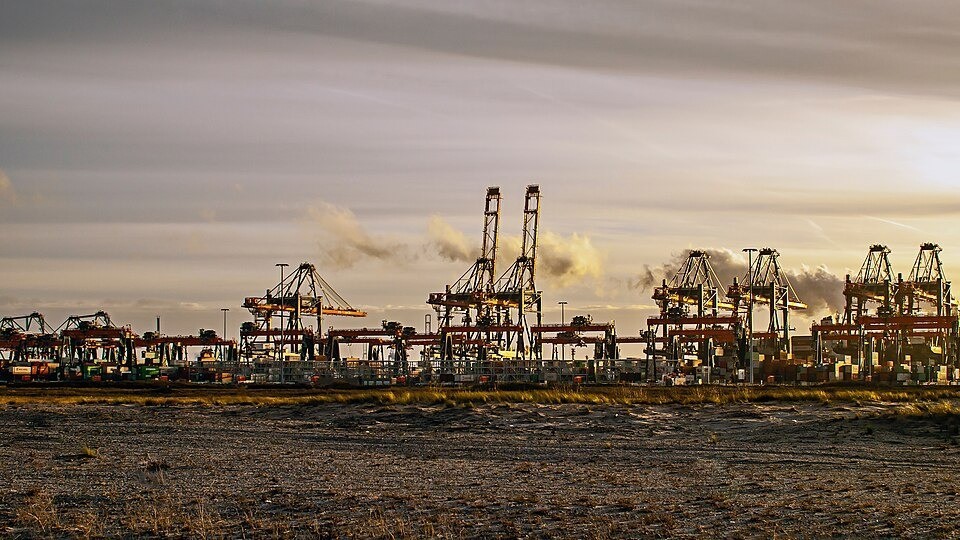
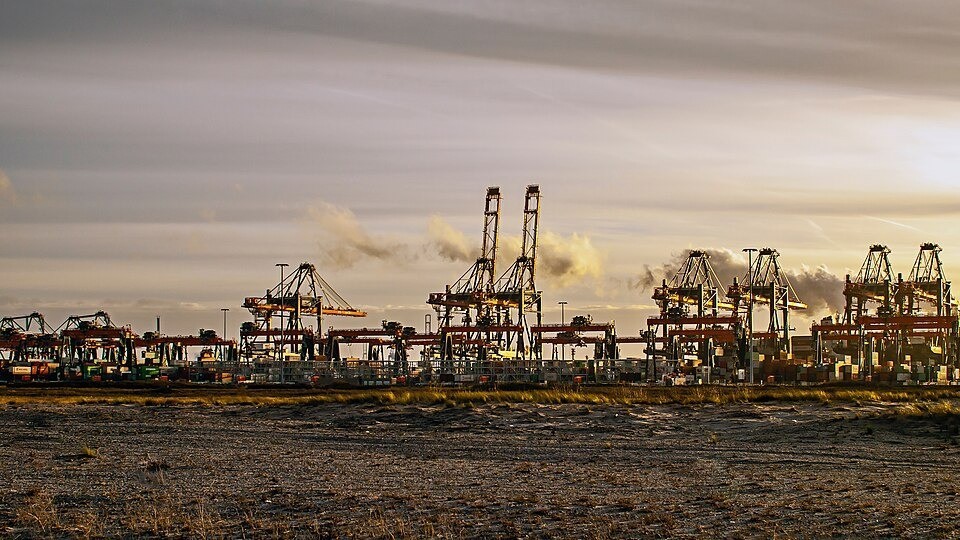
„Euromax terminal – Maasvlakte – Port of Rotterdam. Foto: @ Frans Berkelaar, CC BY 2.0.“
Containers via Rotterdam: The standard hub for North Rhine-Westphalia, northern and western Germany – with maximum process and cash flow leverage
 Raphael Defaudais
What makes the Port of Rotterdam so attractive?
The route Alexandria/Damietta → Rotterdam is the “default corridor” for many German companies when it comes to scalable sea freight, high sailing frequency, predictability, and strong hinterland connectivity—especially toward NRW, Northern and Western Germany.
It is particularly recommended if:
- you move containers regularly (weekly/bi-weekly) and want to build an industrial routine (stable processes instead of one-off firefighting),
- you want to benefit from the density of shipping lines, services and terminals,
- you want to use customs/VAT as a process lever (e.g., NL Article 23 or procedure 42/4200),
- you want to use cross-docking or “near-port” warehousing processes (multi-drop, special equipment, tight free time/detention),
- you value digital processing and fast release/pick-up (Port Community System / Portbase, Secure Chain).
Rotterdam is less ideal if:
- you need maximum speed with minimal variance (then Adriatic or RoRo can often be faster depending on setup),
- in periods of high utilization you must minimize local charges (THC, storage, D&D) and you do not have clean pick-up / documentation discipline,
- your business case is optimized heavily for the cheapest local cost (Rotterdam is fast and powerful, but “local charges” can become a real cost driver).
In short: Rotterdam is the best route if you don’t just want to transport, but build a resilient supply chain — including smart VAT logic.
The route from Alexandria/Damietta to Rotterdam — step by step in practice
Even if Rotterdam is “standard”: the standard only becomes good if you run it as an SOP (Standard Operating Procedure).
1. Pre-carriage in Egypt: the real bottleneck is rarely the sea leg
Starting point is Damietta. Your success depends on stabilizing the pre-carriage:
- production release (goods are truly ready, not “almost ready”),
- packaging/pallet standards (cargo securing, wood/ISPM topics, moisture),
- documents (invoice, packing list, export formalities),
- container stuffing (weight, axle loads, center of gravity, stowage plan).
A classic: the ocean freight is “on time,” but the goods miss gate-in/cutoff because the factory is still repacking or re-documenting.
2. SOLAS / VGM: a small dataset that can stop entire ships
In container transport, VGM (Verified Gross Mass) is not “paperwork,” but a load/no-load criterion. The IMO describes VGM as a prerequisite for a packed container to be loaded; the shipper is responsible.
Practical advice: integrate VGM into your shipping release: no VGM, no release. This prevents rollover risk.
3. Sea transport: why Rotterdam is predictable
Rotterdam benefits from an extreme density of direct connections and hinterland routes. The port explicitly references its route scanner (“Direct Connections”) for direct sea, rail, and inland shipping connections.
This is not just marketing. In day-to-day terms, it means:
- more schedule alternatives,
- more options when equipment is tight,
- more ability to switch services without reinventing the entire setup.
4. Arrival Rotterdam: the terminal process is fast — but not lenient
Rotterdam runs fast if you follow the rules:
- digital pre-notification/processes (Port Community System / Portbase),
- release/pick-up under Secure Chain logic (container release without “PIN chaos”),
- clean customs and documentation handling.
The port describes that container terminals on Maasvlakte II require electronic pre-notifications and that Portbase adds an additional authorization layer under Secure Chain.
Consequence: you need clearly defined roles early: who does the Portbase pre-notification? who is the broker? who is the inland operator? who is authorized to pick up?
Why Rotterdam is so strong for NRW / Northern / Western Germany
1. Hinterland: Rotterdam is not only a seaport, but a network node
For German companies, the question is rarely “Will the container arrive?”, but: How quickly and reliably do I get out of the port—to Duisburg, Cologne, Dortmund, Münsterland, Ruhr area, Emsland, Bremen, Hanover?
Rotterdam positions its logistics connectivity explicitly via sea, rail, and inland shipping and offers comparisons via its route scanner.
2. Rail: arguably the fastest way to cross the border
The port states for rail freight that cargo crosses the German border within three hours and reaches many European destinations within 24 hours. (This is an optimum value; our experience with it was not good.)
In practice, this means:
- rail is not only ecological, but a stability backup against driver shortages, weekends, congestion,
- for NRW, rail can be a real “timetable product” if you establish it as a regular flow.
3. Inland shipping / barge: the underestimated cost and CO₂ lever
For NRW, the barge logic is particularly attractive because you can reach major inland hubs via Rhine corridors. Even if we do not promote specific operators: the basic principle is that Rotterdam explicitly lists “inland shipping” as a direct connection type in the route scanner.
Practical benefit:
- barge can stabilize costs,
- relieves road capacity,
- and is often more predictable if you don’t run lead times “to the edge.”
Customs & tax: the Rotterdam route wins on cash flow, not just transit
This is where your biggest competitive advantage lies compared to simply importing and being “done.”
1. Option: Netherlands Article 23; do not pay import VAT, declare it in the VAT return
The Dutch tax authority (Belastingdienst) describes the “Reverse-charge mechanism on import: Article 23” as follows: you do not have to pay VAT on import immediately; instead you declare it in your VAT return—provided you have an Article 23 permit.
The key sentence for German decision-makers: you turn import VAT from “cash out now” into “a booking within the VAT system.”
But: Belastingdienst also states clearly: as a foreign entrepreneur, you cannot apply for the Article 23 permit yourself; you can appoint a Tax Representative to apply for the permit.
Benefits (why Article 23 is so popular)
- Liquidity: no / lower import VAT pre-financing directly at import.
- Scalability: extremely strong for regular flows, because finance and logistics can plan jointly.
- Process stability: you import into NL and have a repeatable routine.
Typical trade-offs / requirements
- you need a clean VAT setup (often incl. fiscal representation),
- you must have compliance and documentation under control,
- broker + tax rep must work together (otherwise processes become slow).
Summary: Article 23 is not a “trick,” but an official mechanism—yet it is setup-dependent. That is exactly what makes Rotterdam so attractive: many market participants there handle this setup routinely.
2. Option: procedure 42/4200 in NL; import with VAT-exempt onward supply to another EU Member State
If you do not import for the Netherlands to keep the goods there, but onward deliver e.g. to Germany, Customs Procedure 42 (often visible as 4200 in the declaration code) is a classic setup.
The European Court of Auditors describes Customs Procedure 42 as a mechanism enabling a VAT exemption at import when goods are then transported to another Member State and VAT becomes due in the destination country under national rules.
KMLZ also describes in practical terms: import VAT can be exempt if the importer uses the goods for intra-Community supplies; this is marked in the import declaration via procedure code 42 and requires, among other things, the VAT ID of the recipient in another Member State.
Benefits
- Cash flow: very strong (you avoid import VAT pre-financing in the entry country).
- Supply chain design: ideal for distribution (NL as entry, DE as market).
Where it can fail
- missing or incorrect VAT IDs,
- unclear importer/supply roles,
- weak proof package (transport proof/CMR/POD),
- inconsistent documents (invoice/HS code/goods description).
Rule of thumb for 42/4200: if you use 42, you must treat proofs as a “product”: they do not belong at the end; they are part of the delivery.
3. Option: classic import (40/4000); possible, but often unattractive for cash flow
Of course you can also import “classically” and pay VAT and recover it later. That is not wrong—just unnecessarily expensive in liquidity in many setups.
If you use Rotterdam as a hub, it is usually worth at least checking whether Article 23 or 42/4200 is possible—because Rotterdam has a huge practical base for exactly that.
“Customs already on the water”: pre-lodgement as a time gain
With a good partner, clearance can be prepared while the container is still in transit.
This is fundamentally possible because in the EU customs context a declaration lodged before the presentation of the goods (pre-lodged declaration) is foreseen: EU guidance explains that such a declaration can be processed, but it is only accepted once the goods are presented.
What this means in practice:
- the broker can prepare data, classification, plausibility checks and (if needed) control processes before ETA,
- when the container arrives, the chance is higher that the release goes through—rather than discussions starting only then.
Limit: pre-lodgement is not a free pass. If documents don’t match, the system still stops—just earlier.
Aerial view of Maasvlakte (Port of Rotterdam) Photo ©Pymouss License: CC BY-SA 4.0
Port processes in Rotterdam: Portbase, pre-notification, Secure Chain — why “digital” is not optional here
1. Portbase pre-notification: without digital pre-notification, no access
Portbase states: at many terminals, pre-notification is actually mandatory—without pre-notification, no access.
Operationally, this is highly relevant because it clarifies roles:
- forwarder / exporter / inland operator: who pre-notifies?
- driver/truck: only executes (does not “clarify” anything at the gate)
Practical tip: define in your SOP: “Who pre-notifies what by when?”—otherwise the driver stands at the gate and no one can help.
2. Secure Chain: container release without PIN sprawl
Rotterdam is moving import-container release to a more secure authorization system: under Secure Chain, authorization is passed digitally; only authorized inland operators get terminal access, and PIN codes are being abolished.
Why this is good for you:
- less fraud/misuse risk,
- less “PIN shared wrong” chaos,
- clearer accountability.
Why it can still hit you if you ignore it:
- if your forwarder/trucker is not correctly authorized, you won’t get pick-up—no matter how fast the ship was.
Cost reality: THC & local charges — Rotterdam is strong, but not “cheap in the port”
1. What THC is (and why it can sometimes “overtake” ocean freight)
Terminal Handling Charges (THC) are terminal fees for storage/positioning/handling, including unloading, stacking and crane service.
Consequence for procurement: ocean freight can “look cheap,” while the sum of THC + document fees + security/ISPS + handling + gate fees pushes the price up.
2. Demurrage & detention: the second big local-charge killer
Maersk explains it very clearly:
- Demurrage: time full containers spend in the terminal (from discharge until gate-out)
- Detention: time containers spend outside the terminal (gate-out full until empty return)
Why this is especially relevant in Rotterdam: because the port is fast—and fast means: if you don’t pick up/return quickly, you pay quickly.
3. Practical tip
Instead of “price per container,” always ask for:
- all-in rate incl. THC, documents, security, seal, gate, ggf. reefer plugs,
- free time (demurrage/detention) in writing,
- cutoff / ETA / slot booking,
- warehousing options (cross-docking) as backup.
Local charges are not a “fault” of the port. They are a control instrument: those who have processes under control pay less.
Cross-docking & warehouse strategy: how to turn Rotterdam into a process machine
Rotterdam is not just a port, but a logistics cluster. You can work with that.
1. When cross-docking in Rotterdam is especially useful
- Multi-drop: one container, multiple customers in NRW → unload once centrally and distribute via LTL/FTL.
- Special equipment: flat rack/open top/reefer → return equipment quickly, move goods onward separately.
- Buffer customs/doc issues: don’t let cargo “stick” in the terminal; after release, move it out fast and stabilize operations.
- Optimize weight/volume: re-pack, re-palletize, optimize securing for EU road transport.
2. What cross-docking is not (important for expectation management)
Cross-docking is not a “cheap trick.” It is a deliberate decision:
- you pay warehouse handling,
- but you often save significantly on dwell time, detention, and operational friction losses.
For many companies, Rotterdam is therefore the perfect place to build a hub-and-spoke logic: import hub → cross-dock → Germany distribution.
Risks of the Rotterdam route — and what you do about them in practice
Risk 1: fast but not releasable (documents/customs/VAT)
Cause: unclear invoice/PL, shaky HS code, missing VAT IDs, Article 23 / 42 setup not clean.
Countermeasures:
- SOP: documents final at the latest X days before ETA (internal process).
- involve broker early—ideally via pre-lodgement (declaration before presentation).
- for 42/4200: standardize proof package (CMR, POD, tracking, intra-Community reporting logic).
Risk 2: Portbase/terminal access blocks pick-up
Cause: pre-notification not done, wrong actor, wrong authorization.
Countermeasures:
- define Portbase roles clearly; pre-notification is mandatory at many terminals.
- check Secure Chain authorization per shipment.
Risk 3: costs escalate via local charges (THC/storage/D&D)
Cause: container stays in the terminal or too long at the consignee.
Countermeasures:
- fix pick-up/slot before ETA.
- cross-docking as backup.
- negotiate D&D free time in the rate and steer it operationally.
Risk 4: lose time in the inland leg (Rotterdam is big)
Cause: wrong hinterland product (road/rail/barge), no slots, no standard routes.
Countermeasures:
- for NRW: check rail/barge as real options; rail can be very fast (border in ~3 hours).
- think “route scanner”: door-to-door is a network, not just “ship + truck”.
Decision-maker playbook: how you would set up Rotterdam as the standard route
1. Customs/VAT decision logic (simple, but effective)
- If you import regularly and a VAT setup is possible: check Article 23 (tax representative).
- If goods go onward to Germany and proofs are clean: check 42/4200 (VAT IDs, proofs).
- If you want to centralize everything in Germany: transit/T1 + DE clearance.
- If none of that works: classic import—but consciously as a cash-flow cost decision.
2. Operational timeline (SOP framework)
- T-10 to T-7 days before ETA: HS codes/invoice/PL final, broker check
- T-7 to T-3: VGM/export ready, pre-alert, prepare pre-lodgement if needed
- T-2 to ETA: Portbase pre-notification, Secure Chain authorization, fix pick-up slot/trucker
- ETA to ETA+1: gate-out, cross-dock optional, inland to NRW
- ETA+1 to +3: empty return / minimize detention
Cost anchor (internal benchmark, not a market promise)
For Rotterdam, door-to-door setups are often ~€2,500–3,000 per container possible (depending on inland, equipment, season, local charges).
This is often achievable if:
- you use standard equipment,
- you buy local charges cleanly,
- you avoid dwell times,
- and the VAT strategy (Article 23 / 42) protects liquidity.
This is a benchmark from real quotes, not a fixed tariff. Rotterdam rewards process maturity—and punishes process gaps.
Conclusion: Rotterdam is the “process route” — not just the sea route
If Koper/RoRo can be the “sprint track,” Rotterdam is the production line: stable, scalable, strongly networked. The real advantage arises when you treat Rotterdam not as a port, but as a system of:
- connectivity (sea + rail + barge + road),
- digital gatekeeping (Portbase/Secure Chain),
- cash-flow levers (Article 23 / 42/4200),
- and discipline on local charges (THC, D&D).
This is what often makes Rotterdam for NRW/Northern/Western Germany not just the “standard route,” but the best business route—because it optimizes delivery capability and liquidity at the same time.
Sources: