
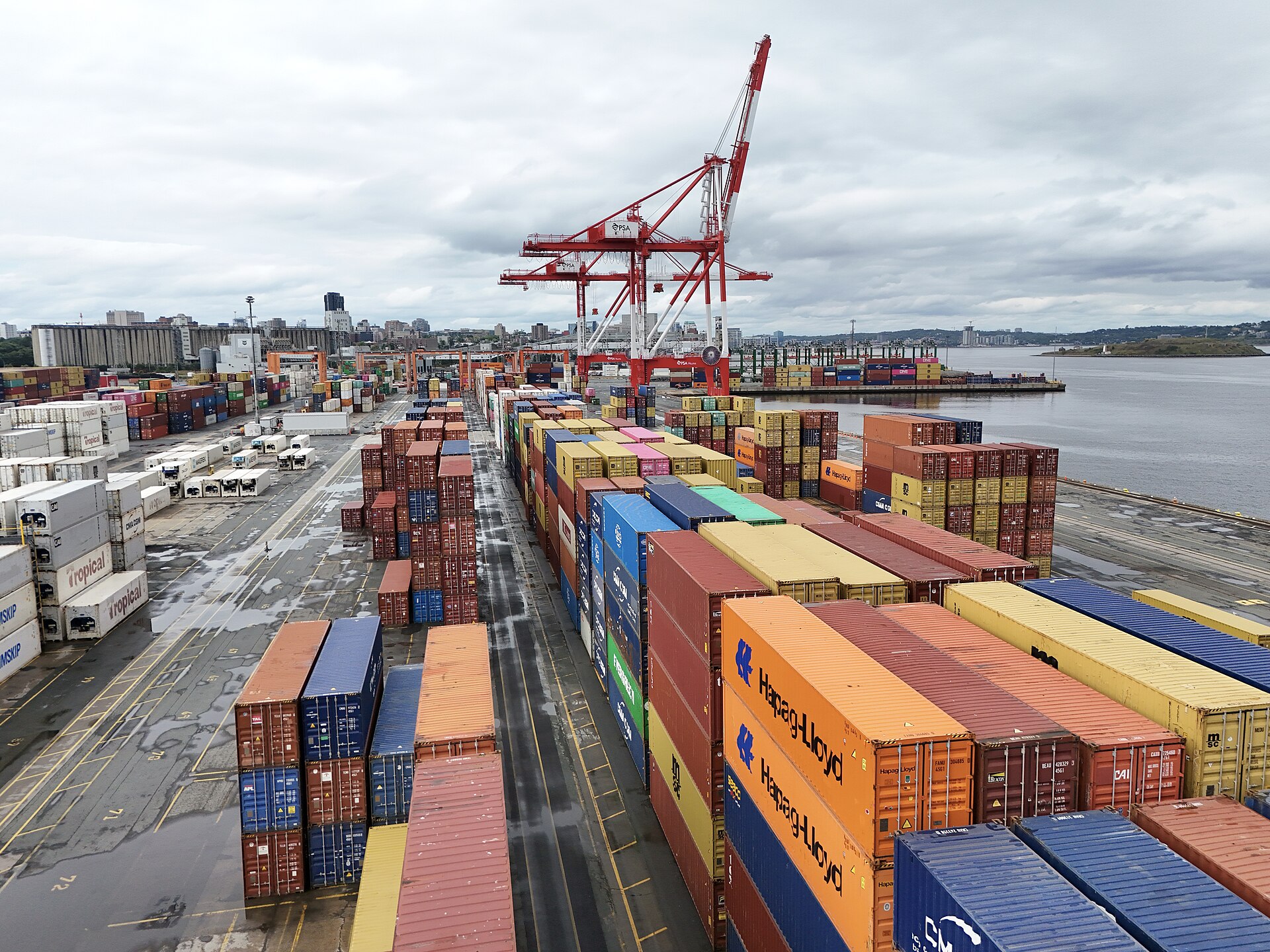
PSA Halifax Atlantic Hub – Foto: Quintin Soloviev – Lizenz: Lizenz: CC BY 4.0 – Quelle: Wikimedia Commons
Damietta as a new container hub on the Suez corridor: what the German stake means for carriers and cargo owners
With the official start of a new container terminal in Damietta, Egypt is strengthening its role in global supply chains. The site is located on the Mediterranean coast, around 60 km west of the northern exit of the Suez Canal—exactly where many East–West services already pass by.
The project stands out because major German players are involved: Hapag‑Lloyd, as well as terminal operators EUROGATE and Contship.
The first vessel call is the “Essen Express” (13,117 TEU), underlining the terminal’s focus on large mainline ships from day one.
For decision‑makers, the key point is that Damietta is positioned as a hub and is expected to be integrated into wider network strategies
What has opened—and why does it matter strategically?
The facility is communicated as Damietta Alliance Container Terminals (DACT). Once fully completed, it is planned to reach up to 3.3 million TEU per year.
According to EUROGATE, the terminal is designed primarily for transshipment, with an expected mix of about 80% transshipment and 20% import/export, serving Egypt (including Damietta and Greater Cairo) and regional markets such as the Levant and the Black Sea.
Location is the key lever: Damietta sits in the Nile Delta on Egypt’s Mediterranean coast, close to established routes connected to the Suez corridor.
This “minimal deviation” factor is typically decisive when alliances select hubs—especially where schedule reliability and smooth connections are top priorities.
Who owns and operates it?
The operator is a joint venture. Reported shareholders include:
- Hapag‑Lloyd Damietta GmbH (39%) (represented by Hanseatic Global Terminals),
- EUROGATE Damietta GmbH (29.5%),
- CONTSHIP Damietta S.p.A. (29.5%),
- plus two smaller shareholders (1% each).
For Hapag‑Lloyd, the project is framed as strengthening its position in the Eastern Mediterranean.
EUROGATE explicitly highlights DACT’s ambition to serve as the Gemini Cooperation’s hub terminal in the region.
Terminal “hard facts”: infrastructure, technology, sustainability
Large infrastructure projects often show slightly different figures depending on phase and source—but the strategic takeaway is consistent: the terminal is built for large ships, high productivity and more sustainable operations.
Layout & depth
- Approx. 93 hectares
- 18 m water depth
Handling equipment (launch set‑up vs. full project set‑up)
- At launch: 12 fully electric STS cranes and 40 (hybrid) RTG cranes (as communicated by EUROGATE/Hapag‑Lloyd ecosystem).
- Project documentation refers to a broader target set‑up (e.g., 16 electric STS and 40 RTGs, including an electrified share), suggesting a ramp‑up or future expansion.
Intermodal
- Rail infrastructure with six train lanes, with two operational at launch.
Investment
- Phase 1 investment is stated at more than USD 600 million.
This directly supports two key trends: higher productivity and improved planning reliability, plus reduced emissions through electrified/hybrid equipment.
Which routes call at Damietta?
For cargo owners, the decisive question is: Which services can I route through this hub? Here, official service updates provide clear answers.
a) Asia ↔ East Mediterranean (Suez corridor connectivity)
Hapag‑Lloyd SE3 (Asia South Europe 3) – revised rotation (from 12 Feb 2026)
Qingdao → Gwangyang → Ningbo → Tanjung Pelepas → Port Said → Izmit → Istanbul → Port Said → Damietta → Singapore → Qingdao
Maersk AE15 – new Damietta call
Izmit → Istanbul → Port Said → Damietta → Singapore → Qingdao → Gwangyang → Ningbo → Tanjung Pelepas → Port Said
These are classic East–West/East Med connections where Damietta functions as a hub node.
b) Middle East / Red Sea ↔ East Mediterranean (Red Sea routes)
This addresses a key question directly: Yes—Red Sea services do call at Damietta, because rotations include Red Sea ports.
Hapag‑Lloyd JD3 (Jeddah Express 3) – revised rotation (from 12 Feb 2026)
Port Said → Aqaba → Jeddah → Aqaba → Damietta → Port Said
Maersk JEDDAH 3 – new Damietta call
Jeddah → Aqaba → Damietta → Port Said → Aqaba
In other words, Damietta is not only a Mediterranean hub; it is also directly linked into rotations serving Red Sea ports (Jeddah, Aqaba)—useful for flows between the Gulf/Arabian markets, the Levant and the Mediterranean.
Special equipment: flat racks & open tops—any evidence?
Important clarification: Flat racks and open tops are container equipment typically provided by carriers/depots, not by the terminal itself. What a terminal must provide is safe, efficient handling and lashing capability for non‑standard units.
DACT‑related communications and project documents do provide strong indicators here:
- Out‑of‑Gauge (OOG) frames and lashing cages are explicitly mentioned as part of the terminal equipment.
That strongly suggests operational readiness for OOG and project cargo, often shipped on flat racks and open tops.
For context (what these containers are):
- Flat rack containers are open on their long sides and used for oversized cargo such as machinery, vehicles and pipes.
- Open top containers use a tarpaulin instead of a solid roof and allow top loading for cargo that can’t be loaded through the door.
Bottom line: There is credible evidence that DACT is equipped for OOG handling, which typically goes hand‑in‑hand with the ability to handle flat‑rack and open‑top shipments—subject to carrier booking and documentation requirements.
Conclusion: What does this mean for decision-makers?
For industrial and commercial companies, Damietta provides an additional, high-performance hub directly on the Suez Corridor, offering:
- high planned capacity,
- modern, partially electrified equipment,
- rail options,
- and—crucially—clearly defined services to Asia and the Red Sea/Middle East.
For decision-makers who want to make their networks more robust (more hub options, better transshipment design, alternative gateways), the terminal is not just “another project,” but a potential strategic building block for 2026+.
Sources
- Süddeutsche Zeitung / dpa (13 Feb 2026): Terminal in Ägypten unter deutscher Beteiligung startet
https://www.sueddeutsche.de/wirtschaft/schifffahrt-terminal-in-aegypten-unter-deutscher-beteiligung-startet-dpa.urn-newsml-dpa-com-20090101-260213-930-683114 - EUROGATE (13 Feb 2026): New Damietta Alliance Container Terminal (DACT) Launches Commercial Operations
https://www1.eurogate.de/zh-hans/new-damietta-alliance-container-terminal-dact-launches-commercial-operations/ - Hapag‑Lloyd (Press Release, Feb 2026): New Damietta Alliance Container Terminals (DACT) launches commercial operations
https://www.hapag-lloyd.com/en/company/press/releases/2026/02/new-damietta-alliance-container-terminals--dact--launches-commer.html - Hapag‑Lloyd (Customer News, 30 Jan 2026): SE3 & JD3 service update incl. Damietta – revised rotations
https://www.hapag-lloyd.com/en/services-information/news/2026/01/shipping-with-our-se3---jd3-sevices--here-s-a-service-update-for.html - Maersk (Advisory, 30 Jan 2026): AE15 – New call at Damietta (DAM)
https://www.maersk.com/news/articles/2026/01/30/ae15-new-call-damietta-dam - Maersk (Advisory, 30 Jan 2026): JEDDAH 3 – New call at Damietta (DAM)
https://www.maersk.com/news/articles/2026/01/30/jeddah-3-new-call-damietta-dam - AIIB (Non‑Technical Summary PDF): Damietta Port / Container Terminal Project
https://www.aiib.org/en/projects/details/2023/_download/Egypt/20231114-Damietta-Port-NTS-1223.pdf - Egyptian Maritime Transport & Logistics Sector (MTS) (21 Jan 2026): Tahia Misr container terminal at Damietta port…
https://www.mts.gov.eg/en/%D9%85%D8%AD%D8%B7%D8%A9-%D8%AD%D8%A7%D9%88%D9%8A%D8%A7%D8%AA-%D8%AA%D8%AD%D9%8A%D8%A7-%D9%85%D8%B5%D8%B1-1-%D8%A8%D9%85%D9%8A%D9%86%D8%A7%D8%A1-%D8%AF%D9%85%D9%8A%D8%A7%D8%B7-%D8%B5%D8%B1%D8%AD/ - DCSA (10 Jan 2024): Shipping Container Types: A Guide (flat rack / open top definitions)
https://dcsa.org/newsroom/shipping-container-types-a-guide