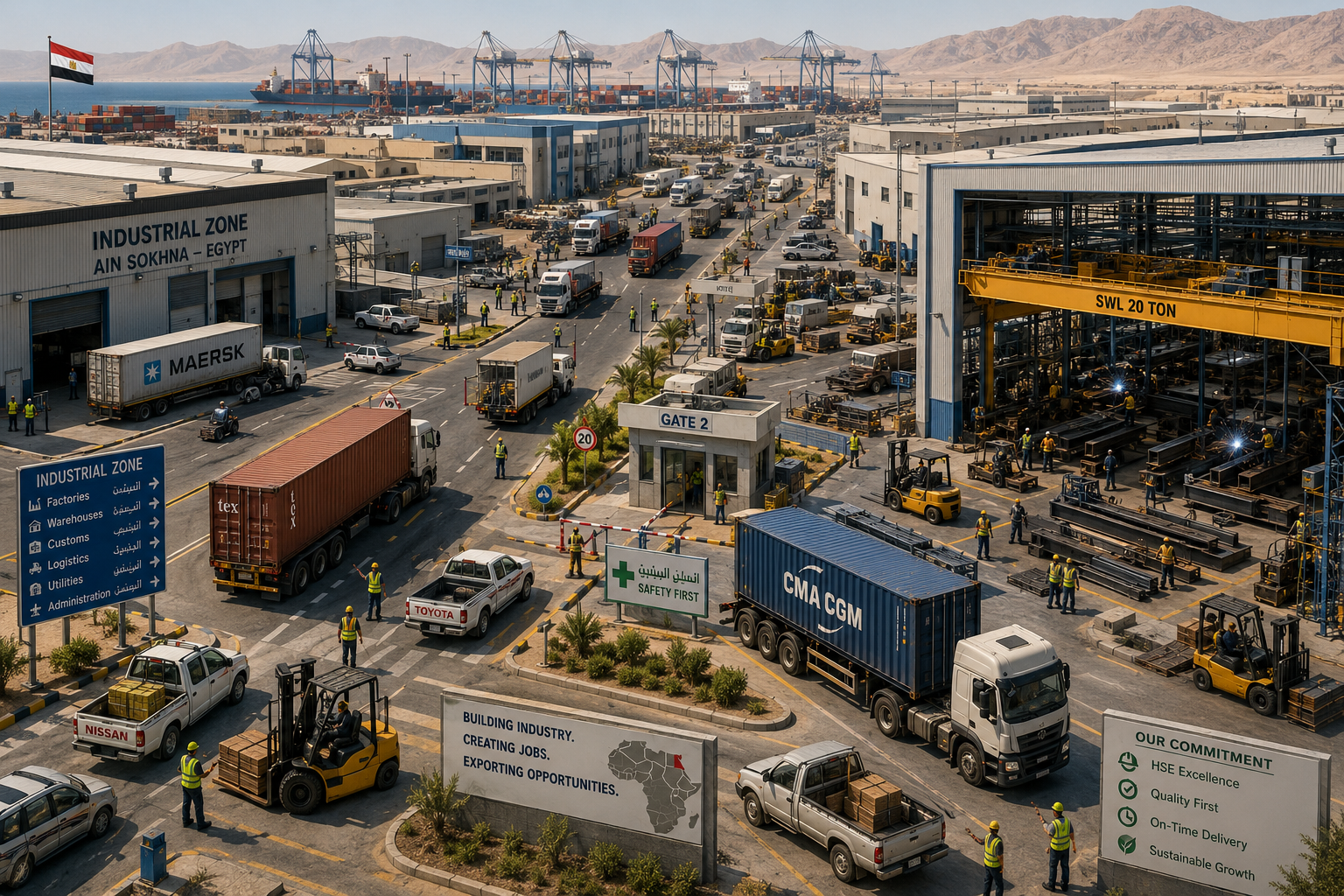
Illustrative AI-generated rendering created by GEMP Consulting for conceptual visualization purposes only. The image does not depict a specific existing industrial site or operation.
Egypt 2026: A More Predictable Manufacturing Base — but Not a Plug-and-Play Location
Egypt in 2026 is not a plug-and-play location, but it is once again far more predictable than during the foreign-exchange crisis of 2022/23. Since the unification of the exchange rate in March 2024, access to foreign currency, reserves and market sentiment have improved. At the same time, inflation, interest rates, public debt and external shocks remain key operational risks. Companies that successfully build or manufacture in Egypt today do not win through “cheap labour” alone, but through clean import and customs processes, disciplined working-capital management, early QA structures and robust liquidity management.
Clear Signals
The most important signals are practical, not theoretical.
First: regime before land. Free zones, Investment Zones, the SCZONE and the Golden License solve different problems. Choosing the wrong regime can later create friction around customs, permits or utilities.
Second: import logic before purchase orders. Nafeza/ACI requires an ACID number before shipment and clean advance documentation. Weak master data, invoices or certificates of origin cost time.
Third: Sokhna is strong when your factory is export-oriented or import-dependent. Port and industrial zones continue to expand, and DP World as well as the state are visibly investing in capacity, warehousing and multimodal logistics.
Fourth: QA, production management, HSE and customs expertise must come before rapid headcount growth. For EU-linked projects in steel and aluminium, CBAM, CPR and EN 1090/FPC are not something to address “later”; they become part of the product from the very beginning.
Sector Picture
For labour-intensive light manufacturing and textiles, Egypt is attractive because of its labour pool, proximity to Europe and the GCC, and its existing export logic. The weaknesses are more likely to be found at supervisor level, in training systems and in imported specialised inputs.
Structural metal fabrication benefits from location and proximity to projects, but depends heavily on traceability, welding discipline and documentation standards under CPR/EN 1090.
Food processing benefits from the domestic market and regional exports, but is extremely sensitive to cold-chain reliability, supplier quality and logistics losses.
Modular manufacturing and automotive supply can work, but the supplier stack is still uneven and often kit- or import-heavy.
Heavy industry and chemicals have potential, but require the earliest possible clarification of energy, environmental, financing and government-interface issues.
In short, as a “prose matrix”:
- High labour intensity = major advantage, but leadership and quality risk.
- Metal = location advantage, but high standards burden.
- Food = strong demand, but cold-chain risk.
- Automotive/modules = good location, but supply-chain risk.
- Heavy industry = market potential, but the highest permitting and energy burden.
Project Checklist
Land: Check ownership, servicing, power/water/gas, truck access and the appropriate contractual form. In Investment Zones, GAFI accepts only clearly established ownership structures, whether through purchase, lease or usufruct, depending on the model.
Permits: Map incorporation, activity permits, construction, environmental approvals, civil defence, OHS and any sector-specific approvals early. The Golden License is powerful, but it is not the standard route.
Construction & Procurement: First clarify customs and ACI logic, then order machinery.
Hiring: Recruit the plant manager, QA, maintenance, HSE and customs/logistics roles before the large wave of operators.
Commissioning: Run pilot imports, test exports, utility load tests, spare-parts pathways and initial emissions/traceability reports before the customer ramp-up.
Scenarios
Best case: FX remains functional, Sokhna/customs processes run smoothly, key roles are in place early, and green-power options plus multilateral financing reduce risk.
Likely case: Formal starts are quick, but real friction emerges around utilities, imports, documentation and shift discipline.
Worst case: The wrong regime is chosen for the wrong plot of land, working capital is too tight, Red Sea/Suez disruptions return, and QA/customs capabilities are built too late.
The positive side remains: EBRD, IFC, MIGA and the World Bank are visibly active in 2025/26 — in green PPAs, green finance, SME lending, port development and macro/private-sector programmes.
Open Core Sources
OECD Egypt Economic Survey 2024
https://www.oecd.org/en/publications/oecd-economic-surveys-egypt-2024_af900de2-en.html
World Bank Egypt overview
https://www.worldbank.org/ext/en/country/egypt
World Bank Macro Poverty Outlook Egypt 2026
https://thedocs.worldbank.org/en/doc/65cf93926fdb3ea23b72f277fc249a72-0500042021/related/mpo-egy.pdf
IMF Egypt country page
https://www.imf.org/en/countries/egy
IMF Egypt report 2024
https://www.imf.org/en/-/media/files/publications/cr/2024/english/1egyea2024001.pdf
IMF Egypt report 2025
https://www.imf.org/-/media/files/publications/cr/2025/english/1egyea2025001-source-pdf.pdf
GAFI Free Zones
https://www.gafi.gov.eg/English/StartaBusiness/InvestmentZones/Pages/FreeZones.aspx
GAFI Investment Zone
https://www.gafi.gov.eg/English/StartaBusiness/InvestmentZones/Pages/Investment-Zone.aspx
GAFI Golden License
https://www.gafi.gov.eg/English/eServices/Pages/DepartmentService.aspx?DSID=38
Nafeza ACI
https://www.nafeza.gov.eg/en/pages/15
SCZONE Ain Sokhna Port
https://sczone.eg/services/ain-sokhna-port/
DP World Sokhna
https://www.dpworld.com/en/ports-terminals/egypt/sokhna
S&P Global CBAM article
https://www.spglobal.com/energy/en/news-research/latest-news/metals/020426-cbam-impact-limited-in-egypt-as-decarbonization-pressure-shifts-to-power-alternative-fuels
EU CBAM
https://taxation-customs.ec.europa.eu/carbon-border-adjustment-mechanism_en
EU CPR
https://single-market-economy.ec.europa.eu/sectors/construction/construction-products-regulation-cpr_en
BSI EN 1090 overview
https://www.bsigroup.com/en-GB/products-and-services/standards/bs-en-1090-steel-structures-and-aluminum-structures/
EBRD private-to-private electricity contracts
https://www.ebrd.com/home/news-and-events/news/2025/ebrd-supports-egypt-with-first-private-to-private-electricity-co.html
IFC Egypt green/MSME projects
https://www.ifc.org/en/pressroom/2026/ifc-announces-projects-to-support-msmes-green-projects-and-healthcare-in-egypt-and
MIGA trade finance facility for National Bank of Egypt
https://www.miga.org/project/trade-finance-facility-national-bank-egypt
World Bank financing package 2026
https://www.worldbank.org/en/news/press-release/2026/05/08/new-us-1-billion-world-bank-group-development-financing-to-support-egypt-s-private-sector-led-job-creation-macroeconomic