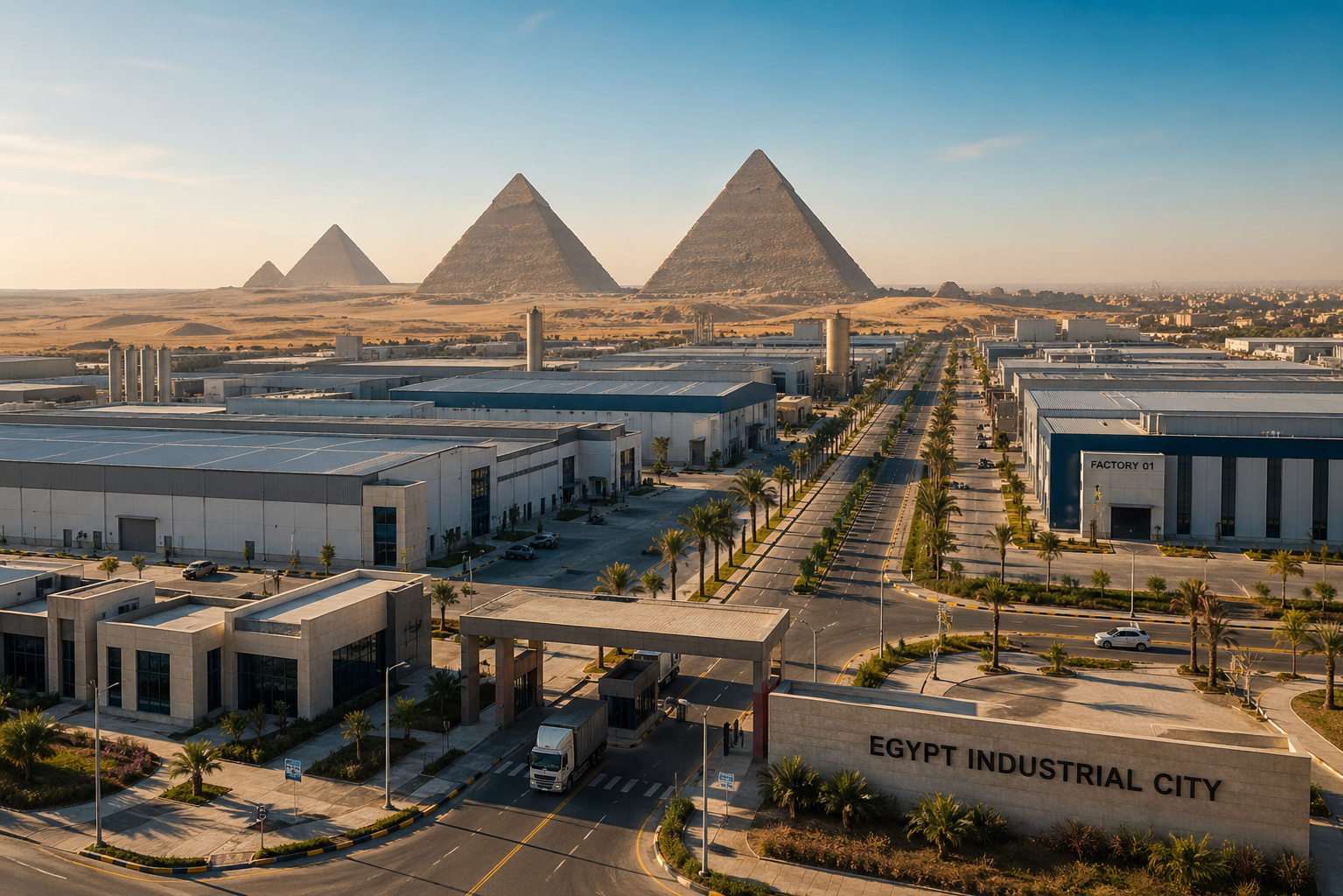
AI-generated illustration by Gemp Consulting. This visual is for conceptual purposes only and does not represent an actual industrial developmet.
Egypt Opens the Factory Gates
Egypt is becoming a more strategic manufacturing option
For manufacturers looking beyond Europe, Egypt has been on the radar for years: close to European markets, positioned between Africa and the Middle East, supported by ports on the Mediterranean and Red Sea, and backed by a government agenda that increasingly prioritizes industrial production and exports.
In April 2026, however, Egypt added a new variable: regulatory momentum.
Two developments stand out. First, the Cabinet approved new private free‑zone projects focused on export production and job creation. Second, the Ministry of Industry issued a new decision restructuring the licensing of industrial activities outside designated industrial zones. Egypt’s Industrial Development Authority announced the decision on 13 April 2026.
For investors, the question is no longer simply whether Egypt is a low‑cost location. The better question is:
Which regulatory model fits the factory – a traditional industrial zone, an investment zone, a private free zone, or a newly permitted off‑zone activity?
1. What changed in 2026?
1.1 More industrial activities outside classic industrial zones
The new ministerial decision reorganizes the licensing of industrial activities outside designated industrial zones. According to the IDA, 65 industrial activities may now be established in separate buildings within urban boundaries and approved built‑up blocks.
This is not a universal permission to build factories anywhere. The general rule remains restrictive. But the list of permitted exceptions has expanded significantly. Activities outside urban boundaries may also be allowed where the nature of the activity and its operational requirements make such a location necessary, provided the competent administrative authority approves and IDA requirements are met.
For German companies, this creates a more nuanced site‑selection process. The key variables are no longer only land price and labour cost. They include activity classification, environmental profile, licensing route, infrastructure, logistics and expansion rights.
1.2 Existing factories may have more room to expand
The new decision preserves existing licences and allows qualifying facilities to expand their current activity or add permitted activities within the boundaries of the existing facility.
For investors, this can be highly relevant. Acquiring or partnering with an existing licensed facility may shorten the path to production compared with a pure greenfield investment. This is especially important for German Mittelstand manufacturers that want to test Egypt with a staged investment: first assembly, then local sourcing, then full production.
1.3 Private free‑zone approvals reveal the government’s direction
In parallel, Egypt approved new private free‑zone projects in April 2026. SIS reported Cabinet approval of new free industrial zone projects designed to support exports and jobs.
The project profiles are revealing. One furniture project in Rubiki Industrial Zone near Badr City was described as covering around 61,000 square metres, with investment costs of about USD 10 million, annual output of 610,000 furniture pieces, around 500 Egyptian workers, a 100 percent export target and 30 percent local component share.
Other approved projects involved socks and textiles, footwear and sports shoes, and large textile and garment production. One large textile project was described as operating seven factories on about 180,000 square metres, with investment of roughly USD 14.125 million, a 100 percent export target, 40 percent local component share and around 1,500 Egyptian workers.
The message is clear: Egypt is not only trying to attract capital. It wants export‑oriented manufacturing capacity.
2. The three location models factory investors should compare
Model A: Private Free Zone
Private free zones are project‑specific investment regimes. GAFI describes them as independent projects outside public free zones where the project may require proximity to raw materials, export markets, labour, related projects, ports or land roads. The investor may own or rent the location.
For export‑heavy factories, this can be powerful. GAFI states that imports and exports between free‑zone projects and foreign markets are exempt from customs duties and taxes, and that projects and their profits are not subject to domestic tax and customs laws during the activity period.
Under Egypt’s Investment Law, goods exported abroad by free‑zone projects or imported for their activities are generally not subject to regular import/export rules, customs procedures, customs duties, VAT or other taxes and fees.
For private free zones, Article 41 provides that manufacturing and assembly projects are subject to a 1 percent fee on total revenues upon exporting goods outside Egypt, and 2 percent upon entry of goods into the country.
Best fit: export manufacturing, assembly platforms, textiles, furniture, footwear, electronics assembly, packaging, components.
Key check: export ratio, domestic sales, customs model, VAT treatment, local content, rules of origin and specific approvals.
Model B: Investment Zone
Investment zones offer integrated infrastructure and administrative support. GAFI defines them as geographic areas designed for one or more specialized investment activities, including industrial, commercial, service and logistics activities. Approvals, licences and permits are issued through one administrative body.
For German manufacturers, this may be the most pragmatic route where predictability and infrastructure matter more than maximum tax optimization.
Ahram Online reported that Egypt’s investment zones have attracted EGP 66.3 billion across 12 zones and created around 77,500 jobs, with occupancy around 90 percent.
Best fit: medium‑sized manufacturers seeking serviced land, industrial units, integrated administration and a more standardised setup.
Key check: available plots, expansion space, zone operator quality, utilities, logistics and sector fit.
Model C: Regular industrial land or permitted off‑zone activity
The April 2026 decision makes this third route more relevant. Selected lower‑impact activities may now be permitted outside classic industrial zones, subject to the decision’s annexes and IDA requirements.
This may suit smaller assembly units, light processing, repair, packaging, customer‑adjacent production or expansion of an existing licensed site.
Best fit: activities where proximity to a customer, warehouse, port or existing facility is commercially important.
Key check: activity code, environmental classification, Annex 1 / Annex 2, local authority approval, building use, fire protection, utilities and expansion rights.
3. Why German manufacturers should pay attention now
3.1 Egypt can function as a regional export corridor
The EU‑Egypt Association Agreement has been in force since 2004 and creates a free‑trade area by removing tariffs on industrial products and facilitating trade in agricultural products. Preferential treatment depends on compliance with rules of origin.
Egypt is also party to multiple trade frameworks listed by Invest in Egypt, including COMESA, Agadir, PAFTA, EFTA, the Egypt‑EU Association Agreement, MERCOSUR, Qualified Industrial Zones and AfCFTA.
This means a factory in Egypt can be more than a cost‑reduction exercise. It can be a platform for Europe, Africa and the Middle East.
3.2 The new rules create optionality
For German manufacturers, the real value of the reforms is optionality.
A private free zone can be strong for export production. An investment zone can reduce infrastructure and administrative friction. A permitted off‑zone activity can support proximity to customers or existing facilities. A classic industrial zone may still be the safest option for many heavier operations.
The right structure depends on:
* export ratio
* import intensity
* local component share
* environmental profile
* energy demand
* port proximity
* workforce needs
* expansion plan
* domestic sales share
* rules of origin
* tax and customs modelling
3.3 Local content is becoming strategic
The newly approved free‑zone projects repeatedly refer to local component shares of 30 to 40 percent.
For German manufacturers, this is not just a political detail. Local sourcing can affect costs, resilience, eligibility, supplier development and potentially origin calculations. The best Egypt strategy is therefore not only a factory strategy. It is a supplier‑ecosystem strategy.
4. What investors should do before selecting a site
First, translate the production process into legal and administrative categories. What exactly will be produced? Is it assembly, processing, packaging or full manufacturing? What inputs are imported? What emissions or waste streams arise? What certifications are required?
Second, model export and domestic sales separately. A structure that is excellent for 100 percent export may be inefficient for domestic sales.
Third, compare all three regimes: private free zone, investment zone and conventional / off‑zone industrial licensing.
Fourth, verify land title, utilities, expansion space and environmental conditions before signing. In emerging manufacturing markets, the cheapest plot can become the most expensive decision.
Finally, run a rules‑of‑origin and customs model early. EU market access depends on product‑specific origin compliance, not simply on producing something in Egypt.
5. Conclusion: Egypt is becoming more investable – but only for disciplined investors
Egypt’s 2026 reforms do not make factory investment simple. But they make the country more interesting for serious industrial investors.
The opportunity is strongest for companies that combine:
* export‑oriented production
* local supplier development
* careful legal structuring
* strong site due diligence
* port‑aware logistics
* realistic ramp‑up planning
* environmental and compliance discipline
For German manufacturers, Egypt should not be seen only as a low‑cost alternative. It is increasingly a near‑Europe production platform with access to multiple regions, a more flexible regulatory toolkit and a government strategy focused on exports.
The winners will be the companies that do not ask, “Where is land cheapest?”
They will ask, “Which legal regime gives our factory the best operating model for the next ten years?”
Sources:
Neue Industrie‑ und Lizenzregeln 2026
1. Industrial Development Authority Egypt – Mitteilung zum Ministerialbeschluss über industrielle Tätigkeiten außerhalb von Industriegebieten
https://www.ida.gov.eg/ar/news/302
2. Al Mal News – Bericht zu Ministerial Decision No. 95 of 2026
https://almalnews.com/2107944/%D9%88%D8%B2%D8%A7%D8%B1%D8%A9-%D8%A7%D9%84%D8%B5%D9%86%D8%A7%D8%B9%D8%A9-%D8%AA%D8%B5%D8%AF%D8%B1-%D9%82%D8%B1%D8%A7%D8%B1%D8%A7-%D8%A8%D8%B4%D8%A3%D9%86-%D8%A5%D9%86%D8%B4%D8%A7%D8%A1-%D8%A7%D9%84%D9%85%D8%B5%D8%A7%D9%86%D8%B9/
3. Ahram Online – Egypt to apply new measures for industrial activity growth
https://english.ahram.org.eg/NewsContentP/3/565842/Business/Egypt-to-apply-new-measures-for-industrial-activit.aspx
⸻
Neue Free‑Zone‑Projekte April 2026
4. SIS – Cabinet approves new free industrial zone projects to boost exports, jobs
https://sis.gov.eg/en/media-center/news/cabinet-approves-new-free-industrial-zone-projects-to-boost-exports-jobs/
5. Amwal Al Ghad – Kabinettsentscheidungen vom 9. April 2026, inklusive neuer privater Freizonenprojekte
https://amwalalghad.com/2026/04/09/%D9%85%D8%AC%D9%84%D8%B3-%D8%A7%D9%84%D9%88%D8%B2%D8%B1%D8%A7%D8%A1-%D9%8A%D9%88%D8%A7%D9%81%D9%82-%D8%B9%D9%84%D9%89-13-%D9%82%D8%B1%D8%A7%D8%B1-%D8%AA%D8%AA%D8%B6%D9%85%D9%86-%D8%AA%D8%B9%D8%AF/
⸻
Free Zones, Investment Zones und Investment Law
6. GAFI – Free Zones
https://www.gafi.gov.eg/English/StartaBusiness/InvestmentZones/Pages/FreeZones.aspx
7. GAFI – Investment Zones
https://www.gafi.gov.eg/English/StartaBusiness/InvestmentZones/Pages/Investment-Zone.aspx
8. GAFI – Investment Law No. 72 of 2017 PDF
https://www.gafi.gov.eg/English/StartaBusiness/Laws-and-Regulations/PublishingImages/Pages/BusinessLaws/Law%20No%20%2072%20of%202017.pdf
9. Ahram Online – Egypt investment zones draw EGP 66.3 billion
https://english.ahram.org.eg/NewsContent/3/12/566498/Business/Economy/Egypt-investment-zones-draw-EGP–billion-as-govern.aspx
10. Invest in Egypt – GAFI forms committee of free zones investors / new public free zones
https://www.investinegypt.gov.eg/English/NewsAndEvents/News/Pages/GAFI-forms-a-committee-of-free-zones-investors-to-maximize-export-.aspx
⸻
Handelsabkommen und Marktzugang
11. EU Access2Markets – EU‑Egypt Association Agreement
https://trade.ec.europa.eu/access-to-markets/en/content/eu-egypt-association-agreement
12. Invest in Egypt – Trading Agreements
https://www.investinegypt.gov.eg/English/Pages/agreements.aspx