
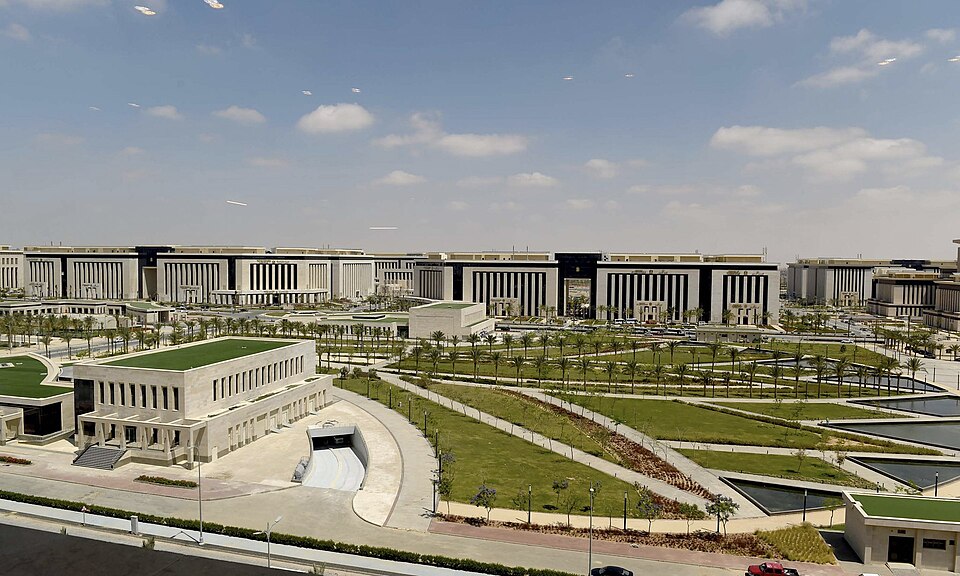
Abdelrhman 1990, “The Government District, New Capital, Egypt”, CC BY-SA 4.0, via Wikimedia Commons
Egypt’s Cabinet Reshuffle (February 2026): New faces, new portfolios — what decision makers should watch
 David Weber
In February 2026, Egypt implemented a cabinet reshuffle with a visible focus on the economy, investment, and institutional performance. After parliament approved the changes, the new ministers were sworn in on 11 February 2026 before President Abdel Fattah El‑Sisi.
The key message is not a full reset, but a targeted redesign of core portfolios: some responsibilities were merged, others separated, and a media/information portfolio was brought back.
For companies, this matters because responsibilities — and therefore counterparts, approval paths and priorities — become more clearly defined, especially across industry, investment/foreign trade, planning, and digital infrastructure.
In short: anyone investing in Egypt, delivering projects, or managing supply chains should understand the new roles — and what signals the government is sending to “serious investors.”
Kamel El‑Wazir is no longer “Industry/Trade” — his remit is now Transport
One of the reshuffle’s headline items is the separation of a previously broader portfolio: Kamel El‑Wazir remains Minister of Transport, but the industry portfolio that was previously combined (often described publicly as a broader industry/transport or industry/trade remit) is now managed separately.
In practice, transport delivery (ports, rail, logistics corridors) and industrial policy (zones, local value creation, industrial programmes) are more clearly decoupled.
Why this matters for companies:
-
Transport remains a dedicated delivery ministry — helpful for port/rail/corridor projects.
-
Industry now has a dedicated minister with private‑sector credentials (see below).
-
Investment and foreign trade are explicitly bundled under the Ministry of Investment & Foreign Trade — potentially simplifying FDI‑related interfaces.
The new Industry Minister: Eng. Khaled Hashem — private‑sector DNA (GE, Honeywell & more)
Eng. Khaled Hashem Ali Maher was sworn in as Minister of Industry.
For decision makers, his profile stands out because it comes from international industrial corporates: multiple profiles note that he most recently served as President, Middle East & Africa at Honeywell, and previously as Country Leader at General Electric (GE) in the Eastern Mediterranean, with additional roles cited at ExxonMobil and Metito.
He also appears closely connected to investor‑ and industry‑facing networks, including board roles with the Sovereign Fund of Egypt and leadership in the American Chamber of Commerce in Egypt (AmCham) energy committee.
Investor signal: support — but implementation matters
In his first public remarks, Hashem emphasised that the ministry would push industrial development forward and support industrial investors to raise output, quality and competitiveness.
At the same time, Egyptian authorities have repeatedly communicated that deadlines and commitments are enforced — including the potential withdrawal of industrial land from non‑compliant investors.
For serious investors, this “carrot‑and‑stick” approach can be positive: it reduces speculative land hoarding, improves land availability, and increases predictability in industrial zones.
Key appointments and portfolio changes — short profiles for decision makers
1) Dr. Hussein Mohamed Ahmed Eissa — Deputy Prime Minister for Economic Affairs
Eissa was sworn in as Deputy Prime Minister for Economic Affairs.
Media profiles describe him as an economist with experience in parliamentary budget/planning work and, according to Al‑Ahram Weekly, as a former head of Ain Shams University.
Business relevance: A DPM economic role can strengthen cross‑ministerial coordination — especially when the “economic group” is being re‑balanced.
2) Dr. Mohamed Farid Mohamed Saleh — Minister of Investment and Foreign Trade
Saleh takes over Investment & Foreign Trade.
Reuters and other sources describe him as the former head of Egypt’s Financial Regulatory Authority (FRA), with additional capital‑markets background including the Egyptian Exchange (EGX).
Relevance: Often the central interface for major investors — incentives, approvals, and aftercare.
3) Dr. Ahmed Mohamed Tawfik Rostom — Minister of Planning and Economic Development
Rostom is the new Planning Minister.
Sources consistently point to a long track record at the World Bank (including senior financial sector roles).
Relevance: Planning drives priority pipelines, public‑investment programmes and sector strategies — important for firms targeting public projects or co‑financing.
4) Eng. Raafat Abdel Aziz Hindi — Minister of Communications and Information Technology
Eng. Hindi was sworn in as Communications & IT Minister.
Profiles describe him as a former MCIT deputy minister for infrastructure development and note interim leadership at the telecom regulator NTRA.
Relevance: Critical counterpart for shared services, BPO/ITO, data centres, cloud, connectivity and digital‑transformation agendas.
5) Mr. Diaa Youssef Rashwan Ahmed — Minister of State for Media
Mr. Rashwan takes over the re‑introduced media/information portfolio as Minister of State for Media.
Reuters and other profiles note he previously led the State Information Service (SIS).
Relevance: Centralised messaging can matter for national programmes and the investor narrative.
6) Mr. Hassan Raddad Ibrahim El‑Sayed — Minister of Labour
Mr. Raddad was sworn in as Minister of Labour.
Profiles mention a background in inspections and legal affairs in the ministry, as well as a role as a labour attaché.
Relevance: Employment compliance, inspections, workforce programmes and training pipelines.
7) Dr. Badr Ahmed Mohamed Abdel Atty — Foreign Affairs + International Cooperation + Expatriates
Dr. Abdelatty remains Foreign Minister; the ministry now explicitly includes International Cooperation and Egyptian Expatriates.
Relevance: Potentially simpler coordination for large programmes involving development finance and bilateral/multilateral partners.
8) Eng. Kamel Abdel Hadi Farag El‑Wazir — Minister of Transport (retained)
Eng. El‑Wazir remains Transport Minister, but reports note he is no longer deputy prime minister and no longer holds the industry portfolio.
Relevance: Continuity for transport infrastructure delivery.
What else changed? (quick overview)
Key structural items worth noting:
-
Local Development and Environment were merged.
-
The Ministry of Public Business Sector was abolished via presidential decree.
-
Additional appointments include Housing, Higher Education, Culture, Youth & Sports, Justice, Parliamentary Affairs, and changes around Defense/Military Production (including a separate state‑minister role).