2026 GEMP – German Egyptian Manufacturing & Procurement. All rights reserved.
Egypt’s economy is accelerating again — and why this matters more to European companies than it may seem at first glance
 David Weber
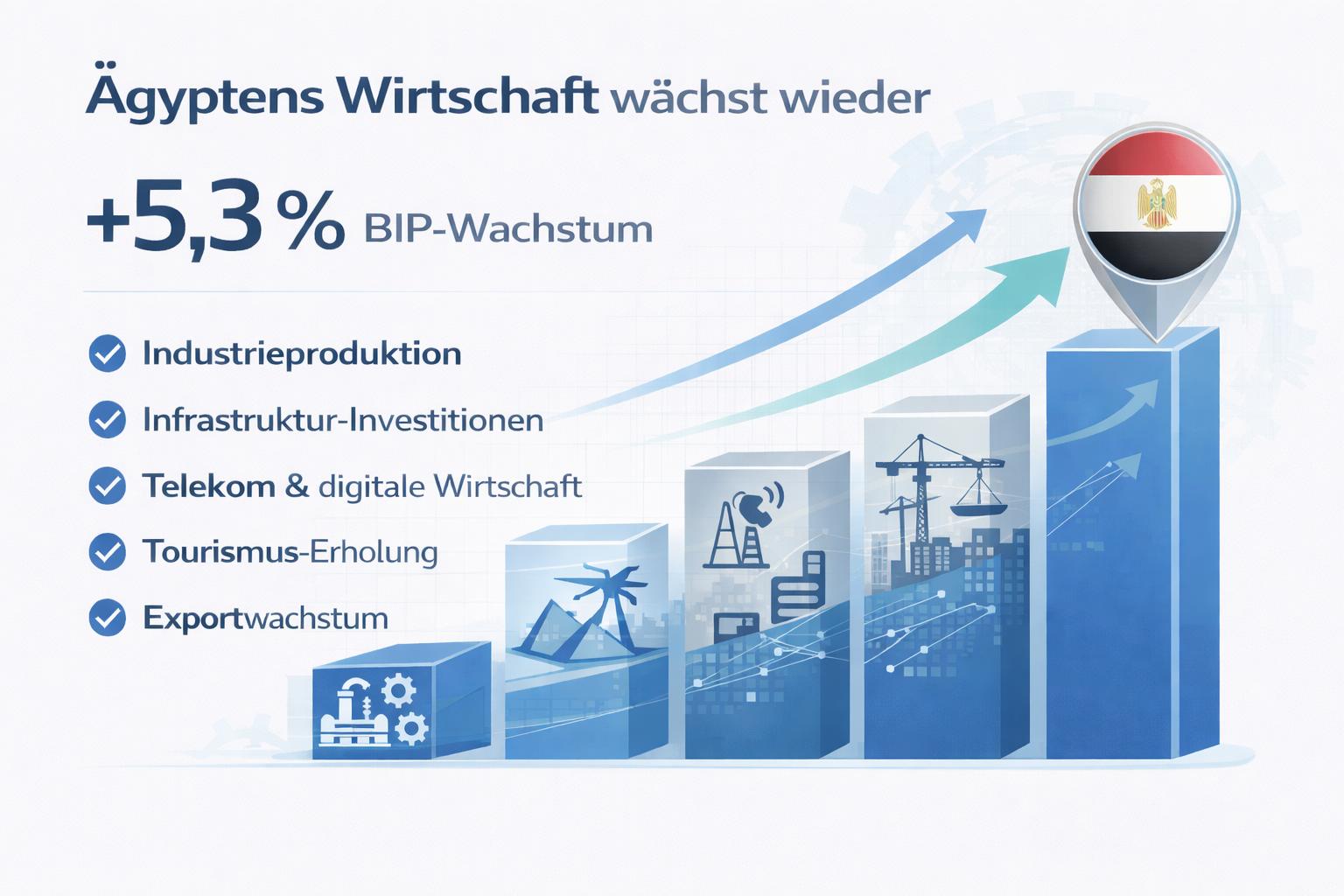
Egypt’s economy has regained visible momentum during fiscal year 2025/2026. After the crisis years of 2023 and 2024 — marked by currency stress, high inflation, pressure on trade routes and delayed investment decisions — the picture is now far more robust: in the first quarter of FY 2025/2026, real GDP expanded by 5.3%, up from 3.5% in the same quarter a year earlier. According to the Ministry of Planning, this was the strongest quarterly performance in more than two years. The IMF has also turned more constructive, projecting growth of 4.7% for 2025/26 and 5.4% for 2026/27. For European decision-makers, this is not merely a macro headline. It is a sign that Egypt is once again becoming strategically relevant as a nearby production base, a tourism and services engine, a logistics platform and a potential industrial partner between the EU, Africa and the Middle East.
The quality of the rebound matters almost more than the top-line number. Growth is not being driven by a single bubble, but by several productive engines at the same time: manufacturing, tourism, information and communications technology, and a recovery in private investment. That combination is exactly what makes Egypt interesting for European business. A location becomes strategically relevant only when it can produce, export, deliver services and attract capital at the same time.
1. The growth numbers: clearly back on an upward path
Official data from Egypt’s Ministry of Planning show a clear turning point. In the first quarter of FY 2025/2026, real GDP growth reached 5.3%. That is not only a significant improvement on the 3.5% recorded in the comparable quarter a year earlier; it is also, according to the ministry, the strongest quarterly reading in more than two years. The rebound was led by tradable and productive sectors — above all non-oil manufacturing, tourism, ICT and a recovery in Suez- and transport-related activity.
The IMF has also become more optimistic. In its January 2026 update, it raised Egypt’s growth outlook to 4.7% for FY 2025/2026 and 5.4% for FY 2026/2027. At the same time, the Fund stresses that the recovery will only become durable if structural reforms continue, the state reduces its economic footprint in selected sectors and the private sector invests more strongly. That final point is critical for European investors: growth in Egypt is now becoming more private-sector-led again than it was during the recent crisis years.
2. Industry and manufacturing: the most important rebound story
The most striking performance comes from non-oil manufacturing. The sector expanded by 14.5% in Q1 FY2025/2026. Several subsectors grew much faster: motor vehicles by 50%, chemical products by 44%, beverages by 37%, furniture by 34%, pharmaceuticals by 19% and ready-made garments by 17%, according to the official GDP note. This matters because it shows that Egypt’s industrial recovery is not just a statistical base effect; it is broadening across multiple manufacturing segments.
The government is deliberately trying to build local production capacity and export readiness. Official economic and investment communication repeatedly frames Egypt as an industry and export hub between Europe, Africa and the Middle East. This is where German companies become particularly visible — although not all in the same way.
The clearest example is BSH, the Bosch home appliance group. In June 2025, BSH opened a state-of-the-art plant in 10th of Ramadan City — the company’s first production site on the African continent. The facility represents an investment of roughly EUR 50 million, is designed for around 350,000 appliances per year and, according to BSH, is expected to create about 1,000 direct and indirect jobs. It produces wide gas-powered range cookers for the Egyptian market and for export across Africa and the Middle East. For European observers, this is a strong signal: German industrial companies are no longer treating Egypt only as a sales market, but also as a manufacturing base.
A second example is the Villeroy & Boch Group — although here the industrial footprint comes through the 2024 acquisition of Ideal Standard. Ideal Standard Egypt has had manufacturing operations in the country since the 1980s and operates multiple facilities in 10th of Ramadan City for ceramics, fittings, bathing and wellness products and shower enclosures. According to the company, more than 50% of local production is exported, while large parts of its acrylic output are shipped to Europe, the Middle East and Africa. This shows that Egypt can function as an export platform for German-owned industrial groups within a wider regional manufacturing strategy.
A particularly interesting case is Cube / Pending System. According to German trade media and industry reporting, the company has been evaluating a plant in Egypt to produce plastic-reinforced carbon parts for export to Europe; reports also mentioned that the option of a full bicycle factory was being explored. The wording matters: this should be treated as a reported plan or evaluation, not as a fully executed greenfield project. Precisely for that reason, however, it is revealing: Egypt is increasingly appearing in German strategic discussions as a possible nearshoring location.
Siemens, by contrast, is less a consumer-goods factory example and more a case of industrial ecosystem building. Siemens says it now employs more than 2,000 people in Egypt and is active in electrification, automation, mobility, software development and digital transformation. For any industrial location, that matters enormously: sustainable production growth does not depend only on halls and machines, but on power systems, transport infrastructure, industrial digitalization and engineering capacity.
3. Tourism: once again a major FX engine and capacity driver
Tourism is the second big growth engine. According to official figures, Egypt welcomed almost 19 million visitors in 2025 — a new record. That makes tourism one of the country’s most important sources of foreign exchange once again. The World Travel & Tourism Council estimates that the sector supports roughly one in every twelve jobs in Egypt and that its contribution to the economy has returned to record levels. For the wider economy, this matters because tourism receipts bring in foreign currency quickly and help stabilize the external position.
Capacity growth is also becoming more sophisticated. The Grand Egyptian Museum at Giza is now fully open to the public and stands as one of the most important global cultural projects of recent years. It is not just a museum; it is a premium tourism magnet and a national branding instrument. On the Red Sea coast, new resort capacity continues to come on stream: in the Sharm El Naga / Naga Bay area, Sentido Naga Bay and Aldiana Club Naga Bay illustrate how Egypt is expanding beyond classic mass-market packages into higher-value club and resort formats that can generate more stable demand for European tour operators and airlines.
4. Telecommunications and the digital economy: from service sector to export engine
A third driver is the digital economy. According to the official GDP note, ICT activity also expanded by 14.5% in Q1 FY2025/2026. Already in FY2023/2024, the sector’s contribution to GDP had risen to 5.8%. What matters even more for international decision-makers is the export dimension: ITIDA puts Egypt’s digital export revenues at USD 4.8 billion in 2025 and notes that the country now hosts more than 240 offshoring companies operating over 270 global service delivery centres. These activities span IT services, BPO, engineering R&D and knowledge-intensive back-office processes.
Market-size estimates vary by methodology, but the direction is consistent. Multiple market studies place Egypt’s ICT sector in the mid-USD-20-billion range in 2025 and project it to exceed USD 50 billion by 2030/31. For a blog article, the exact endpoint matters less than the broader signal: Egypt is no longer seen merely as a call-centre location, but increasingly as a digital and outsourcing hub with growing technical depth.
5. Investment: the private sector is coming back
The investment mix is another key signal. In Q1 FY2025/2026, private investment expanded by 25.9% year on year and accounted for around 66% of executed investment. That matters because the Egyptian economy spent the crisis years dealing with postponed projects, foreign-exchange shortages and a perception of strong state dominance. When the private share rises again, it points to improving confidence in exchange-rate stability, demand recovery and project viability.
The IMF remains cautious, however. In releasing a further USD 2.3 billion in February 2026, the Fund acknowledged clear macroeconomic stabilization but also stressed that structural reform progress remains uneven. In particular, the reduction of the state’s footprint, a more level playing field and a stronger debt-management strategy remain essential if the recovery is to evolve into durable, private-sector-led growth.
6. The downside: what remains problematic despite the rebound
As positive as the current momentum looks, structural weaknesses remain very visible. First, the oil and gas sector is still under pressure. In Q1 FY2025/2026, total extraction activity contracted by 5.3%, with oil down 6.6% and natural gas down 10.9%. That is important because Egypt is not only an energy producer but also a country with sharply rising domestic demand.
Second, Suez Canal revenues remain geopolitically exposed. The Ministry of Planning reported a return to positive growth in canal activity in Q1 FY2025/2026, and Reuters noted a temporary recovery in late 2025. At the same time, the IMF explicitly flags regional tensions as a major downside risk. In other words: the canal is an enormous asset, but also an inherently volatile one.
Third, the debt and financing question is not resolved. The IMF acknowledges the stabilization, but explicitly says that high public debt and elevated gross financing needs continue to constrain fiscal space. Put differently, growth has returned, but it remains sensitive to external shocks, geopolitical disruptions and delays in reform implementation.
7. Extra: why Egypt is trying to become a steel and industrial hub for Europe right now
Egypt’s push to position itself not only as a general production location but specifically as a steel and industrial hub for Europe has several layers. First, Europe’s industrial strategy increasingly demands shorter and more resilient supply chains. The EU is looking for nearby partners large enough to scale, but close enough to shorten lead times. Second, Egypt fits this logic geographically: it combines Suez-based maritime access, industrial land, export windows into the EU, MENA and Africa, and increasingly concentrated logistics and energy infrastructure.
Third, Cairo is pursuing an explicit metals strategy. In autumn 2025, Prime Minister Madbouly presented a ten-year strategy intended to turn Egypt into a regional centre for iron and steel. In early 2026, the government also communicated plans for a USD 10 billion automotive and industrial steel complex with a Chinese partner. These are not simply volume projects. They are meant to push the country deeper into higher-value industrial steel, better quality and more specialized downstream production.
Fourth, there is an energy and decarbonization dimension. Europe increasingly needs industrial partner locations that can, over time, run on green electricity, green hydrogen and green ammonia. Egypt is trying to build exactly that role, particularly around Ain Sokhna and the Suez Canal Economic Zone. If those energy projects continue to materialize, Egypt could become more than a sourcing market for Europe: it could become part of Europe’s extended industrial production base for energy- and materials-intensive sectors.
Conclusion
Egypt’s current growth story is real, but it is not a simple boom narrative. The country is benefiting from a recovery in several productive sectors at once: manufacturing, tourism, the digital economy and private investment. That is exactly what makes Egypt relevant for European companies. Anyone looking only at low-cost labour is missing the real signal. Egypt becomes strategically interesting where proximity to Europe, export capability, industrial depth and an active industrial policy all come together.
At the same time, the vulnerabilities remain obvious: energy, Suez, debt and reform execution are not side issues. The right conclusion for European decision-makers is therefore neither blind enthusiasm nor blanket scepticism, but selective strategy. Egypt will not be the right nearshoring answer for every product or every industry. But for many manufacturing, export and industrial services models, it could become one of Europe’s most important production and sourcing partners in the southern neighbourhood over the next few years.
Sources
Egypt Ministry of Planning and Economic Development – The Quarterly GDP Note, Q1 FY 2025/2026
https://mped.gov.eg/adminpanel/sharedFiles/GDP_Note_Eng_252026_222.pdf
IMF – Transcript: Press Conference on the Release of the January 2026 World Economic Outlook Update
https://www.imf.org/en/news/articles/2026/01/21/tr-01212026-weo-press-conference-on-release-of-the-january-2026-world-economic-outlook-update
IMF – Executive Board Completes the Fifth and Sixth Reviews Under the Extended Fund Facility and First Review Under the RSF for Egypt
https://www.imf.org/en/news/articles/2026/02/26/pr-26064-egypt-imf-completes-5th-and-6th-revs-under-ext-arrange-under-eff-and-1st-rev-under-rsa
State Information Service (Egypt) – Egypt tourism records historic growth in 2025 receiving 19 million tourists
https://sis.gov.eg/en/media-center/news/egypt-tourism-records-historic-growth-in-2025-receiving-19-million-tourists/
World Travel & Tourism Council – Travel & Tourism in Egypt reaches historic milestones
https://wttc.org/news/travel-and-tourism-in-egypt-reaches-historic-milestones
Grand Egyptian Museum – Official website
https://grandegyptianmuseum.org/
AP News – The $1 billion Grand Egyptian Museum opens to the public
https://apnews.com/article/f5bf88997dff98cc3c3e95743ababdbd
Aldiana – Aldiana Club Naga Bay official page
https://www.aldiana.com/clubs/naga-bay.html
DERTOUR Group – New Winter-Getaway in Egypt now open for bookings: Sentido Naga Bay
https://www.dertour-group.com/en/new-winter-getaway-in-egypt-now-open-for-bookings-sentido-naga-baybookings-sentido-naga-bay/
DERTOUR – Sentido Naga Bay hotel page
https://www.dertour.de/hotel/sentido-naga-bay-12sDjV
Ahram Online – ICT sector contribution to Egypt’s GDP rises to 5.8% in FY2023/2024
https://english.ahram.org.eg/News/534854.aspx
ITIDA – Egypt Doubles Digital Offshoring Exports to $4.8B, Secures 55 New Agreements at Global Offshoring Summit 2025
https://itida.gov.eg/English/PressReleases/Pages/Egypt-Doubles-Digital-Offshoring-Exports-to-4.8B-Dollars.aspx
ITIDA – Egypt’s ICT sector industry outlook
https://itida.gov.eg/English/Programs/Industry-Outlook/Pages/default.aspx
Mordor Intelligence – Egypt ICT Market Report
https://www.mordorintelligence.com/industry-reports/egypt-ict-market
BSH Press – New BSH plant in Egypt marks milestone for future growth in the African market
https://press.bsh-group.com/pressreleases/new-bsh-plant-in-egypt-marks-milestone-for-future-growth-in-the-african-market-3394614
Siemens Press – Siemens celebrates 125 years of partnership and innovation in Egypt
https://press.siemens.com/global/en/pressrelease/siemens-celebrates-125-years-partnership-and-innovation-egypt
Bike Europe – Cube Bikes plans to invest €5 million in component factory in Egypt
https://www.bike-eu.com/48877/cube-bikes-plans-to-invest-e5-million-in-component-factory-in-egypt
RadMarkt – Cube-Macher Pending System lotet Produktionsstandort Ägypten aus
https://radmarkt.de/cube-macher-pending-system-lotet-produktionsstandort-aegypten-aus/
Villeroy & Boch / Ideal Standard – Villeroy & Boch completes acquisition of Ideal Standard
https://www.idealstandardgulf.com/about-us/newsroom/2024/villeroy-and-boch-completes-acquisition-of-ideal-standard
Ideal Standard International Egypt – About / manufacturing in Egypt
https://idealstandard-egypt.com/about/
Ideal Standard International Egypt – Export
https://idealstandard-egypt.com/export/
Reuters – Egypt’s Suez Canal revenues rise 14% as Red Sea tensions ease
https://www.reuters.com/world/africa/egypts-suez-canal-revenues-rise-14-red-sea-tensions-ease-2025-11-04/
Ahram Online – Egypt launches 10-year plan to boost iron and steel industry
https://english.ahram.org.eg/NewsContent/3/12/553986/Business/Economy/Egypt-launches-year-plan-to-boost-iron%2C-steel-indu.aspx
State Information Service (Egypt) – Egypt plans $10B automotive & industrial steel complex with Chinese partner
https://sis.gov.eg/en/media-center/news/egypt-plans-10b-automotive-industrial-steel-complex-with-chinese-partner/
European Commission – EU and Egypt join forces to accelerate strategic investment, industrial transformation and innovation
https://north-africa-middle-east-gulf.ec.europa.eu/news/eu-and-egypt-join-forces-accelerate-strategic-investment-industrial-transformation-and-innovation-2025-10-22_en
European Commission – EU and Egypt launch initiatives for sustainable energy cooperation
https://north-africa-middle-east-gulf.ec.europa.eu/news/eu-and-egypt-launch-initiatives-sustainable-energy-cooperation-2026-02-10_en
Scatec – Egypt green hydrogen project signed 20-year offtake agreement with Fertiglobe based on H2Global award
https://www.scatec.com/en/scatecs-egypt-green-hydrogen-project-signed-20-year-offtake-agreement-with-fertiglobe-based-on-h2global-award/