Egypt’s New Capital: Why "The New Capital" is more than a prestige project for German SMEs
 David Weber
Anyone looking only at satellite imagery sees broad boulevards, large plots of land and still a great deal of open space. Anyone looking at Egypt’s new capital through the lens of a German SME sees something different: a long-term administrative, infrastructure and business location where demand for technology, equipment, operations and services is being concentrated over many years. The debate over whether the city is already “finished” or still “incomplete” therefore misses the point for companies. For the Mittelstand, the relevant question is whether a location creates real projects, real budgets, real users and real follow-on business. That is exactly what the new capital is increasingly doing at a scale that matters for German SMEs.
In official communication, the city is now branded as “The New Capital” and positioned by ACUD as Egypt’s first smart city. It lies around 60 kilometres east of Cairo and combines government institutions, parliament buildings, administrative districts, residential neighbourhoods, cultural and religious landmarks, and a new central business district. As early as 2024, Reuters reported that almost 48,000 employees were commuting there every day to work in ministries and public offices. At the same time, up to 100,000 housing units had already been completed and the first families had moved in. This shows that the new capital is no longer just an architectural rendering; it is a growing place to work and live, with genuine baseline demand.
For German SMEs, that matters because the city is creating not just isolated construction projects but entire value chains. Wherever ministries, agencies, banks, developers, EPC contractors, operators, transport systems and utilities are concentrated in one place, a dense market emerges for solutions – from building technology and energy systems to water infrastructure, digitalisation, security, training and after-sales service.
Why the new capital matters for German SMEs
For small and medium-sized companies, the new capital is attractive for three main reasons. First, public and private demand is being physically concentrated. Second, the technical standard being built up in the city favours high-quality, durable and integrated solutions rather than the cheapest single product. Third, the new capital acts as a showcase for Egypt as a whole: once a company builds a strong reference there, its chances of winning follow-on projects in other cities, industrial zones and infrastructure programmes improve significantly.
This is especially relevant in the following areas:
· building technology, HVAC, energy and load management
· power distribution, grid technology, backup systems and controls
· water, wastewater, pumps, valves and quality monitoring
· safety, fire detection and access systems
· lifts, escalators, parking and traffic management
· smart-city software, control rooms, sensors and data integration
· hospital and laboratory equipment, technical services and training
· hotel and office fit-out, interior systems, FM and maintenance
German SMEs are particularly strong in these fields because they rarely sell “just a product”. They usually bring system understanding, reliability, documentation, training and service with them. That combination is often highly valued in Egypt – especially where new infrastructure must not only be built, but also operated over the long term.
The infrastructure behind the project: why the city is becoming operational
For investors and SMEs, the decisive question is not the symbolism of the skyline but whether the city functions as an operational location. The answer is becoming increasingly positive because central systems are now either in place or already running.
One important sign is the energy infrastructure. Siemens and Hassan Allam Construction won the contract in 2020 to build the new National Energy Control Center in the new capital. This centre monitors and controls high-voltage networks and power generation connections across Egypt and is a strong example of how the city is not limited to representative buildings but is hosting critical national infrastructure. For German SMEs, this sends a clear message: German technology is not exotic in the new capital environment; it is already part of the system architecture.
Transport connectivity is another important piece. In March 2026, the 56.5-kilometre East Nile Monorail between Cairo and the new capital was inaugurated. This marks another shift away from the image of an isolated mega-project and toward a genuinely connected urban centre. Alstom describes the two Cairo monorail lines as high-capacity, automated links serving key areas of Greater Cairo and especially the new capital. At the same time, Siemens Mobility is building the nationwide high-speed and regional rail network. In Siemens’ own communication, the new capital is explicitly embedded in a much larger mobility system linking cities, seaports, production clusters and logistics corridors.
For companies, that means staff, goods, service visits and customer meetings become more predictable. And that predictability is often more important for SMEs than spectacular photos of towers or ministry buildings.
What German SMEs can do with this opportunity
The real opportunity does not lie in simply “going to the new capital”. It lies in using the project as a structured market-entry platform. There are three realistic ways to do that.
The first route is to enter through supply, specialist packages and technical subcontracting. Most German SMEs do not need to appear immediately as general contractors. In many cases, it is far more effective to enter as a solution partner for EPCs, developers, operators or system integrators – for example with components, subsystems, control technology, specialist installation or commissioning services.
The second route is the service and operations model. In young urban and infrastructure projects, success is rarely decided in the build phase alone. The most valuable providers are often those that can deliver maintenance, spare parts, training, remote support and operator qualification. This is exactly where many German SMEs have an advantage, because they think about technology over the full lifecycle.
The third route is to combine the new capital with a wider Egypt set-up. Companies that rely on a single city project remain too narrow. Companies that use the new capital as a reference environment while also connecting to the SCZone, Cairo, Alexandria and existing industrial clusters build a much more resilient business model. This also fits the message from the Egyptian-German Business Forum 2025: Egypt wants to become a production and export hub for German companies. At the same time, Egyptian officials highlighted the SCZone’s advantages, including six seaports and integrated industrial and logistics zones.
Why the location is more attractive for German SMEs today than a few years ago
One underestimated factor is institutional support. AHK Egypt explicitly describes itself as a market-entry and growth platform for German companies and points to networking opportunities with more than 2,500 member companies as well as access to authorities and decision-makers. For SMEs, that is not a luxury; it often makes the difference between a long blind flight and a structured market entry. In addition, the “Partnering in Business with Germany” programme identifies Egypt as a country with strong potential for German SMEs in climate protection, renewable energy, engineering, building materials and healthcare – and explicitly refers to nearshoring.
This matters because Egypt is being positioned not only as a sales market, but also as a cooperation and production location. Companies that become active in the new capital or its wider ecosystem should therefore think beyond sales: training, local partner structures, small local stock, spare parts supply and – where it makes sense – regional assembly or service hubs all become part of the business case.

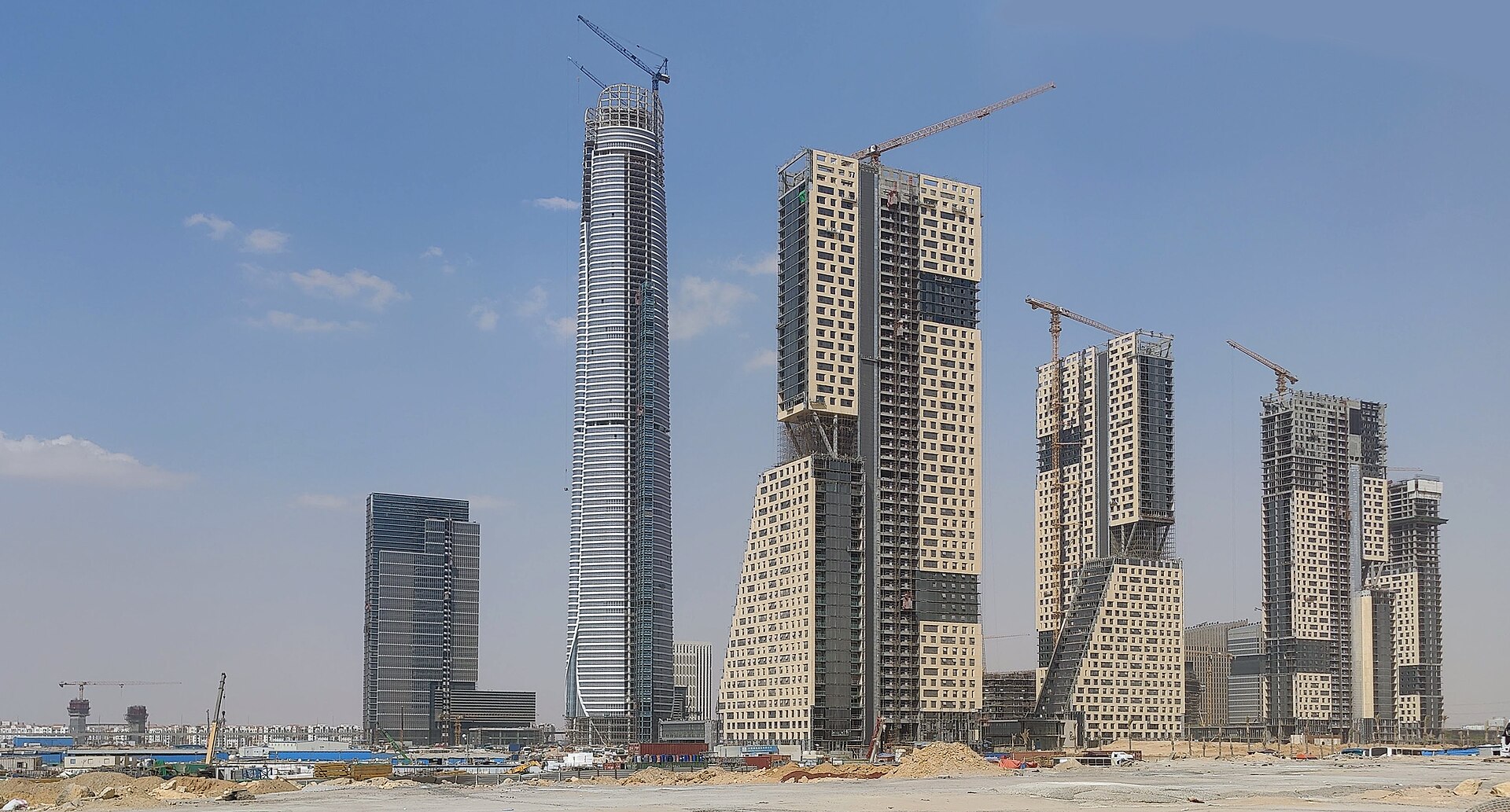
The Government District, New Capital 2. Photographer: Abdelrhman 1990. License: CC BY-SA 4.0
Opportunity fields in detail
For German SMEs, I see five especially attractive fields around the new capital.
1. Energy efficiency and building operations. New administrative and office complexes require controls, monitoring, metering systems, HVAC regulation, UPS, power-quality management, fire safety and operational concepts. Many buildings will not fail because of a missing product, but because of poor integration. That is where system-oriented suppliers can create real value.
2. Water and environmental technology. A new city in a desert environment needs reliable water, wastewater and recycling systems. That opens up opportunities for pumps, valves, treatment solutions, leak detection, remote monitoring, laboratory technology and operator training.
3. Mobility and traffic technology. As monorail, rail connections and urban districts expand, demand rises for signalling, passenger information, safety systems, operating components and urban mobility interfaces.
4. Healthcare, education and fit-out. The new capital is not only a seat of government; it is meant to become a permanent place to live, work and provide services. That creates demand for hospital and laboratory equipment, premium building materials, acoustics, doors, sanitary systems, kitchens, training rooms and technical furnishing.
5. Digitalisation and control rooms. The more Egypt turns smart-city functions into daily operations, the greater the need for middleware, data integration, cybersecurity, control rooms, user interfaces and training. German SMEs with niche expertise are well positioned here if they present themselves in a practical and partnership-oriented way.
What should still be prepared professionally despite the positive outlook
The positive view of the new capital is justified – but it does not replace serious preparation. For German SMEs, four points matter most.
1. The city is growing in phases. Not every district is equally mature, and not every location fits every business model. Location decisions within Egypt therefore need to be taken on a micro-location basis.
2. The market remains relationship-driven. Companies that want to succeed in Egypt need presence, reliable contacts and patience in project development. That is precisely why AHK Egypt, local advisers, technical partners and strong references matter so much.
3. Documentation and tender participation must be prepared professionally. Arabic and English documentation, technical data sheets, compliance materials, certifications and clear service commitments are not optional extras; they are prerequisites.
4. After-sales service often matters more than the first sale. Companies that only export but do not offer service will rarely win long term in complex projects.
Conclusion
Egypt’s new capital becomes interesting for German SMEs once it is understood not as a finished postcard image, but as a long-term business platform. The government is there, infrastructure is growing, transport connections are improving, and demand for technology, operations and service is gradually shifting into a new urban centre. Companies that enter early and intelligently can use that environment not only to win individual projects, but to build an Egypt business with references, partners and recurring revenues.
The decisive question is therefore not: “Is the city already completely finished?” For the Mittelstand, the better question is: “Is a market emerging here in which German technology, quality and service can make a real difference?” Based on everything that is visible today, the answer is yes – and that is precisely why German SMEs should not just look at the new capital, but take it seriously as a strategic opportunity.
Sources
1. NZZ (Visuals): Geisterstadt im Sand? Satellitenbilder zeigen Ägyptens neue Hauptstadt https://www.nzz.ch/visuals/geisterstadt-im-sand-satellitenbilder-zeigen-aegyptens-neue-hauptstadt-ld.1930283
2. Reuters (04 Jan 2024): Egypt plans expansion of new capital as first residents trickle in https://www.reuters.com/world/africa/egypt-plans-expansion-new-capital-first-residents-trickle-2024-01-04/
3. Reuters (02 Apr 2024): Egypt’s Sisi starts third term in new capital https://www.reuters.com/world/africa/egypts-sisi-sworn-third-term-2024-04-02/
4. Egypt Today (08 Nov 2025): Egypt’s New Administrative Capital rebranded as ‘New Capital’ in official correspondence https://www.egypttoday.com/Article/1/143350/Egypt%E2%80%99s-New-Administrative-Capital-rebranded-as-%E2%80%98New-Capital%E2%80%99-in-official
5. Administrative Capital for Urban Development (ACUD): The New Capital / Smart City Vision https://acud.eg/new-capital
6. AHK Egypt: About AHK Egypt https://aegypten.ahk.de/en/about-ahk-egypt
7. Partnering in Business with Germany: Egypt https://partnering-in-business.de/en/partnercountries/egypt/
8. AHK Egypt (29 Sep 2025): Egyptian-German Business Forum 2025 https://aegypten.ahk.de/en/news2/egyptian-german-business-forum-2025
9. Siemens (08 Dec 2020): Siemens, Hassan Allam Construction to build Egypt’s new National Energy Control Center https://press.siemens.com/global/en/pressrelease/siemens-hassan-allam-construction-build-egypts-new-national-energy-control-center
10. Siemens Mobility: Transform Mobility in Egypt https://press.siemens.com/global/en/feature/transform-mobility-egypt
11. Alstom: The Monorail story for greater Cairo https://www.alstom.com/monorail-story-greater-cairo
12. Egypt Today (20 Mar 2026): East Nile monorail begins operations linking Cairo to New Capital https://www.egypttoday.com/Article/1/145804/East-Nile-monorail-begins-operations-linking-Cairo-to-New-Capital