
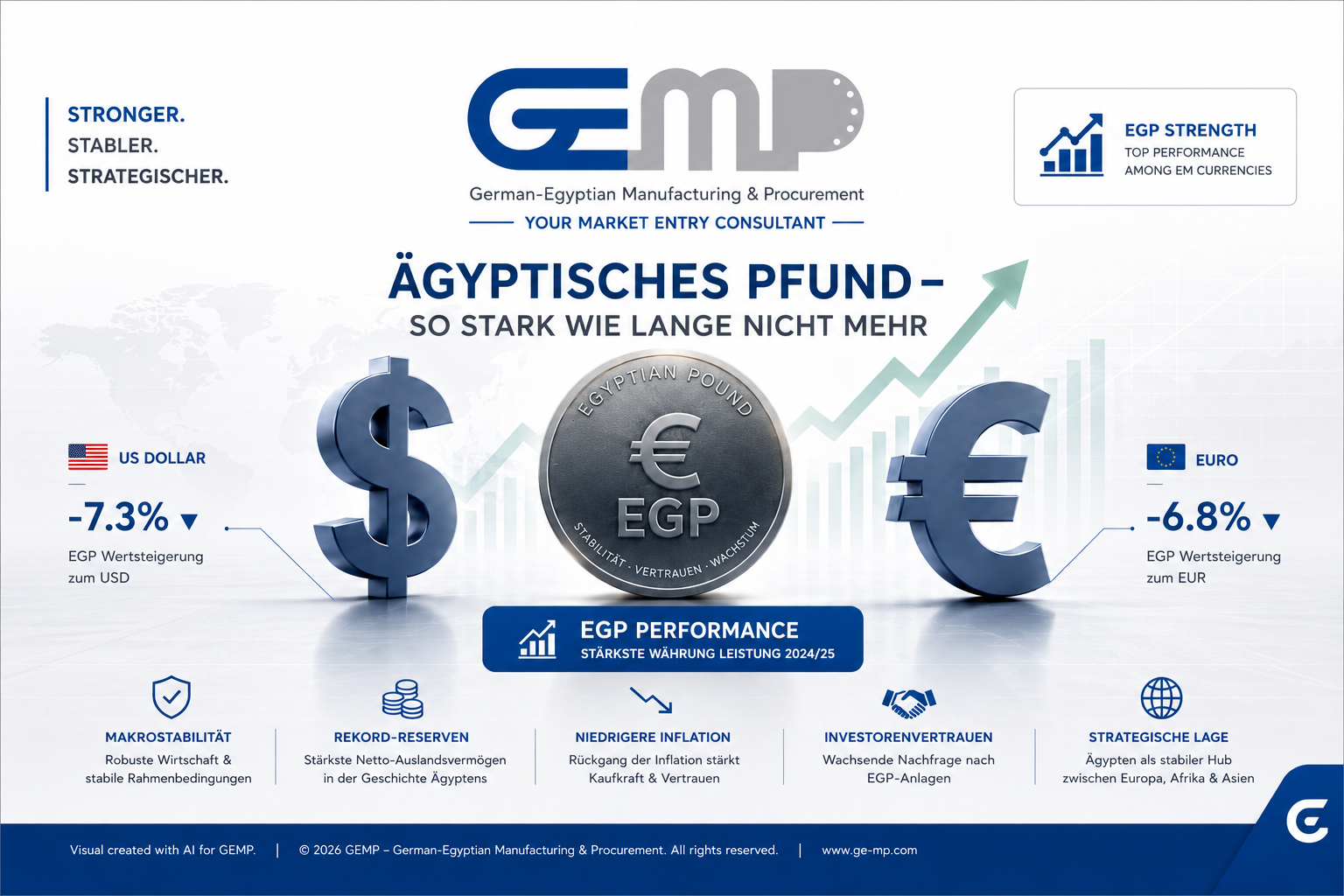
Visual created with AI for GEMP. © 2026 GEMP – German-Egyptian Manufacturing & Procurement. All rights reserved.
Egypt’s pound, oil prices and investor confidence: why the recovery is real — but the market is watching again
 David Weber
Egypt is back in focus for international investors. The Egyptian pound has recently recovered strongly after coming under severe pressure in March. At that time, the Iran conflict, higher energy prices and capital outflows hit the country at once. Reuters reported in March that foreign investors had pulled an estimated USD 5–8 billion from Egyptian pound treasury instruments, while the currency weakened from around EGP 47 per US dollar to more than EGP 52 per US dollar. At the same time, higher oil, gas, freight and insurance costs threatened to increase Egypt’s import bill and fiscal burden.
The pound’s latest recovery is therefore more than a short-term market mood. It reflects several real improvements: lower energy prices compared with the March shock, high net foreign assets earlier this year, record remittances from Egyptians abroad, IMF support, European financing and improved foreign-currency liquidity. However, the situation is not risk-free. New reports on 28 June 2026 show that geopolitical calm in the Gulf is becoming fragile again. Reuters reported renewed US-Iran strikes, missile and drone attacks on US bases in Kuwait and Bahrain, and an attack on a tanker near the Strait of Hormuz. Gulf markets closed mixed, while Egypt’s EGX30 fell 2.1%.
The key message is therefore: Egypt is much more macro-financially resilient than two years ago — but it remains highly exposed to energy prices, capital flows and regional security.
The direct driver: oil, Hormuz and the risk premium
For Egypt, the Strait of Hormuz is not just a geopolitical issue. It is a macroeconomic cost factor. When the passage becomes unsafe, oil and LNG prices, freight costs, insurance premiums and financing costs tend to rise. In March, Reuters reported that a prolonged escalation could add USD 1–2.4 billion to Egypt’s energy import bill. For a country with high debt service and subsidies, that matters immediately. (
The pound rally was initially supported by lower oil prices and improved risk sentiment. Reuters reported in mid-June that Brent crude fell to around USD 78.96 per barrel, its lowest level in roughly three months, after preliminary US-Iran de-escalation. The US dollar also weakened against several major currencies as investors reduced safe-haven demand.
Now the market is more cautious again. The latest tensions do not automatically mean a return to March stress levels. But they show that the currency rally depends heavily on whether energy prices and shipping routes remain stable. For Egypt, every decline in oil prices is positive — but every new Hormuz shock can quickly reverse part of that benefit.
Why the pound still has support
The positive side is that Egypt is not starting from the same weak position it faced before the 2024 currency reform. In January 2026, net foreign assets in the banking system rose to a record USD 29.54 billion. Reuters attributed the increase to Gulf investments, the 2024 exchange-rate reform and strong remittances. Remittances from Egyptians working abroad reached around USD 41.5 billion in 2025, up from USD 29.6 billion the previous year.
This matters because net foreign assets indicate how much foreign assets the central bank and commercial banks hold after deducting foreign liabilities. The figure is not a single government cash reserve, but it is a strong indicator of foreign-currency liquidity in the banking system. Better liquidity helps importers finance raw materials, machinery, medicines, energy products and spare parts. For companies, that can matter more than the exact daily exchange rate.
The IMF track also helps. In February 2026, the International Monetary Fund completed further programme reviews and unlocked around USD 2.3 billion. The IMF confirmed that Egypt’s foreign-currency shortage had eased, but it also warned about high public debt, large financing needs and slow progress in reforming state-owned companies.
European support is another pillar. Reuters reported in January 2026 that Egypt received EUR 1 billion from an EU assistance package. Such inflows strengthen the foreign-currency position and signal continued support from international partners.
New development: privatisation as a confidence signal
A key new development is the 28 June 2026 announcement that Egypt approved the preliminary stock-market listing of four state-owned companies. They include three petroleum-sector companies — ENPPI, Egyptian Linear Alkyl Benzene Company (ELAB) and Petroleum Marine Services — plus Maamoura for Reconstruction and Tourism Development from the tourism sector. Reuters framed the move as part of Egypt’s broader IMF-linked privatisation programme.
This is relevant for the currency because privatisation does not only bring capital. If executed credibly, it also improves transparency, governance and investor confidence. If investors see Egypt seriously bringing state assets to the exchange, they may become more willing to re-enter local bonds, equities and direct investment.
At the same time, this remains a reform-risk area. The IMF has repeatedly pushed Egypt to strengthen the private sector and reduce the dominance of state-owned companies. British International Investment, which Reuters says has USD 850 million invested in Egypt, also urged Egypt on 23 June 2026 to create a more level playing field between state-owned and private firms.
Inflation: better, but not solved
Inflation has improved compared with the crisis years, but it remains a central risk. Reuters reported that annual urban inflation slowed to 14.9% in April 2026, down from 15.2% in March. Analysts expected a further slight decline to around 14.5% in May, but also warned of renewed pressure from electricity tariffs and other cost adjustments.
A stronger pound can help reduce inflation by making imported goods cheaper. This is especially relevant for machinery, food, pharmaceuticals, chemicals, spare parts and industrial inputs. However, the effect is neither immediate nor complete. Energy prices, electricity tariffs, fuel prices and administered prices feed through with a delay. The currency recovery should therefore be seen as an inflation relief factor, not as a final solution.
What this means for businesses
For companies, the current environment is better than it was in March, but it is not risk-free.
For importers, a stronger pound improves cost calculations. Machinery, spare parts, raw materials and components become cheaper in local-currency terms as long as the exchange rate holds. Companies should still budget with exchange-rate ranges, not a single fixed rate.
For exporters, the picture is mixed. A stronger currency can reduce margins because Egyptian costs become higher in dollar or euro terms. At the same time, imported inputs become cheaper. The net effect depends on each product’s import content.
For construction and industrial projects, foreign-currency availability is especially important. If banks are better supplied with hard currency, imported equipment, automation, valves, electrical systems, machinery and steel become easier to procure.
For investors, the combination of IMF support, EU funding, privatisation steps and lower energy prices improves the picture. But the renewed Gulf escalation shows that Egypt remains a market where geopolitical shocks can quickly affect the exchange rate, stock market and financing costs.
Current conclusion
The Egyptian pound has genuine support: record remittances, high net foreign assets earlier this year, international financing, a more flexible exchange rate and new privatisation steps all point to a more stable macro-financial position. At the same time, 28 June showed that the rally is not immune to geopolitical setbacks. Renewed US-Iran tension and a 2.1% drop in the EGX30 show that the market is reassessing the risk premium.
The better formulation for today is not: “The pound is definitively back.” It is: Egypt’s currency and markets are showing a robust recovery — but the next phase depends on energy prices, Hormuz security, capital flows and reform execution.
For businesses and investors, that is a constructive but sober message: planning conditions are improving, but exchange-rate, energy and liquidity risks still belong in every budget and investment model.
Quellen:
Reuters – Iran war tests Egypt’s unsteady economy, 10 March 2026
https://www.reuters.com/world/middle-east/iran-war-tests-egypts-unsteady-economy-2026-03-10/
Reuters – Most Gulf markets gain after preliminary US-Iran deal, 15 June 2026
https://www.reuters.com/world/middle-east/most-gulf-markets-gain-iran-deal-2026-06-15/
Reuters – Oil falls to three-month low following US-Iran developments, 16 June 2026
https://www.reuters.com/world/asia-pacific/oil-rebounds-concerns-about-us-iran-peace-deal-restoration-supply-2026-06-16/
Reuters – Dollar hits ten-day low after US-Iran preliminary agreement, 15 June 2026
https://www.reuters.com/world/asia-pacific/forex-dollar-hits-10-day-low-us-iran-reach-peace-deal-2026-06-15/
Reuters – Gulf markets mixed as US-Iran strikes rattle region, 28 June 2026
https://www.reuters.com/world/middle-east/gulf-markets-mixed-us-iran-trade-attacks-2026-06-28/
Reuters – Egypt lines up four state-owned companies for privatisation, 28 June 2026
https://www.reuters.com/world/africa/egypt-lists-four-state-owned-companies-part-privatisation-programme-cabinet-says-2026-06-28/
Reuters – UK overseas development body urges Egypt to level playing field for private sector, 23 June 2026
https://www.reuters.com/world/africa/uk-overseas-development-body-urges-egypt-level-playing-field-private-sector-2026-06-23/
Reuters – Egypt net foreign assets climb to record USD 29.5bn in January, 2 March 2026
https://www.reuters.com/world/africa/egypt-net-foreign-assets-climb-record-295-bln-january-2026-03-02/
Reuters – IMF completes Egypt reviews, unlocking about USD 2.3bn, 26 February 2026
https://www.reuters.com/world/africa/imf-completes-egypt-reviews-unlocking-about-23-billion-2026-02-26/
Reuters – Egypt receives EUR 1bn from EU assistance package, 15 January 2026
https://www.reuters.com/world/africa/egypt-receives-1-billion-euros-eu-part-assistance-package-2026-01-15/
Reuters – Egypt’s annual urban inflation slows to 14.9% in April, 6 May 2026
https://www.reuters.com/world/africa/egypts-annual-inflation-slows-149-april-2026-05-06/
Reuters – Egypt inflation seen easing in May, but analysts warn of rebound, 8 June 2026
https://www.reuters.com/world/africa/egypt-inflation-seen-easing-145-may-analysts-warn-rebound-ahead-2026-06-08/
Reuters – Egypt clears USD 6.1bn arrears owed to oil and gas companies, 10 June 2026
https://www.reuters.com/business/energy/egypt-clears-arrears-oil-gas-companies-2026-06-10/
Central Bank of Egypt – official website
https://www.cbe.org.eg/en/