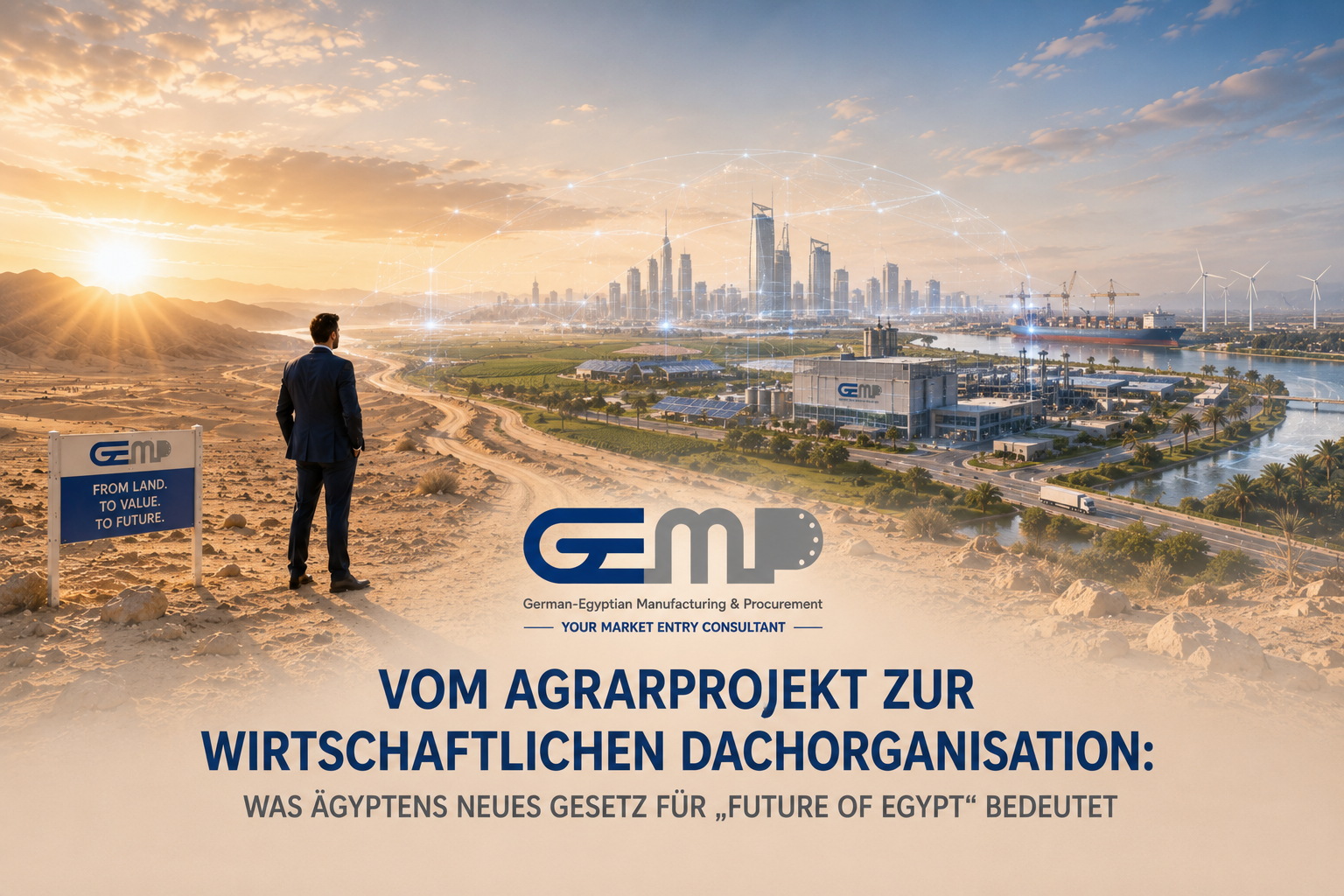
Visual created with AI for GEMP.
© 2026 GEMP – German-Egyptian Manufacturing & Procurement. All rights reserved.
From land-reclamation project to economic umbrella: what Egypt’s new law means for the Future of Egypt Authority
 David Weber
Egypt has fundamentally reorganised the Future of Egypt Authority for Sustainable Development, also known as Mostaqbal Misr. President Abdel Fattah El-Sisi ratified Law No. 147 of 2026, which was published in the Official Gazette on 26 July and entered into force the following day. The authority is being separated from its previous affiliation with the Ministry of Defence and placed directly under presidential oversight. At the same time, the law gives formal legal structure to an organisation whose activities already extend far beyond agriculture and land reclamation.
The reform is therefore neither a simple name change nor a conventional privatisation. It creates a special-purpose economic platform that can manage state land and shareholdings, establish companies, organise development zones, host investors and invest through affiliated funds in Egypt and abroad. For international businesses, the authority may become a new central counterparty for large agricultural, industrial, logistics and energy projects. At the same time, its expanded role raises an important question: how will such a powerful state platform fit with Egypt’s stated objective of strengthening the private sector and reducing the state’s economic footprint?
From land reclamation to a multi-sector platform
The origins of Future of Egypt can be traced back to a land-reclamation project launched in 2017. In 2022, it was transformed by presidential decree into a formal authority that remained linked to the military establishment. Its initial mission focused on turning desert land into productive agricultural areas, increasing domestic food output and reducing Egypt’s dependence on imported strategic crops.
Its scope has since expanded significantly. Future of Egypt now operates not only in agriculture and food processing, but also in livestock, poultry, fisheries, storage, logistics, commodity trading, industry, energy, mining, digitalisation, urban development, housing and tourism. Official descriptions present the model as an integrated value chain extending from land development and production through processing, packaging, storage, transport, marketing and export.
The authority’s economic importance became particularly visible in late 2024, when it took over key responsibilities for importing strategic food commodities from the long-established General Authority for Supply Commodities. Egypt is one of the world’s largest wheat importers, making state procurement directly relevant to the subsidised bread system and national food security. Future of Egypt has also become the largest shareholder in the revamped Egyptian Commodities Exchange, through which the government intends to register and coordinate private importers and exporters.
At the same time, the authority is becoming a major producer in its own right. Reuters reported in June 2026 that Egypt had procured a record domestic wheat crop during the current season, with Future of Egypt supplying around 530,000 tonnes. This helps explain why the reorganisation matters: the authority now operates simultaneously as producer, project developer, procurement platform, land manager and partner to private businesses.
What changes under Law No. 147 of 2026
The most important formal change is the authority’s institutional position. Future of Egypt becomes a special-purpose legal entity with financial, technical and administrative independence, reporting directly to the President. Its head receives employment and remuneration treatment equivalent to a minister, while the executive directors of the two new funds are ranked at deputy-minister level.
For the first time, the authority is governed by a comprehensive statute. Previously, its legal position rested largely on Presidential Decree No. 591 of 2022 and a series of later assignments. The new framework covers the authority, its subsidiaries, development zones, asset management, investment vehicles, funds, licensing powers and transitional arrangements. The parliamentary package contained 81 substantive articles in addition to the promulgating and transitional provisions.
State land and assets
The new framework creates mechanisms for transferring state land, assets, company stakes and management rights to the authority or its new sovereign fund. Land already transferred to Future of Egypt before the law took effect is to be identified by presidential decision within three months and may then be treated as part of the new Sustainable Development Zones.
By May 2025, Future of Egypt had already been mandated to reclaim around 4.5 million feddans, equivalent to approximately 1.89 million hectares. The areas include parts of the Western Desert, Sinai and land close to the Sudanese and Libyan borders. The New Delta project alone is intended to cover 2.2 million feddans and combine agriculture, processing, logistics, new communities and private investment. These figures represent development mandates and targets; not every allocated area is already fully cultivated or equipped with infrastructure.
New Sustainable Development Zones
One of the law’s central concepts is the creation of special development zones. Within these areas, Future of Egypt can take a consolidated role in land allocation, company registration, licensing, infrastructure and investor services. The framework provides for simplified approval models, including a central project approval mechanism, as well as potential customs and tax incentives resembling free-zone arrangements.
Land required for projects may be allocated through several structures:
- outright sale,
- lease,
- lease-to-own arrangements,
- or long-term usufruct rights.
Allocation decisions are expected to consider the project’s size, activity, investment value, development impact and implementation plan, while the principles of Egypt’s Investment Law No. 72 of 2017 remain relevant.
For investors, this could create a significant practical advantage. Rather than coordinating land, construction, operating licences, infrastructure and sector approvals through numerous authorities separately, Future of Egypt may act as a more central administrative and development interface within designated zones. The actual efficiency of that model will depend on the internal regulations, presidential decisions and zone-specific rules still to be issued.
Two new funds: Nile Pyramids and Daem
The legislation also establishes two new financing and investment vehicles.
The Future of Egypt Sovereign Wealth Fund, also referred to as Nile Pyramids, will be able to invest state-designated assets in Egypt and abroad, acquire shareholdings, establish subsidiaries and cooperate with foreign sovereign and investment funds. The purpose is to manage state assets commercially and generate long-term returns rather than simply holding them administratively.
The parallel Daem Service Fund is intended to channel returns into education, healthcare, adequate housing, infrastructure, research and training. The new structure therefore links commercial asset management with a separate channel for social and public-service development.
Creating another sovereign-wealth-style vehicle alongside the existing Sovereign Fund of Egypt naturally raises questions about institutional boundaries. For investors, it will be essential to understand whether a project is contracted with the authority itself, the Nile Pyramids fund, a subsidiary or a private development partner. That distinction may affect governance, financing, ownership, liability and dispute resolution.
The final law is more restrained than the original draft
Early reporting on the bill triggered significant controversy. The original government draft contained far-reaching exemptions from tax, social-insurance, remuneration and public-procurement rules. Concerns were also raised about placing rule-making, licensing, land allocation, investment, supervision and enforcement powers within the same institution.
A substantial number of provisions were amended during the parliamentary process. According to Al-Ahram, the final changes included the following safeguards:
- The authority remains responsible for its taxes and social-insurance contributions.
- The Central Auditing Organisation retains its normal oversight powers.
- The authority’s annual report must also be submitted to Parliament.
- The creation of new Sustainable Development Zones is subject to stronger parliamentary involvement.
- The proposed power to issue its own bonds and financing instruments was removed.
This does not mean that all special arrangements disappeared. Future of Egypt retains a distinct administrative and financial system and may develop internal rules for approvals, contracts, human resources, fees and investor services within its zones. It is also important to distinguish between the authority’s own tax obligations and the incentives available to a zone or project: a project located in a designated zone may receive customs or tax benefits while the authority itself remains liable for its own taxes and social contributions.
Why the government is adopting this model
From the government’s perspective, the reorganisation is intended to address several structural problems.
First, it is designed to accelerate strategic projects. Large agricultural, food-processing, water, logistics and energy developments rarely depend on one approval alone. They require coordination among land authorities, ministries, utility providers, environmental bodies, construction authorities and financing institutions. A central platform may reduce those interfaces.
Second, the model allows the authority to organise complete value chains. An agricultural development requires not only cultivable land, but also water, energy, roads, silos, cold storage, processing, packaging, transport, finance and offtake. Bringing these elements together can make projects more bankable and operationally resilient.
Third, Future of Egypt is expected to mobilise private and international capital. During the parliamentary debate, authority head Bahaa El-Ghannam said the authority should function not primarily as an investor itself, but as an “incubator” for foreign investors. Presidential statements have also emphasised private-sector partnerships in agriculture, industry, urban development and employment creation.
The central question: a private-sector platform or another dominant state group?
This is where the main economic-policy tension lies. The International Monetary Fund has repeatedly called on Egypt to reduce the state’s role in commercial activity, improve governance of state-owned enterprises and establish equal conditions for private and state-owned competitors. In February 2026, the IMF said progress on reducing the state footprint and implementing divestment had fallen short. Its staff report noted that little material divestment had occurred during the previous two years while new military-linked entities had been created.
As recently as 1 July 2026, the IMF again described improvements to the business environment, a reduced state role and a level playing field as central requirements for stronger private-sector-led growth.
The Future of Egypt reform can be consistent with that agenda if it brings private capital into projects, simplifies approvals, makes state land transparently available and structures partnerships rather than displacing competitors. It can conflict with the agenda if a state-backed platform uses regulatory privileges, preferential access to land, finance or information in a way that disadvantages private firms.
The true measure of success will therefore not be the number of assets transferred to the authority, but whether it mobilises private investment while preserving fair competition.
What European companies should examine
German and other European firms may find opportunities in agricultural technology, food processing, silos and storage systems, cold chains, water treatment, irrigation, renewable energy, automation, logistics, urban development, construction equipment and industrial infrastructure.
Before making a commitment, investors should clarify at least the following:
- Contracting party: Is the counterparty the authority, one of its funds, a subsidiary or a private project developer?
- Legal status of the location: Is the site formally designated as a Sustainable Development Zone?
- Land and usage rights: Is the project based on sale, lease, lease-to-own or usufruct?
- Incentives: Which customs or tax benefits are expressly granted, and under which law or decision?
- Scope of approvals: Which other authorities remain involved despite the central approval mechanism?
- Financing and payment security: What guarantees, foreign-exchange arrangements or collateral exist?
- Dispute resolution: Which law applies, and which court or arbitral tribunal has jurisdiction?
- Water, energy and environmental rights: Are utility capacities, water rights and impact assessments properly documented?
During the transition period, investors should not rely solely on broad political announcements. The project contract, zone designation, permits and implementing regulations will be decisive.
What to watch over the next twelve months
The law includes a transition period. Previously transferred land is to be identified within three months. The authority has one year to align its organisation with the new statute, while the current executive director will continue managing operations until the new board is established.
Five developments will be particularly important:
- Which areas will be formally declared Sustainable Development Zones?
- What investment, licensing and fee regulations will be published?
- Which state companies or shareholdings will be transferred to the authority or its fund?
- How will the Central Auditing Organisation and Parliament exercise their oversight powers?
- Which major private or foreign investments will be signed under the new structure?
Only these implementation steps will reveal whether the law mainly formalises existing arrangements or creates a genuinely new investment model.
Conclusion
Law No. 147 of 2026 turns Future of Egypt into one of the country’s most powerful economic development platforms. The authority gains direct access to the presidency, its own investment and fund architecture, broad powers over land, development zones and projects, and the ability to bring state and private partners together across multiple sectors.
The model offers genuine opportunities: faster decisions, integrated infrastructure, larger project scale and potentially clearer access for international investors. Yet the central governance question remains unresolved: will Future of Egypt become a platform that enables private investment, or another dominant state actor in markets where Egypt is officially trying to create more competition?
For investors, the appropriate response is neither enthusiasm without scrutiny nor automatic rejection. Each project requires careful examination. The new law creates a powerful framework; its economic quality will ultimately be judged by transparency, competitive neutrality, contractual clarity and genuine private-sector participation.
This article is a business-policy analysis and does not constitute legal or tax advice.
Quellen:
Reuters – Egypt to restructure military-linked “Future of Egypt” economic body, 27 July 2026
https://www.reuters.com/world/africa/egypt-restructure-military-linked-future-egypt-economic-body-2026-07-27/
Reuters – Draft Egyptian law expands powers of military-linked economic body, 7 July 2026
https://www.reuters.com/world/africa/draft-egyptian-law-expands-military-linked-economic-bodys-powers-under-2026-07-07/
Al-Ahram Weekly – Mustaqbal Misr gains new powers, 15 July 2026
https://english.ahram.org.eg/NewsContent/50/1201/572862/AlAhram-Weekly/Egypt/Mustaqbal-Misr-gains-new-powers.aspx
Ahram Online – Egypt restructures Future of Egypt as independent development authority, 14 July 2026
https://english.ahram.org.eg/NewsContent/1/64/572816/Egypt/Politics-/Egypt-restructures-Future-of-Egypt-as-independent-.aspx
Al-Ahram / Official Gazette report – Law No. 147 of 2026
https://www.ahram.org.eg/Daily/News/205662/136/1024574/
Al Masdar – Official Gazette, Issue 30 bis, Law No. 147 of 2026
https://www.almasdar.com/172624
Reuters – Egyptian military agency takes over wheat buying from decades-old supply group, 6 December 2024
https://www.reuters.com/world/africa/egypts-mostakbal-misr-takes-over-gascs-role-commodities-importer-2024-12-06/
Reuters – Egypt’s military-linked agency to oversee new exchange for commodity imports and exports, 15 July 2025
https://www.reuters.com/world/africa/egypts-military-linked-agency-oversee-new-exchange-commodity-imports-exports-2025-07-15/
Reuters – Egypt buys record amount of wheat from farmers after reforms, 11 June 2026
https://www.reuters.com/world/africa/egypt-buys-record-amount-wheat-farmers-after-reforms-2026-06-11/
State Information Service – Egypt’s New Delta: A quantum leap for food security and investment, 4 July 2026
https://sis.gov.eg/en/media-center/news/egypt-s-new-delta-a-quantum-leap-for-food-security-and-investment/
Presidency of Egypt – President follows up on Future of Egypt Authority projects, 1 October 2025
https://www.presidency.eg/AR/قسم-الأخبار/أخبار-رئاسية/news1102025-1/
Future of Egypt Authority – official website
https://foe.gov.eg/
IMF – Fifth and Sixth Reviews under Egypt’s Extended Fund Facility, 25 February 2026
https://www.imf.org/en/news/articles/2026/02/26/pr-26064-egypt-imf-completes-5th-and-6th-revs-under-ext-arrange-under-eff-and-1st-rev-under-rsa
IMF – Egypt Staff Report, Country Report No. 26/69, March 2026
https://www.imf.org/en/publications/cr/issues/2026/03/26/arab-republic-of-egypt-fifth-and-sixth-reviews-under-the-extended-arrangement-under-the-574987
IMF – Staff-level agreement on the seventh EFF review, 1 July 2026
https://www.imf.org/en/news/articles/2026/06/29/pr26231-egypt-imf-staff-reaches-sla-7th-review-eff-2nd-review-rsf
Egyptian Initiative for Personal Rights – A Blank Check for the “Future of Egypt”, 14 July 2026
https://eipr.org/en/publications/blank-check-%E2%80%9Cfuture-egypt%E2%80%9D