
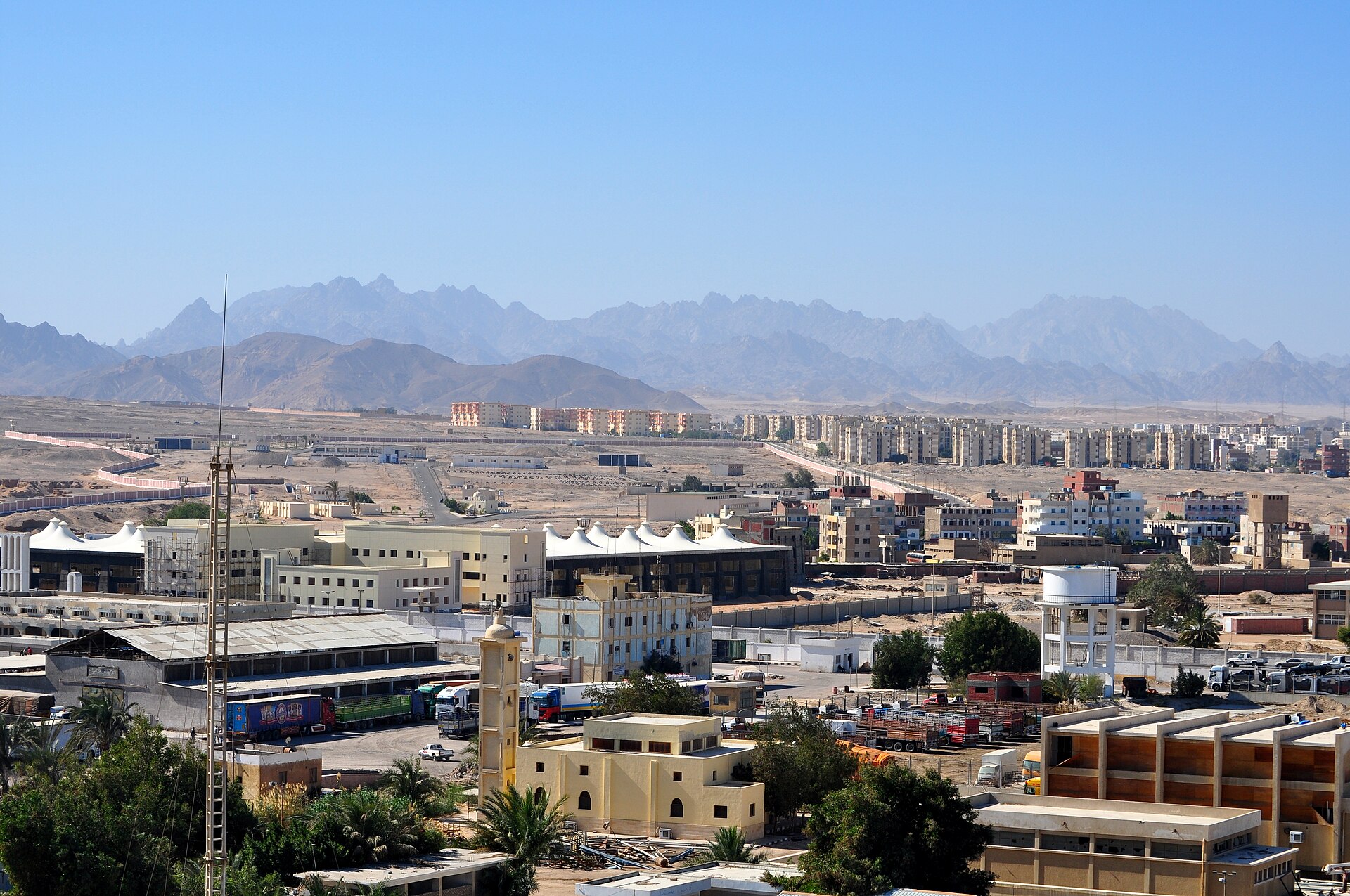
“Images from Safaga No 1..JPG” — photo by Badics — CC BY-SA 3.0 — source: Wikimedia Commons.
Rethinking Safaga: Why the Red Sea port build-out matters far more than the ‘ONE terminal’ narrative
Safaga is often reduced to a simplistic headline: sometimes it is described as a “ONE terminal”, sometimes as a “Chinese port project”. The cleaner primary sources tell a much more interesting story. At its core, this is a multipurpose port development led by AD Ports Group and Noatum, positioned as the first internationally operated terminal serving Upper Egypt and embedded in a much wider Red Sea infrastructure transformation.
The key question, therefore, is not which shipping line gets mentioned most often on social media, but how Safaga is being integrated into a new corridor that combines port infrastructure, rail, roads, mining, industry, and export logistics. If you read Safaga only as another quay project, you miss the strategic point. If you read it as part of the “Grand Safaga Port” concept and the Safaga–Qena–Abu Tartour corridor, its relevance for industry, mining, breakbulk and container flows in Upper Egypt becomes much clearer.
The core project: not an exclusive liner terminal, but an AD Ports / Noatum multipurpose gateway
The cleanest primary sources frame the project as the “Safaga Multipurpose Terminal” or “Noatum Ports – Safaga Terminal” under AD Ports Group. AD Ports first signed the 30-year concession in March 2023, followed by the definitive concession agreement in December 2023 after Egyptian approval. From an investor perspective, that matters because it provides both political intent and legal confirmation.
The technical profile is also remarkably consistent across operator, builder and financing sources: roughly 810,000 square metres, 1,000 metres of quay, annual capacity for 450,000 TEUs, 5 million tonnes of dry bulk and general cargo, 1 million tonnes of liquid bulk, and Ro-Ro facilities for around 50,000 vehicles per year. The supporting scope includes workshops, warehouses, authority buildings, roads, utilities and security systems. In other words, Safaga is not being built as a pure container quay. It is being designed as a genuine multipurpose terminal with a broad cargo mix.
That cargo logic matches the hinterland. Noatum’s own presentation highlights export flows such as phosphate, animal feed, fertilizers, perishables, dry foodstuff and cement; on the import side it points to petrochemicals, paper, FMCG and other consumer goods. Safaga should therefore be read not simply as a maritime point on the map, but as an attempt to connect Upper Egypt to global markets through a modern, internationally operated Red Sea gateway.
Bigger than the terminal itself: Safaga as part of the Safaga–Qena–Abu Tartour corridor
The real strategic logic starts beyond the terminal fence. Egyptian government sources explicitly connect “Safaga 2” and the “Grand Safaga Port” concept with the broader Safaga–Qena–Abu Tartour logistics corridor. The objective is to link production areas, mining zones and industrial clusters in Upper Egypt much more directly to the Red Sea, shortening export and import routes for the region. That is highly relevant for phosphate, building materials, industrial goods and, increasingly, containerized cargo linked to the Golden Triangle and Upper Egypt industrial development.
This also helps explain why public figures appear inconsistent. AD Ports, Noatum, Hassan Allam and IFC are highly consistent on the concession project itself: 810,000 square metres, 1,000 metres of quay and 450,000 TEUs. Egyptian transport ministry materials under the “Safaga 2” label, by contrast, mention around 776,000 square metres, 1,100 metres of quay, a depth of 17 metres, and—depending on the publication—between 500,000 and 2 million TEUs plus roughly 7 million tonnes of general cargo. The most plausible reading is that these sources are referring to the same broader build-out at different planning stages, or to different editorial summaries of the wider Safaga development complex. For decision-makers, the implication is straightforward: the AD Ports / Noatum numbers remain the cleaner investor-grade reference point, while the government sources are especially useful for understanding the larger corridor strategy.
Hinterland access is where the project becomes strategically compelling. Noatum compares road distances from Safaga to inland cities such as Qena, Sohag, Asyut, Minya, Aswan, Toshka and Oweinat against the corresponding distances from Sokhna, showing a clear advantage for large parts of Upper Egypt. This is reinforced by the existing freight rail connection and the planned third high-speed / fast freight line toward Qena, Hurghada and Safaga. In projects like this, value is not created only at the quay; it is created in the interaction between sea, rail and road. We are active in an advisory role here—especially in port infrastructure and automated truck processing.
What is Chinese here — and what is not
Because Safaga is frequently associated with Ocean Network Express (ONE) or Chinese operators in market chatter, it is worth separating evidence from shorthand. ONE’s official Egypt page lists regular Egyptian ports as Damietta, Sokhna, Port Said and Alexandria. Safaga does not appear there. That does not mean Safaga cannot be used by multiple lines in the future; it does mean that the often-repeated story of an already established or exclusive “ONE terminal” is not supported by the cleanest public sources.
The same applies to the Chinese angle. The clearest, verifiable Chinese role in Safaga today is on the equipment side: in March 2025, AD Ports announced the planned delivery of three ship-to-shore cranes from Shanghai Zhenhua Heavy Industries (ZPMC), along with six hybrid RTGs for the Safaga project. That is a substantial and very real Chinese link—but it is an equipment and supply-chain role, not a clearly documented exclusive operator or liner role. Public COSCO materials relating to Egypt point much more directly to Ain Sokhna than to Safaga. Anyone trying to assess Safaga accurately should therefore read it first and foremost as an AD Ports / Noatum project with Egyptian state embedding, not as the private terminal of one shipping line or as a “Chinese terminal” in the strict sense.
Where the real competitive edge will be won: superstructure, gate processes, and automated truck handling
Official documents naturally focus on quay length, draft and cranes. That is understandable, but it is not enough to explain future competitiveness. The real next productivity leap in Safaga will be decided on the landside interface: pre-arrival data, OCR and license-plate recognition, weighbridges, appointment systems, truck routing, yard allocation, customs integration and the overall speed with which trucks can move through the port. For a corridor project that aims to serve Upper Egypt, truck processing is not a side issue—it is central to the business case.
This is where the financing narrative becomes relevant. IFC explicitly links the project to sustainability and emissions reduction, pointing to electrified container-handling equipment and potential emission reductions of almost 50,000 tonnes of CO2e annually, partly through more efficient operations and a modal shift away from road-only logistics. That means automation in Safaga is not only about speed. It is also about energy intensity, reliability and environmental performance.
From our perspective, this interface is exactly where projects are won or lost. Between crane delivery and full commercial launch, the decisive frictions are often found in the “small” process points: truck congestion at the gate, weak slot control, unclear yard-routing logic or poor coordination between port systems and inland transport. That is precisely why we are active in an advisory role here—especially in port infrastructure and automated truck processing.
What decision-makers should watch now
For investors, users and infrastructure partners, four themes matter most.
First, the timetable. Public documentation clearly shows that target dates have shifted. AD Ports materials at one stage pointed to Q2 2025, later H2 2025, then Q3 2026 and subsequently H2 2026, while Noatum’s June 2025 presentation still referred to a May 2026 soft go-live and June 2026 full operational readiness window. That is not unusual for greenfield infrastructure, but it does mean that “go-live”, “operations trials”, “readiness” and “commercial launch” should not be treated as the same milestone.
Second, the actual superstructure. Official material consistently points to three ship-to-shore cranes and six hybrid RTGs; the Noatum presentation further specifies three super-post-panamax STS cranes and an 18-metre draft. That suggests a robust but initially focused terminal set-up, with scope to expand once volumes and service patterns are established.
Third, the real performance of the hinterland corridor. The project becomes truly strategic only if the Safaga–Qena–Abu Tartour corridor functions in practice—meaning rail, roads, customs, warehousing and industrial land all work together. Fourth, the market side. Safaga will only become a strategic Red Sea gateway if miners, manufacturers, project logisticians and shipping lines actually begin to use it as an operational alternative—not simply as a future headline.
That is why the real question is not “who is building whose terminal?”, but whether Safaga can become a credible export and import corridor for Upper Egypt. If it can, Egypt will gain more than another quay wall. It will gain a new industrial and logistics gateway on the Red Sea.
Conclusion
Safaga is more strategically important than the simplified debate around ONE, COSCO or “Chinese participation” suggests. The primary sources point to a project led by AD Ports and Noatum, deeply embedded in Egypt’s wider port and corridor strategy. The terminal itself matters, but the real leverage lies in how it connects the Red Sea to Upper Egypt’s mining, industrial and logistics base. That is what will determine whether Safaga becomes a genuine gateway rather than just another terminal project. And that is exactly why we are active in an advisory role here—especially in port infrastructure and automated truck processing.
Sources
1. AD Ports Group (18 March 2023): AD Ports Group signs a 30-year Concession Agreement to Develop and Operate Safaga Port in Egypt
https://www.adportsgroup.com/en/news-and-media/2023/03/18/ad-ports-group-signs-a-30-year-concession-agreement-to-develop-and-operate-safaga-port-in-egypt
2. AD Ports Group (27 December 2023): AD Ports Group and RSPA Sign Definitive Concession Agreement to Develop and Operate Multipurpose Terminal in Safaga Port
https://www.adportsgroup.com/en/news-and-media/2023/12/27/adpg-and-rspa-sign-agreement-to-develop-and-operate-multipurpose-terminal-in-safaga-port
3. Hassan Allam Construction (18 December 2024): AD Ports Group appoints Egypt’s Hassan Allam Construction to build Noatum Ports – Safaga Terminal infrastructure
https://www.hassanallam.com/news/ad-ports-group-appoints-egypts-hassan-allam-construction-to-build-noatum-ports-safaga-terminal-infrastructure
4. Noatum Ports (June 2025): Noatum Ports Safaga Terminal Presentation (PDF)
https://www.noatumports.com/media/pdf/noatum-ports-safaga-terminal_presentation-2025-adpg.pdf
5. AD Ports Group (4 March 2025): AD Ports Group prepares to receive state-of-the-art Panamax-class cranes for new multipurpose cargo terminal in Safaga, Egypt
https://www.adportsgroup.com/en/news-and-media/2025/03/04/ad-ports-group-prepares-to-receive-state-of-the-art-panamax-class-cranes-in-safaga
6. IFC (3 February 2026): IFC Supports Port Development in Egypt to Boost Trade and Create Jobs
https://www.ifc.org/en/pressroom/2025/ifc-supports-port-development-in-egypt-to-boost-trade-and-create-jobs
7. AD Ports Group (3 February 2026): AD Ports Group secures USD 115 million financing led by IFC and NBK – Egypt to advance Safaga Terminal in Egypt
https://www.adportsgroup.com/en/news-and-media/2026/02/03/ad-ports-group-secures-usd-115-million-financing-to-advance-safaga-terminal-in-egypt
8. Maritime Transport & Logistics Sector / Egypt (21 August 2025): Get to know more about Safaga 2 multipurpose terminal at Safaga seaport
https://www.mts.gov.eg/en/%D8%AA%D8%B9%D8%B1%D9%81-%D8%B9%D9%84%D9%89-%D8%A7%D9%84%D9%85%D8%AD%D8%B7%D8%A9-%D9%85%D8%AA%D8%B9%D8%AF%D8%AF%D8%A9-%D8%A7%D9%84%D8%A3%D8%BA%D8%B1%D8%A7%D8%B6-%D8%B3%D9%81%D8%A7%D8%AC%D8%A7-2-%D8%A8/
9. Maritime Transport & Logistics Sector / Egypt (27 September 2025): Transport ministry: implementing a comprehensive plan for Egyptian ports’ development and the giant project 'Safaga2'
https://www.mts.gov.eg/en/%D9%88%D8%B2%D8%A7%D8%B1%D8%A9-%D8%A7%D9%84%D9%86%D9%82%D9%84-%D8%AA%D9%86%D9%81%D9%8A%D8%B0-%D8%AE%D8%B7%D8%A9-%D8%B4%D8%A7%D9%85%D9%84%D8%A9-%D9%84%D8%AA%D8%B7%D9%88%D9%8A%D8%B1-%D8%A7%D9%84%D9%85/
10. Maritime Transport & Logistics Sector / Egypt (March 2026): Expansions in Safaga port… new terminal supporting transit trade and Upper Egypt development
https://www.mts.gov.eg/en/%D8%AA%D9%88%D8%B3%D8%B9%D8%A7%D8%AA-%D8%A8%D9%85%D9%8A%D9%86%D8%A7%D8%A1-%D8%B3%D9%81%D8%A7%D8%AC%D8%A7-%D9%85%D8%AD%D8%B7%D8%A9-%D8%AC%D8%AF%D9%8A%D8%AF%D8%A9-%D8%AA%D8%AF%D8%B9%D9%85-%D8%AA/
11. Ocean Network Express – Egypt page: regular global services calling at 4 Egyptian seaports
https://eua.one-line.com/tab-page/egypt
12. COSCO SHIPPING Lines – Egypt / Sokhna branch contact page
https://lines.coscoshipping.com/home/Contact/global/countryList/more/Africa/Egypt/Sokhna/50000000000000299
13. COSCO SHIPPING Ports / COSCO SHIPPING annual reporting referring to Ain Sokhna investment in Egypt (PDF)
https://en.hold.coscoshipping.com/cms_files/filemanager/1664/attach/20251/776721A97DAF55063094174719455E0D.pdf
14. AD Ports Group Q1 2024 Earnings Presentation (Safaga operational timing Q2 2025 in then-current outlook, PDF)
https://www.adportsgroup.com/-/media/sites/adports/investors/adpg-earnings-presentation-q1-2024.pdf?rev=-1
15. AD Ports Group Q3 2024 Earnings Presentation (Safaga expected start of operations H2 2025, PDF)
https://www.adportsgroup.com/-/media/sites/adports/investors/adpg-earnings-presentation-q3-2024.pdf?rev=-1
16. AD Ports Group Q2 2025 Earnings Presentation (Safaga target launch Q3 2026, PDF)
https://www.adportsgroup.com/-/media/sites/adports/investors/2025/downloads/adpg-earnings-presentation-q2-2025.pdf?rev=-1
17. AD Ports Group Q4 2025 Earnings Presentation (Safaga target launch H2 2026, PDF)
https://www.adportsgroup.com/-/media/sites/adports/investors/2025/downloads/adpg-earnings-presentation-q4-2025.pdf?rev=-1