
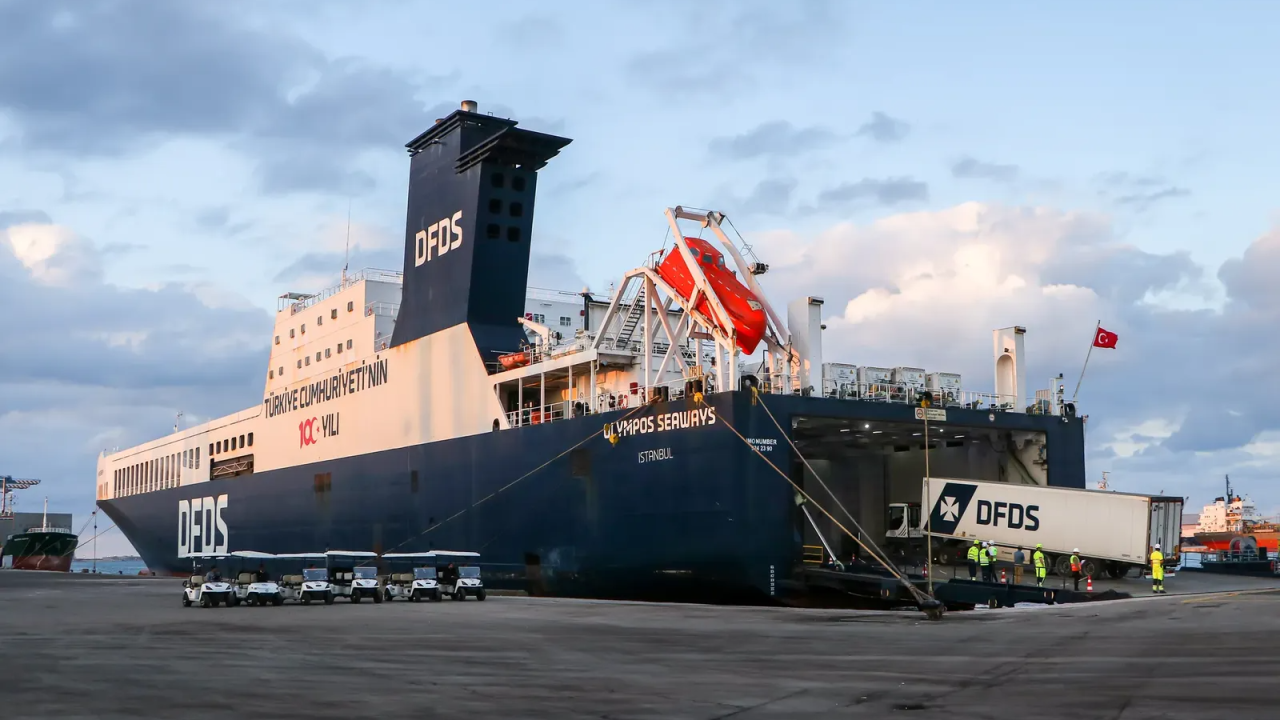
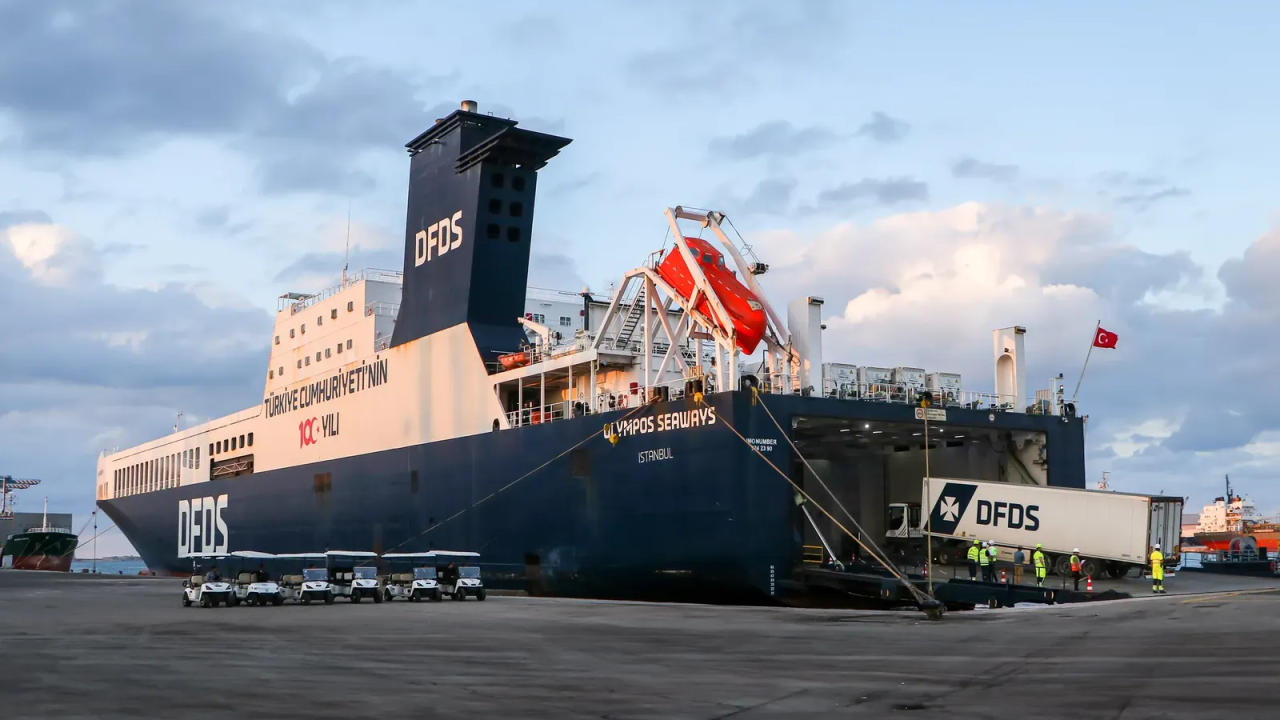
© Kamel Tarek Lizenz: CC-BY SA 3.0 Source: marinetraffic.com
RoRo Trailer Damietta–Trieste: When speed is of the essence
 Raphael Defaudais
The RoRo trailer route Damietta → Triest is the best choice if you prioritize door-to-door speed, minimal handling and maximum process control. It plays to its strengths when:
· material is time-critical (production ramp-up, spare parts in large units, serial supply with tight cadence),
· damage/loss from frequent rehandling must be minimized at all costs,
· you want an end-to-end trailer (factory pick-up → port → ship → Europe → delivery) – with a tractor swap, but without rehandling the cargo,
· and you are willing to run the customs/document process very disciplined (especially if you don’t want to “burn” EUSt liquidity).
On this lane, a round-trip service between Damietta and Triest with a transit time of about 68 hours is described. That is a massive lever: in practice, RoRo can be the difference between “the material still arrives in time for assembly” and “the line stops”.
What RoRo means here in concrete terms and why it’s faster
RoRo (roll-on/roll-off) means: the transport unit (trailer, possibly also mafi roll trailers/units) rolls onto the ship and rolls back off. There is no classic container handling with a crane, no stuffing/stripping in the port CFS, no container repositioning and significantly fewer “hand-offs”.
The core advantage for German companies
If you are a German industrial company sourcing/producing in Egypt and delivering into Europe, you often have three hard goals at the same time:
1. Time (delivery windows, production supply)
2. Integrity (quality, claims rate)
3. Predictability (when is the truck really at the gate?)
In many cases, RoRo is the cleanest middle ground: you buy speed through minimal handling and reduce variance in the damage statistics because far fewer people physically touch the cargo.
Typical RoRo units used in the market
· Standard semi-trailer (curtainsider/tarpaulin trailer) for industrial goods
· Reefer trailer (refrigerated trailer) for temperature-controlled goods
· Flat/platform units or mafi roll trailers for out-of-gauge/heavy-lift (e.g. long parts, machine components)
Important: RoRo is often not optimized in “cents per kg”, but in delivery capability. That is crucial for cost comparisons: a transport that seems expensive can be the cheaper one if it prevents production downtime.
Route in practice: step-by-step from Cairo to
Southern Germany
Starting point: pick-up at a factory in the Cairo area, start at the plant, destination area e.g. Southern Germany.
Step 1: Pick-up planning at the plant
RoRo is only as fast as your pre-carriage. The most common time losses happen not at sea, but:
· truck arrives late at the plant (missing slots, driver dispatching, security releases)
· cargo is not ready for pick-up (packing/palletizing/export release)
· documents are missing (commercial invoice, packing list, export customs clearance)
Practical tip: If onward transport in Europe is done with your own truck: lock in loading slots very early, then actively remind 48h / 24h / 6h beforehand. RoRo lives on cadence; a missed slot can quickly cost you a whole cycle (or expensive waiting time).
Step 2: Trailer setup and load securing
With RoRo, the cargo is often traveling “in the trailer”. That’s good – but only if it is loaded RoRo-ready:
· clean weight distribution (axle loads, center of gravity)
· sufficient lashing points, straps, anti-slip and edge protection
· for sensitive goods, shock/vibration protection is recommended
Why this matters: RoRo ships work with ramp movements, acceleration/braking forces and sometimes higher micro-vibration than a quiet container stow. If your cargo gets damaged in the trailer, the damage often only shows up in Europe – and then it becomes expensive and contentious.
Step 3: Export process in Egypt and gate-in in Damietta
In Damietta, the rule is: pre-advise early, observe cut-offs, and provide the documents cleanly to the agent/carrier. On this route, Pan Marine is named as the agency in Damietta.
Step 4: Sea transport Damietta → Triest
For this stretch, a service with ~68h transit time is described. The schedule is typically weekly; one example in a published schedule lists departure Friday and arrival Monday (times can rotate – so always pull the current weekly plan).
Why this is so strong: you get a sea leg that feels more like an “extended land transport”: short passage, little buffer needed, fast ability to react.
Step 5: Arrival/clearance in Triest and terminal process
In Triest, RoRo runs through terminal structures that are linked, among others, with Samer; Samer Co. is named as contact/agent on this route. The terminal operator describes RoRo connections that also include Damietta.
Practical relevance: RoRo terminals are fast – but “fast” means: documents must match exactly, otherwise you are stuck. That is not a “Triest problem”, it’s a RoRo system feature: throughput is high, mistakes are not simply “parked away”.
Step 6: Tractor swap and onward transport in Europe
From Triest, a European tractor unit (or your own carrier) takes the trailer towards the destination. This is a central benefit of RoRo:
· Cargo stays in the trailer
· no rehandling
· lower damage risk
· very fast onward-leg organization, if you work with a strong partner
Cost picture: why “EUR 5,000 door-to-door” can be realistic
– and when not
You mentioned a practical value: ~EUR 5,000 door-to-door for certain setups. That is plausible as an order of magnitude, but RoRo costs fluctuate strongly depending on:
· trailer type (curtainsider, reefer, ADR-capable)
· pre-/onward-leg kilometers (Egypt & EU)
· season/peak surcharges, capacity, equipment scarcity
· waiting time/standing charges, weekend handling
· documentation and customs broker costs
· additional services (e.g. timed delivery, time windows, night driving)
A useful way of thinking for decision-makers
Instead of comparing only “transport price”, always calculate RoRo as:
· risk/damage costs (probability × impact)
· supply chain costs (expediting surcharges, buffer inventories, line stoppage)
· cashflow costs (EUSt pre-financing, tied-up capital)
RoRo often looks “more expensive”, but wins in the real business case if you are buying delivery capability.
Customs and tax logic: which procedures fit
Triest – and what does that mean for cashflow
This is where the biggest difference lies between “the route runs great” and “the route turns into a cashflow trap”.
The basic principle: where does the cargo become “Union goods”?
When goods come from Egypt, they are non-Union goods upon entry into the EU. They only become “Union goods” when they are cleared in the EU for release for free circulation. After that, they can generally move freely – but the question is: In which country do you do this release – and how do you handle EUSt?
Procedure 40 00 in Italy: straightforward to “do”, but cashflow-intensive
Procedure 40 00 (release for free circulation) is the “classic import”:
· customs duties may be due (depending on tariff & preference)
· import VAT (EUSt) is due in the country of import
EU customs describes the purpose of release for free circulation as the procedure that fulfills all import formalities and gives non-Union goods Union status.
Advantage
· Process-wise often straightforward: you import where you arrive.
Disadvantage in our practical example
· import VAT pre-financing in Italy can tie up liquidity, especially with high value density.
· Reclaiming import VAT can take time (in practice, companies sometimes report long lead times; in extreme cases 12–18 months). That is less the “rule”, but a real risk in cashflow management.
When is it still sensible?
· If you have low goods values.
· If you already have a stable tax structure in Italy anyway.
· If the alternative (T1/42) is more complex/riskier in your setup.
Procedure 42 00 in Italy: strong for cashflow, but setup-sensitive
Procedure 42 (often referred to as 42 00/4200) is essentially: you import into EU country 1, without paying import VAT there, because the goods are immediately moved into another EU country and treated there as an intra-Community acquisition (if all conditions are met). The European Commission describes the underlying logic as a VAT exemption at import when the subsequent supply/movement is a VAT-exempt intra-Community supply/movement – under conditions, including evidence of the intent to transport and the indication of VAT IDs.
“Customs Procedure 42” is also described in EU documentation as a regime to obtain a VAT exemption when goods are transported onward into another Member State.
Advantage
· Massive cashflow lever: no (or significantly reduced) import VAT pre-financing in the import country.
Why Italy is often experienced as “difficult” here
Legally, the principle is anchored EU-wide. In practice, it often fails on setup details:
· Who is the importer of record?
· Is there a clean VAT chain (VAT ID, intra-Community supply, evidence)?
· Is an Italian VAT registration or fiscal representation required and implemented cleanly?
· Are transport proofs and documentation exact?
If your setup is not 100% clean, 42 in Italy is often not the route where you “just run quickly on the side”. For RoRo speed this is dangerous: a document problem destroys the time advantage.
Practical recommendation: Use 42 in Italy only if you:
· have a very experienced customs broker,
· the VAT structure (liability/importer role) is crystal clear,
· and you have the evidence chain (especially onward transport) under process control.
Alternative: T1 transit to Germany and clear customs there
If Italy is too risky for 42, the practical workaround is often T1 (external transit procedure): the goods remain non-Union goods until clearance in Germany. The EU describes Union transit as a procedure for transit movements within the EU, especially relevant for non-Union goods. In a quick info, “External transit (T1)” is described as generally applicable to non-Union goods.
Advantage
· You move the customs process into your “home processes”: German broker, German compliance, German accounting.
· You can manage EUSt payment more predictably in Germany.
Cashflow point: deferment account and EUSt due date
German customs administration describes that with approved payment deferment, EUSt is only due on the 26th of the second month following the clearance. That is a real liquidity advantage compared to “pay immediately”.
Important: T1 is not a “magic trick”, but a procedure with obligations: NCTS processing, security/guarantee logic, deadlines, correct discharge at the customs office of destination. In return, you get control.

Preference and EUR.1: why the original document is a critical path for RoRo
What EUR.1 gives you
If your goods meet the preference rules (EU–Egypt context), you can use duty advantages. In the context of the Pan-Euro-Med rules, the EU describes that a preference proof can be provided, among other things, via EUR.1/EUR-MED. The PEM context is also explained by the European Commission, and the EU lists the EU–Egypt trade relationship within the association structures.
Why “the original must travel with the ship” is so important in practice
With RoRo you gain time – but only if the documents run in sync.
Practical tip for our example:
· Original freight documents and EUR.1 often need to be available in a way that the broker in Triest does not have to work “on speculation”.
· At the same time, you want to send advance scans (or copies) to the broker so they can prepare clearance while the originals are still in transit.
What you should make of this organizationally
· Request the bill of lading draft very early.
· As soon as the trailer/unit is gate-in or export is running, trigger the document countdown: EUR.1 issuance, courier run, broker pre-check.
· Plan for weekends/holidays, especially if Friday departure and Monday arrival is the pattern.
The terminal factor Triest: fast, but strict
Triest is a strong RoRo node. Samer describes RoRo connections, including to Damietta, and also mentions terminal resources such as reefer plugs. In the carrier route info, Triest is named as a European gateway and the agency roles (Triest: Samer, Damietta: Pan Marine) are explicitly listed.
What this means for your practice
· Document quality is essential, because it is a cost driver.
· As soon as customs/terminal start asking questions, the clock is ticking: dwell times, additional handling, onward-leg shifts.
· If you use RoRo as premium speed, you need a direct contact person who can really take action in the port. That is typically a well-connected partner (e.g. Pan Marine on the Egyptian side, and a strong broker/agent on the Italian side).
Risk profile and proven practical tips
Risk 1: Customs and document hold eats the time advantage
Symptom: Trailer is in Triest, but no release. Causes: missing originals, inconsistent values/lines, unclear importer role, 42 setup not clean. Countermeasures:
· Use the document checklist (see below) as a “gate”: no departure without a complete file.
· Involve the broker in advance with a scan set.
· For 42: dry-run the VAT chain before the first shipment (test import).
Risk 2: Cashflow shock from EUSt
Symptom: Import works, but finance gets pressure: “Why do we have to pay so much EUSt immediately now?” Countermeasures:
· Decide early: 40 in Italy, 42 in Italy, or T1 → DE.
· If clearing in DE: check whether payment deferment/deferment account makes strategic sense (EUSt due later).
· If importing in Italy: factor EUSt liquidity cleanly (working-capital costs).
Risk 3: Pre-carriage in Egypt is the hidden bottleneck
Even the fastest sea leg loses against:
· missing pick-up slots
· “cargo not finished yet”
· missing export release
Countermeasures:
· Pick up only when cargo is physically ready + packing list final.
· Confirm loading windows in writing, remind multiple times.
· “Golden rule”: no cut-off day without a status call.
Risk 4: Load securing and packaging
With trailer loading, packaging is often underestimated.
Countermeasures:
· Define a standard packing instruction (pallet quality, lashing concept, photo documentation).
· For sensitive goods: shock logger or tilt indicator as a learning tool for the first shipments.
Risk 5: Schedule changes and seasonal bottlenecks
Even a good service is not immune to:
· weather, port congestion, holidays
· capacity shifts
Countermeasures:
· Always use the “weekly sailing schedule” as the single source of truth.
· For critical projects: define plan B (e.g. alternative entry points such as Koper/Rotterdam – covered in detail in the other route articles).
Alternative to Italy: RoRo towards Koper via
Grimaldi
RoRo options towards the Adriatic entry point Koper are also offered in the market (including references to Grimaldi). Pricing can be similar, but depending on rotation/port calls they can have significantly longer transit times (e.g. by ~12 days). The recommendation here is to always verify the current sailing plan directly with carrier/agent for reliable planning. If you want speed, Damietta–Triest remains the faster route in your setup. Koper RoRo is more of a “less hectic” Adriatic entry if Triest slots are unfavorable at the moment or if you deliberately want to use the Koper customs/hinterland logic.
Documents and data: a practical checklist
Must-have documents (almost always)
· Commercial invoice (clean Incoterms, values, currency, delivery terms)
· Packing list (weights, packages, dimensions, goods description)
· Transport documents (RoRo B/L or sea waybill depending on setup, CMR for pre-/onward leg)
· Export documents Egypt (depending on goods/regulation)
· EORI/VAT info of the importer (EU)
If preference is to be used
· EUR.1 / EUR-MED original (or permitted alternative such as statement on origin depending on status/rules)
Procedure-specific
· For 42 00: evidence/info for VAT exemption at import and onward transport (VAT IDs, proof-of-dispatch setup, etc.)
· For T1: NCTS data, security/guarantee setup, clear customs office of destination
Conclusion on the route from Damietta to Triest
Choose this route if:
· you need maximum speed with minimal handling,
· you want to run the trailer end-to-end,
· you steer documentation proactively (instead of “cleaning up afterwards”),
· and you choose the customs path so that it fits your cashflow:
The most important sentence for decision-makers: RoRo does not win because it’s cheap – but because it buys delivery capability.
Sources
1. DFDS – Route Damietta–Triest (transit time ~68h, schedule, agents Pan Marine/Samer) https://www.dfds.com.tr/ro-ro/en/4/damietta-trieste/3733
2. Samer Seaports & Terminals – RoRo Terminal Triest, connection overview (incl. Damietta) https://www.samerseaports.com/ro-ro-terminal/
3. European Commission – Release for free circulation https://taxation-customs.ec.europa.eu/customs/customs-procedures-import-and-export/what-importation/free-circulation_en
4. European Commission – VAT exemptions, Article 143(1)(d) logic (import with subsequent intra-Community supply/movement) https://taxation-customs.ec.europa.eu/taxation/vat/vat-directive/vat-exemptions/other-exemptions_en
5. European Court of Auditors – “Customs procedure 42” as VAT exemption regime for onward transport into another Member State https://www.eca.europa.eu/lists/ecadocuments/sr11_13/sr11_13_en.pdf
6. European Commission – Union transit (basics) https://taxation-customs.ec.europa.eu/customs/customs-procedures-import-and-export/what-customs-transit/union-and-common-transit_en
7. European Commission – Customs Transit Quick Info (T1 basic logic for non-Union goods) https://taxation-customs.ec.europa.eu/system/files/2019-03/11_taxud_ucc_customs_transit_quick_info_en.pdf
8. German customs administration – Payment deferment and EUSt due date (26th of second following month) https://www.zoll.de/DE/Fachthemen/Zoelle/Abgabenerhebung/Zahlung-der-Abgaben/Mit-Zahlungserleichterung/mit-zahlungserleichterung_node.html
9. EU Access2Markets – Pan-Euro-Med Rules of Origin, preference proof via EUR.1/EUR-MED https://trade.ec.europa.eu/access-to-markets/en/content/rules-origin-pan-euro-mediterranean-convention
10. European Commission – Pan-Euro-Med cumulation & PEM Convention (context) https://taxation-customs.ec.europa.eu/customs/international-affairs/pan-euro-mediterranean-cumulation-and-pem-convention_en
11. European Commission – EU trade relations with Egypt (trade framework) https://policy.trade.ec.europa.eu/eu-trade-relationships-country-and-region/countries-and-regions/egypt_en