
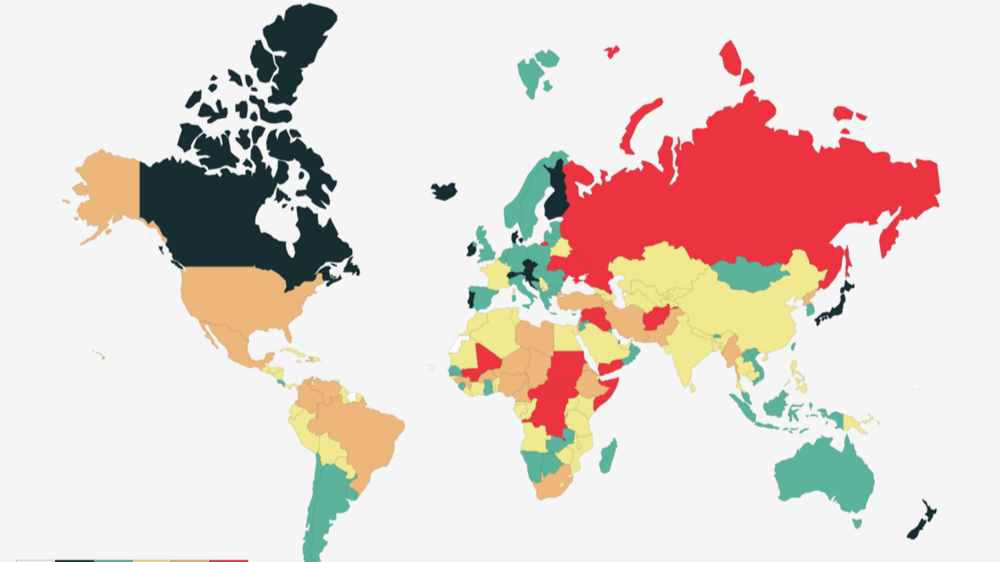
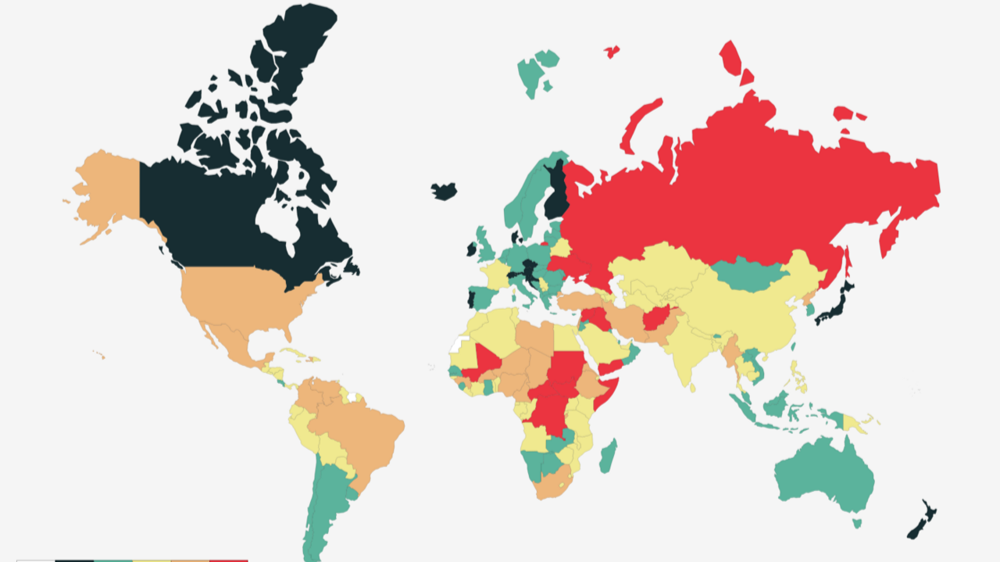
Weltkarte des Global Peace Index – Visualisierung der Friedens- und Sicherheitsrankings weltweit © Arthur123lol, CC BY-SA 4.0, via Wikimedia Commons
Security in Egypt – The remarkable rise in the security ranking
 David Weber
Dramatic improvement according to the Global Peace Index
Egypt has made an unprecedented leap in international security rankings in recent years. This is particularly evident in the Global Peace Index (GPI) of the Institute for Economics & Peace.
Between 2014 and 2025, Egypt moved up 38 places in the overall ranking – from rank 145 to rank 107.
Even more impressive is the development of individual indicators: In the “violent crime” index (violent criminality), Egypt improved by 93 places and ranks 29th worldwide in 2025 (2014: rank 122).
This enormous improvement signals a clear decline in serious crime and a noticeably higher level of internal security. According to the IEP, Egypt thus became the “most improved country” in the GPI over the past decade.
Egypt also made a jump forward of 111 places in the Crime Perception Index (subjective sense of safety) – from 143rd (2014) to 32nd (2025).
This metric measures how safe people feel, for example when walking alone at night, and shows: from being one of the least safe countries in 2014, it became a country with one of the lowest levels of crime in 2025.
Other international benchmarks also confirm the trend. According to the Global Terrorism Index, the terrorism threat declined significantly – Egypt improved from 11th place (2014) to 29th place (2024).
In the WEF security index (World Economic Forum), Egypt climbed 63 places between 2015 and 2024. It is also remarkable that, according to the WEF, Egypt ranks 10th place worldwide in 2024 on the “Safety Walking Alone at Night” indicator – a sign of how strongly public confidence in safety and security has grown.
These broad improvements across various indices support the statement: Egypt is now as safe as it has not been for decades.
Causes: Stable conditions through state measures
The Egyptian government attributes this success to comprehensive security reforms and a consistent stabilization policy. Official bodies emphasize “continuous efforts to consolidate the foundations of security and strengthen social stability.” Security authorities – especially the Ministry of Interior – were modernized and upgraded in terms of personnel and technology.

Security experts highlight that the police have continuously updated their equipment and surveillance systems to keep pace with new forms of crime. Through the use of modern technology, improved training programs for police officers, and new deployment plans, crimes could be detected and prevented more quickly. “The ongoing development of security plans has played a central role in reducing crime rates and strengthening citizens’ sense of security,” explains General Amr al-Sharkawy, a former senior police officer.
Another success factor was the tough stance against terrorism, particularly in the Sinai region, and against extremist potential for violence within the country. Massive counter-terror operations and preventive security policy have led to Egypt suffering far fewer attacks today than it did ten years ago. The decline in the Global Terrorism Index clearly reflects this. President Abdel Fattah al-Sisi has received international recognition for this – even former US President Trump praised Sisi’s “tremendous achievement” in uniting the country and effectively allowing “almost no crime” anymore. The UK government also confirms in its travel advice Egypt’s “generally low crime rate” and notes that nearly one million British tourists visit the country each year – “mostly without incident.” Such voices underline the growing international confidence in Egypt’s security situation.
Last but not least, political stability and extensive state investments in order and development have contributed to this success. After the unrest of the early 2010s, calm returned relatively quickly under the current leadership. The consistent enforcement of the rule of law and extensive infrastructure projects (such as new transport routes, surveillance cameras in cities, modernization of neighborhoods) created an environment in which crime finds less fertile ground. According to government statements, the pursued policies “have led to a significant decline in crime rates and improved security indicators” – which in turn had “positive effects on development paths and confidence in the stability of the state.” In other words: security and economic development went hand in hand.
Relevance for investors and business decision-makers
For international companies and investors, this development is a decisive signal. Egypt was considered a higher-risk location during the political upheavals of 2011–2013. But now the tide has turned: the country is officially recognized as one of the safest and most stable nations in the region. In a MENA region shaped by conflict and uncertainty, Egypt stands out as a stability anchor. According to the Cabinet Media Center, Egypt has proven “that it can manage regional changes and preserve stability despite upheavals.” This also strengthens the confidence of international institutions in Egypt. Companies looking to expand in the region can now view Egypt very differently than just a few years ago: as an attractive investment location with manageable risk.

The improved security situation has a direct positive impact on the business climate. Investment projects can be planned and implemented more reliably in a safe environment. Supply chains and operating sites are less threatened by disruptions – an important factor, for example, for manufacturing and logistics, where stability determines success or failure. Tourism – a key sector of the Egyptian economy – also benefits enormously: tour operators are once again increasingly promoting Egypt as a safe travel destination, which is driving visitor numbers up. This creates new opportunities for hospitality, gastronomy, and the leisure economy, in which foreign investors can also participate.
In addition, the security progress sends psychological signals: international assignments are more likely to be considered by multinational corporations when the destination country is seen as livable and safe. Expatriates feel more comfortable in Cairo or Alexandria today than they did a few years ago, which increases Egypt’s attractiveness as a regional headquarters for companies. Some firms have already begun relocating offices for the Middle East market to Egypt – supported by the security gains and comparatively moderate location costs.
Also not to be underestimated is the image boost: Egypt’s rise from a former problem case in internal security to a country that, in relevant rankings, surpasses Western industrialized nations is a PR success. Government and business are actively promoting the new security status. In an official infographic campaign, the Cabinet emphasizes that the “created secure environment attracts investment and supports development.” This message is aimed specifically at international decision-makers and capital providers. Anyone seeking to expand in the MENA region is meant to place Egypt at the very top of the list.
Conclusion: Competitive and location advantage through security
Egypt has, within a decade, transformed from a hotspot of unrest into one of the safest countries in the Arab world. The statistics of the Global Peace Index 2025 and other institutions objectively demonstrate this progress. For business decision-makers, this is not just a numbers game, but a tangible criterion in location selection. Security means predictability – whether for production sites, for the deployment of skilled workers, or for the permanent establishment of regional headquarters. Egypt today offers a stable environment in which business risks are minimized and growth opportunities in a large domestic market are maximized.
Given geopolitical uncertainties in some other countries in the region, Egypt’s stable situation provides a competitive advantage. It is not surprising that, according to current rankings, Egypt is also gaining influence in other categories – for example, it was recently classified by CEOWORLD magazine as the most economically and politically influential nation in Africa and the Arab world in 2025. The foundation of this success lies in internal security. For potential investors, the message is clear: Egypt 2025 is a reliable partner. Anyone looking to develop the MENA region will find a location here that is not only culturally and demographically attractive, but now finally also offers the necessary security and stability to implement long-term business strategies.
Companies that bet on this trend early can benefit from Egypt’s new image and participate in the country’s next success story – in a market of around 100 million inhabitants and now an improved security profile that promises enormous potential. Egypt’s significant rise in the security ranking is therefore more than just a positive statistic – it is a call to action to examine and seize the opportunities of this “new Egypt” for one’s own expansion.
Sources:
1. Institute for Economics & Peace (IEP) (June 2025): Global Peace Index 2025 (Report, PDF) https://www.visionofhumanity.org/wp-content/uploads/2025/06/Global-Peace-Index-2025-web.pdf
2. Egypt Independent (12.12.2025): Egypt certified as one of the region’s safest and most stable nations https://www.egyptindependent.com/egypt-certified-as-one-of-the-regions-safest-and-most-stable-nations/
3. Businessmen Egypt (25.01.2026): Egypt #1 in regional influence, 29th globally in security https://www.businessmen-eg.com/en/3989/egypt-1-in-regional-influence-29th-globally-in-security
4. Youm7 (25.01.2026): مركز معلومات مجلس الوزراء: مصر تقفز 93 مركزاً فى مؤشر الجريمة العنيفة العالمى… https://www.youm7.com/story/2026/1/25/مركز-معلومات-مجلس-الوزراء-مصر-تقفز-93-مركزا-فى-مؤشر/7281204
5. Youm7 (25.01.2026): قفزة عالمية فى مؤشرات الأمن.. كيف نجحت الداخلية فى خفض معدلات الجريمة؟https://www.youm7.com/story/2026/1/25/قفزة-عالمية-فى-مؤشرات-الأمن-كيف-نجحت-الداخلية-فى-خفض-معدلات/7281606
6. Institute for Economics & Peace (March 2022): Global Terrorism Index 2022 (Report, PDF) https://www.visionofhumanity.org/wp-content/uploads/2022/03/GTI-2022-web-04112022.pdf
7. World Economic Forum (WEF) – Travel & Tourism Reports (selection, PDFs)
• Travel & Tourism Competitiveness Report 2015 (PDF): https://www3.weforum.org/docs/TT15/WEF_Global_Travel&Tourism_Report_2015.pdf
• Travel & Tourism Competitiveness Report 2019 (PDF): https://www3.weforum.org/docs/WEF_TTCR_2019.pdf
• Travel & Tourism Development Index 2021 (PDF): https://www3.weforum.org/docs/WEF_Travel_Tourism_Development_2021.pdf
• Travel & Tourism Development Index 2024 (PDF): https://www3.weforum.org/docs/WEF_Travel_and_Tourism_Development_Index_2024.pdf
8. UK Foreign Travel Advice (GOV.UK): Egypt – Safety and security (crime / security) https://www.gov.uk/foreign-travel-advice/egypt/safety-and-security
9. CEOWORLD magazine (09.12.2025): Revealed: The World’s Most Powerful Countries For 2025 (incl. methodology/142 countries) https://ceoworld.biz/2025/12/09/revealed-the-worlds-most-powerful-countries-for-2025/