
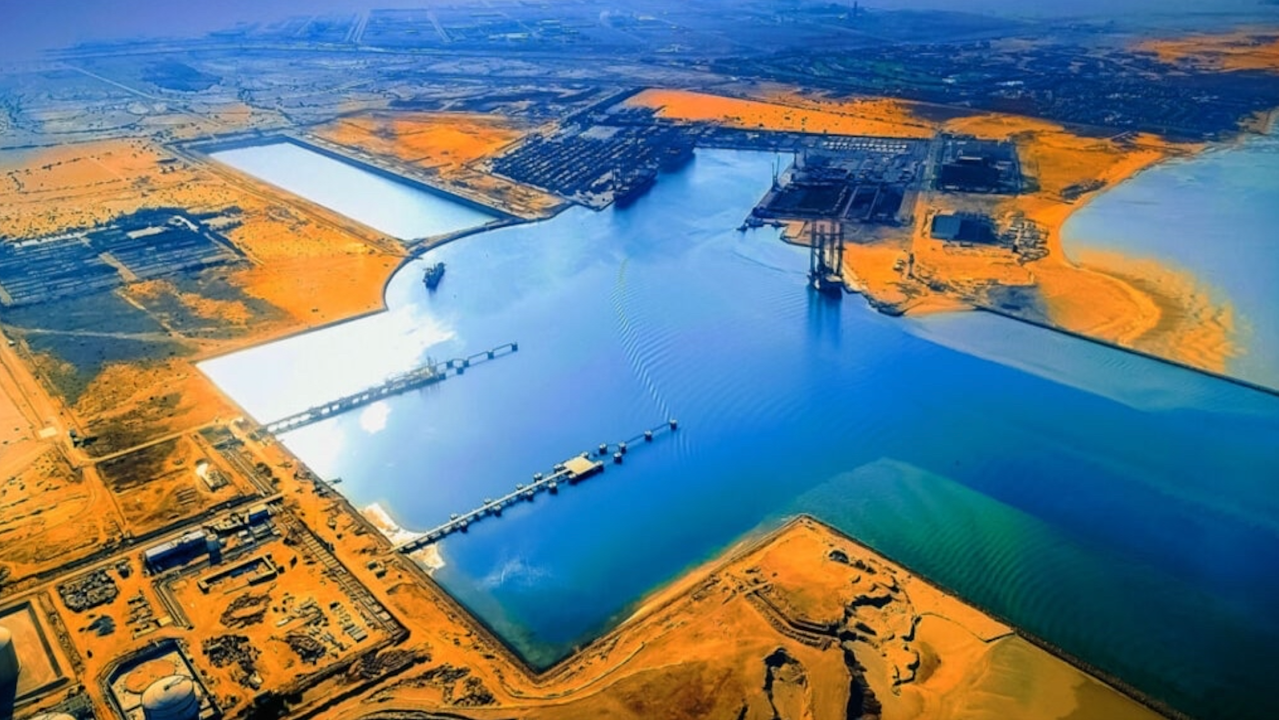
"Sokhna Port - SCZone areal.jpg" — SC Zone — Source: sczone.eg/media-gallery/#
Sokhna Port makes a statement: Egypt's first semi-automated container terminal is live
 David Weber
Egypt took an important step toward becoming a “Smart Port” in mid-January 2026:
In Sokhna on the Gulf of Suez, Red Sea Container Terminals (RSCT) officially opened the country’s first semi-automated container terminal. The project is backed by a 30-year concession and an international consortium consisting of Hutchison Ports, CMA Terminals (CMA CGM Group), and COSCO SHIPPING Ports.
Why is this exciting—not only for Egypt, but also for European shippers, freight forwarders, and carriers?
Because Sokhna is located exactly where the major trade flows converge: just a few kilometers from the southern entrance of the Suez Canal—one of the most critical chokepoints in global trade.
Egypt took an important step toward becoming a “Smart Port” in mid-January 2026:
In Sokhna on the Gulf of Suez, Red Sea Container Terminals (RSCT) officially opened the country’s first semi-automated container terminal. The project is backed by a 30-year concession and an international consortium consisting of Hutchison Ports, CMA Terminals (CMA CGM Group), and COSCO SHIPPING Ports.
Why is this exciting—not only for Egypt, but also for European shippers, freight forwarders, and carriers?
Because Sokhna is located exactly where the major trade flows converge: just a few kilometers from the southern entrance of the Suez Canal—one of the most critical chokepoints in global trade.
A location that can (almost) do it all: Gateway between Asia, Africa, and Europe
RSCT is embedded in the Suez Canal Economic Zone and is intended to act as a “gateway” accelerating the flow of goods between East and West—with road and rail connectivity as well as links to industrial clusters in the hinterland. In official statements, the terminal is positioned as a building block in Egypt’s national vision to further develop the country as a logistics and maritime hub.
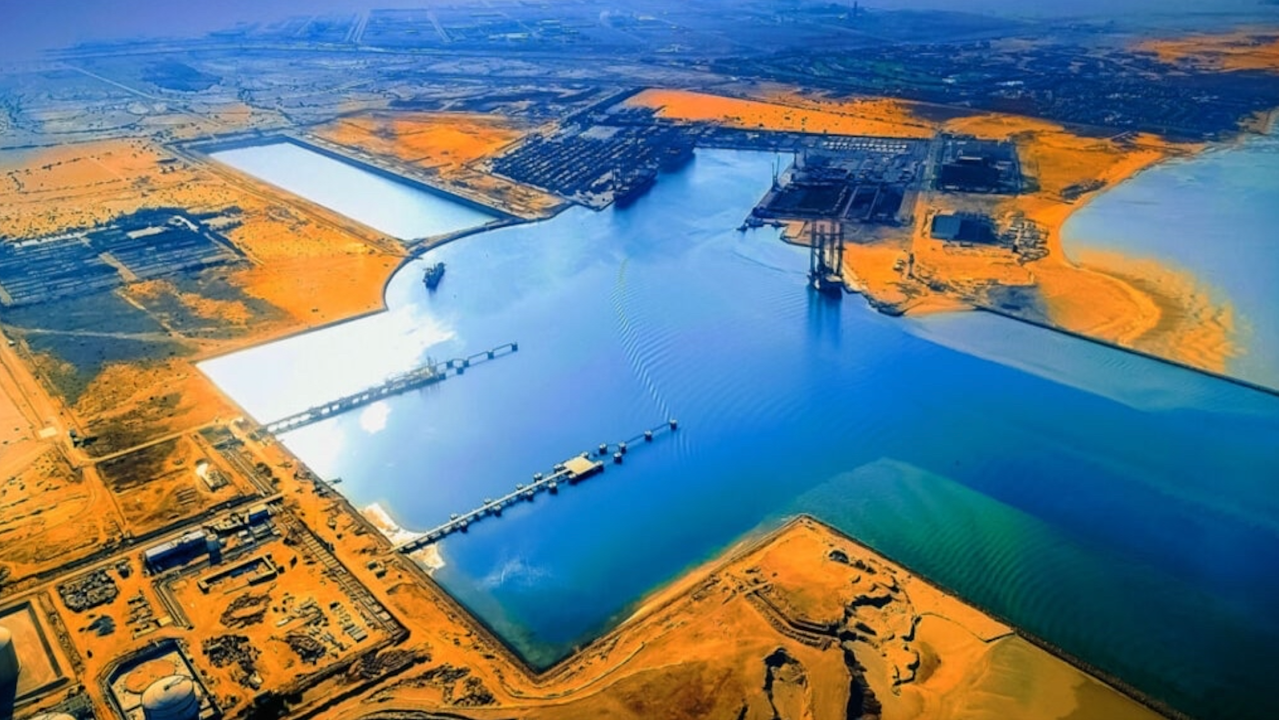
The port itself is also remarkable: according to Guinness World Records, the Sokhna Port Basin is the deepest artificial port basin in the world—a clear signal that the site is designed for large vessels and high capacities in the long term.
What exactly has been opened—and what technology is behind it?
In Phase 1, RSCT brings the following specifications according to published key figures:
- 1,200 meters of quay length
- 18 meters water depth
- Initial capacity: 1.7 million TEU per year
- Future expansion to 3.5 million TEU (with up to 2.6 km of quay length)
Technologically, RSCT relies on a semi-automated setup: remotely controlled ship-to-shore cranes, automated RTGs (Rubber Tyred Gantry Cranes), a terminal operating system for real-time tracking, and automated gate processes. The objective is clear: greater predictability, higher handling performance, fewer safety risks, and improved working conditions.
Also noteworthy is the “green” component: RSCT describes the use of fully electric handling equipment (including e-trucks and e-reach stackers) to reduce emissions. This is particularly relevant for large shippers that increasingly embed CO₂ reporting and “green logistics” requirements in tenders.
Which vessels are calling—and from where / to where?
For new terminals, the key question is often: Will there actually be traffic—and which services integrate the location into their networks?
For RSCT, there are already concrete, publicly documented calls:
1) Trial phase (soft opening) – December 2025
At the start of the trial operations, it was reported that the terminal began its first operations with the call of the CMA CGM Helium. Another report states that the CMA CGM Helium arrived from Singapore—a clear indication of integration into larger Asia / Red Sea routes.
2) Commercial start – 15 January 2026
According to the Egyptian Maritime Transport Sector (official government source), the start of commercial operations coincided with the arrival of the CMA CGM IRON, which entered from Beirut.
The CMA CGM IRON is also a 13,000 TEU newbuild and part of a new dual-fuel methanol series—an interesting side aspect where “green shipping” and “green terminal” intersect.
3) Short-sea / feeder movements – current AIS picture (examples)
Looking at AIS-based port data for Sokhna, typical regional rotations are also visible. For example, VesselFinder data (mid-January 2026) shows container ships operating between Aqaba (Jordan) and Sokhna, such as:
- KOTA SABAS: last port Aqaba, destination Sokhna
- ISTANBUL BRIDGE: last port Aqaba, destination Sokhna
- SSF VALENCE: last port Sokhna, destination Aqaba
Important: AIS port data refers to the Port of Sokhna as a whole (which includes several terminal areas). However, it clearly illustrates which trade lanes are actually being served in the region—and that Sokhna can function not only as a “Far East hub,” but also as a regional node.
4) Who is generally active in Sokhna?
Aggregated schedule data (based on planned frequencies) lists a wide range of carriers calling Sokhna, including COSCO, CMA CGM, Maersk, PIL, Wan Hai, X-Press Feeders, and others. This is not proof of exclusive RSCT calls, but it does indicate that the location is commercially present across many networks.
Does the terminal make handling faster?
Short answer: It is very plausible that RSCT will handle cargo faster and more predictably in the medium term—but not automatically at peak performance from day one.
Why plausible?
Because automation combined with data-driven control (TOS, auto gate, automated yard moves) directly targets classic bottlenecks: unproductive dwell times, re-handles, gate congestion, and lack of real-time transparency. RSCT explicitly cites auto gate processes, real-time tracking, and automated RTGs / remote STS cranes as core building blocks.
What does research and industry experience say?
Studies and industry reviews on port automation and gate management show that automation and digital slot / appointment systems can improve handling quality and, in particular, truck turn times—provided that processes, IT interfaces, and hinterland logistics are cleanly integrated.
Reality for new terminals:
There is always a ramp-up curve. The fact that RSCT initially entered trial operations in December 2025 fits this pattern perfectly: testing systems, calibrating workflows, stabilizing data quality, and training the workforce.
Does this reduce THC (Terminal Handling Charges)?
Here it is important to clearly distinguish between
(a) operational efficiency and
(b) pricing / tariff logic.
What is THC?
According to ZIM, Terminal Handling Charges are fees levied by terminal authorities/terminals for the handling of containers during loading and discharge. They vary by port and are often collected by the carrier from the shipper/consignee for exports and imports.
Does “faster” automatically mean “lower THC”?
Not necessarily. THC structures are regularly adjusted and announced as separate charges by carriers and market participants. This can be seen, for example, in Maersk announcements on THC adjustments or in THC overviews from other carriers (e.g., Hapag-Lloyd), which vary by country, port, and time period.
For RSCT itself, I have not found any publicly available announcement stating that THC in Sokhna will be “reduced”—neither as a blanket statement nor in the form of a published RSCT tariff list that would allow a direct before/after comparison.
(This does not mean that effects are impossible—only that they are not publicly substantiated.)
What can still pay off financially?
Even if THC remains unchanged, improved handling can reduce indirect costs: less waiting time, lower risk premiums, fewer disruptions in supply-chain planning—and potentially fewer dwell times at port/depot (although demurrage/detention strongly depend on contracts and local rules).
THC overview – Port of Sokhna (40’ container, dry / general cargo)
1) Emirates Shipping Line (ESL)
- Export (EGY local): USD 176.25
- Import (EGY local): USD 305.48
- Export (non-EGY local): USD 332.00
2) Hapag-Lloyd
- Export / loading (THC), 40’: USD 261
- Import / discharging (THD), 40’: USD 459
3) Regional Container Lines (RCL)
- Export THC (origin), 40’: USD 255
- Import THC (destination), 40’: USD 551
4) Unifeeder
- Export THC, 40’: USD 250
- Import THC, 40’: USD 525
Short summary:
- Export THC (40’) range roughly between USD 176 and USD 332
- Import THC (40’) range between USD 305 and USD 551

"Sokhna Port - SCZone Dock.jpg" - SC Zone - Source: sczone.eg/media-gallery/#
My conclusion: Why RSCT in Sokhna can be a real game changer
RSCT is more than “just another terminal.” It represents a technology and capacity upgrade at one of the most strategic points in global trade, backed by renowned global partners and a clear focus on automation and electrification.
Over the coming months, I will be watching three things closely:
- Which lines/services permanently include RSCT as a port of call (beyond the opening calls)
- Performance KPIs (berth productivity, gate turn time, rail handling)
- Tariff / THC developments in carrier announcements and local price lists
Sources:
1) Daily News Egypt (15.01.2026): “Grand Opening of Egypt’s First Semi-Automated Container Terminal – Red Sea Container Terminals in Sokhna” https://www.dailynewsegypt.com/2026/01/15/grand-opening-of-egypts-first-semi-automated-container-terminal-red-sea-container-terminals-in-sokhna/
2) Daily News Egypt (15.12.2025): “Egypt begins trial operations at Red Sea container terminal as first vessel docks at Sokhna Port” https://www.dailynewsegypt.com/2025/12/15/egypt-begins-trial-operations-at-red-sea-container-terminal-as-first-vessel-docks-at-sokhna-port/
3) Egyptian Ministry of Transport (mts.gov.eg) (15.01.2026): “Celebrations Begin for the Launch of Commercial Operations …” (u. a. CMA CGM IRON arriving from Beirut) https://www.mts.gov.eg/en/%D8%A8%D8%AF%D8%A1-%D9%81%D8%B9%D8%A7%D9%84%D9%8A%D8%A7%D8%AA-%D8%A7%D9%84%D8%A7%D8%AD%D8%AA%D9%81%D8%A7%D9%84-%D8%A8%D8%A7%D9%86%D8%B7%D9%84%D8%A7%D9%82-%D8%A7%D9%84%D8%AA%D8%B4%D8%BA%D9%8A%D9%84/
4) Seatrade Maritime News (16.01.2026): “Egypt’s first semi-automated container terminal launches operations” https://www.seatrade-maritime.com/ports-logistics/egypt-s-first-semi-automated-container-terminal-launches-operations
5) Port Technology (16.01.2026): “Egypt’s first semi-automated terminal opens” https://www.porttechnology.org/news/egypts-first-semi-automated-terminal-opens/
6) Guinness World Records (Eintrag; Achieved: 01.10.2025): “Deepest artificial port basin created on land” https://www.guinnessworldrecords.com/world-records/571705-deepest-artificial-port-basin-created-on-land
7) State Information Service (Egypt, sis.gov.eg) (15.12.2025): “Wazir receives Guinness World Records certificate for Ain Sokhna port” https://sis.gov.eg/en/media-center/news/wazir-receives-guinness-world-records-certificate-for-ain-sokhna-port/
8) VesselFinder (AIS-Daten, dynamisch; Abruf: 22.01.2026)
- KOTA SABAS (Vessel details) https://www.vesselfinder.com/vessels/details/9645451
- ISTANBUL BRIDGE (Vessel details) https://www.vesselfinder.com/vessels/details/9200811
- SSF VALENCE (Vessel details) https://www.vesselfinder.com/vessels/details/9304693
- Port of Sokhna (EGSOK) – Arrivals/Expected https://www.vesselfinder.com/ports/EGSOK001
9) ZIM (o. D.): “Terminal Handling Charges (THC)” https://www.zim.com/global-network/asia-oceania/india/terminal-handling-charges
10) Maersk (02.12.2025): “THC Revision Malaysia Jan 2026 (Tanjung Pelepas / Pasir Gudang)” https://www.maersk.com/news/articles/2025/12/02/tanjung-pelepas-pasir-gudang-thc-revision
11) Hapag-Lloyd (PDF): “Terminal Handling Charges” https://www.hapag-lloyd.com/content/dam/website/downloads/detention_demurrage/Terminal_Handling_Charges.pdf
12) Emirates Shipping Line – THC‑Tabelle für Sokhna (gültig ab 15.02.2025) https://www.emiratesline.com/wp-content/uploads/2025/03/image-4-1024x210.png
13) Hapag‑Lloyd‑Dokument „Egypt – Local Charges“ https://www.hapag-lloyd.com/content/dam/website/downloads/detention_demurrage/egypt_locals_26.pdf
14) RCL-Dokument "LocSurcharge-EG-Exp-20251030.pdf" (update vom 10.10.2025) https://www-imedia.rclgroup.com/CorpWEB/PDF/Surcharge/LocSurcharge-EG-Exp-20251030.pdf
15) Unifeeder-Dokument "India ISC Africa Asia and Middle East Local Recovery Charges" https://www.unifeeder.com/hubfs/AFRICA%20LOCAL%20RECOVERY%20CHARGES%20-%2020240906.pdf