
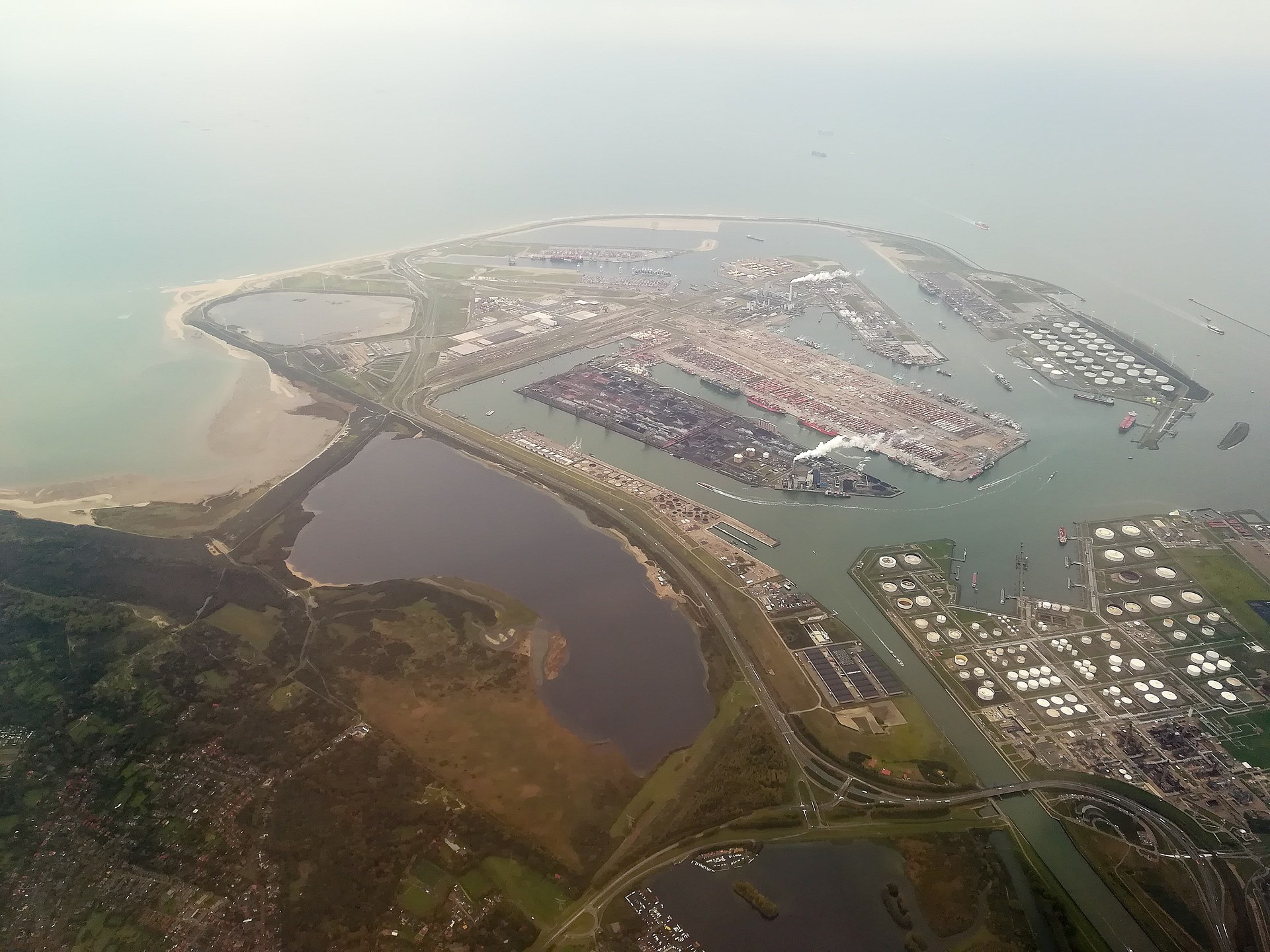
Maasvlakte (Port of Rotterdam), aerial view. Photo: Pymouss, Source: Wikimedia Commons, License: CC BY-SA 4.0.
Best practice for outbound and inbound logistics with europe
Contents
1. Executive summary: choosing the right corridor
2. The seven core transport routes (Damietta as the anchor port)
3. Customs & VAT playbook: 4000 vs 4200 vs T1 (Italy, Slovenia, Germany, Netherlands)
4. Egypt import compliance (EU → Egypt): ACI/ACID, Nafeza, CargoX, GOEIC registration
5. Packaging, pallets and load security: ISPM-15, VGM, weights & dimensions
6. Costs you must model (THC, local charges, demurrage/detention, special equipment)
7. Documentation checklists: Egypt → EU and EU → Egypt
8. Incoterms and insurance: how to allocate risk and avoid expensive surprises
9. Practical implementation roadmap and templates
10. Sources
1. Executive summary: choosing the right corridor
Egypt–EU logistics is not a single “lane” but a toolbox. The fastest option is not always the best option, and the cheapest option is rarely cheap once you add customs cashflow, terminal charges, and delay risk. What works consistently is a route strategy that matches (a) your target region in Europe, (b) your required lead time, (c) the shipment size and cargo type, and (d) the customs/VAT setup you can actually operate without friction.
This playbook starts from the same practical anchor point for most export setups in Egypt: the Damietta area as a gateway on the Mediterranean, plus Cairo as the consolidation point for airfreight. From there, we map seven route archetypes that cover 95% of real-world use cases for German and EU companies:
· Express RoRo trailer via Damietta ↔ Trieste (time-critical, minimal handling)
· Container via Koper (Slovenia): the Adriatic corridor for Southern Germany and often the fastest sea option overall
· Container via Rotterdam: the cost/process workhorse for NRW, Benelux, and Western/Northern Germany
· Container via Hamburg: when you intentionally want German customs clearance and German VAT logic
· Container via Trieste or Genoa: fast port-to-port Mediterranean options, but highly setup-sensitive in practice
· LCL vs FCL: how to start small, and when to scale into full containers
· Airfreight via Cairo: for exceptions (stoppage avoidance, prototypes, high value), not for daily replenishment
A second pillar is customs and tax. In day-to-day operations, your customs procedure often decides whether a route is “smooth” or “painful” more than the sailing time does. The key concepts you must master are:
· Procedure 4000 (standard import into free circulation): simplest, but may create import VAT cash-out
· Procedure 4200 (Procedure 42, onward supply relief): import VAT is not paid in the entry country if you immediately deliver to another EU member state — powerful for cashflow if your documentation is airtight
· T1 transit (Union transit): you postpone import clearance and pay duty/VAT at a later customs office (e.g., Germany) — useful when 4200 is not workable in the entry country
· Netherlands Article 23 (import VAT reverse-charge): a Dutch cashflow advantage that makes Rotterdam particularly attractive for many importers
Quick route recommendation (one-sentence rules) · Need the shortest door-to-door for industrial cargo with minimal handling? Start with RoRo to Trieste. · Supplying Bavaria/Baden-Württemberg with a stable sea lane and good VAT options? Koper is usually your first look. · Supplying NRW/Benelux with the lowest friction in frequency and carrier options? Rotterdam is the default. · Want maximum control and German customs governance? Hamburg is the “import in DE” lane. · Shipping a few pallets while validating the Egypt lane? Start with LCL — but manage CFS handling and storage risk. · Only ship by air when the cost of not shipping by air is higher than the airfreight bill. |
Finally, the playbook covers Egypt-specific compliance (ACI/ACID, Nafeza/CargoX, GOEIC registration for certain product groups) and packaging/wood rules (ISPM-15), because many delays do not happen at sea — they happen at the interfaces between documentation, customs, and physical packaging.
2. The seven core transport routes (Damietta as the anchor port)
Damietta is one of the most practical Mediterranean gateways for Egyptian export flows, especially for shippers who consolidate cargo from the Greater Cairo industrial belt (6th of October, 10th of Ramadan, Badr, New Cairo) and want predictable sailings into the EU. In this chapter, every route starts from the same operational picture:
· Factory pickup in/around Cairo (or another industrial zone) → drayage to Damietta (or to Cairo airport for airfreight)
· Export documentation + origin paperwork (EUR.1 where applicable) prepared in parallel
· Carrier booking + pre-alert to the EU broker (documents sent early to reduce port dwell time)
· EU entry port clearance strategy chosen before the vessel departs (4000 vs 4200 vs T1)
The goal is not to memorize routes. The goal is to understand when each route wins, what customs procedures are realistically workable, and where the operational risks are hiding.
2.1 RoRo trailer via Damietta ↔ Trieste: when speed and low handling matter most
Use this route when you have time-critical cargo and want to minimize the number of handling points. RoRo (Roll-on/Roll-off) is effectively “one load unit” end-to-end: the trailer drives onto the ship and drives off again. If your priority is shortest door-to-door lead time with industrial robustness (not just a fast port-to-port leg), RoRo is usually the first option to evaluate.
How the route works (end-to-end)
A typical operating model looks like this:
· Egypt leg: a trailer is positioned at the Cairo-area factory, loaded and sealed, and drayed to Damietta.
· Sea leg: the trailer is rolled onto the RoRo vessel at Damietta and transported to Trieste.
· EU leg: a European tractor unit picks up the same trailer in Trieste and continues by road (or in some setups, via intermodal).
· Optional: if your shipment is oversized or not suited for a standard trailer, the cargo can be carried on Mafi trailers (RoRo platform trailers) — useful for long/awkward industrial parts.
Why it is attractive
The DFDS/Pan Marine service is marketed as an express alternative to conventional container services. DFDS’ route information references a sea transit time of roughly 68 hours (~2.5 days), which is a meaningful lead-time advantage over standard Mediterranean and North Range container routings.
Operationally, RoRo reduces the most common delay and damage drivers:
· Fewer lift points (no CFS handling, no terminal stacking and re-handling like containers).
· Lower risk of pallet collapse or packaging damage caused by multiple warehouse moves.
· Less “last-minute” dependency on finding empty containers, chassis, and slot times — especially valuable in peak periods.
· Better fit for door-to-door industrial shipments where the trailer is the packaging.
Customs/VAT: what is realistic in practice
Your customs strategy for Trieste can make or break the total cost and timeline. In simple terms, you have three strategic directions:
A) Procedure 4000 (standard import into Italy)
This is the straightforward option: goods are released into free circulation in Italy. The drawback is cashflow: import VAT (and any duty) becomes payable in the entry country. In many setups, reclaiming VAT can take time, and non-resident recovery procedures can be administratively heavy. Use this when you either have an Italian VAT setup or when speed is more important than cashflow optimisation.
B) Procedure 4200 (Procedure 42 / onward supply relief)
In theory, Procedure 42 allows you to avoid paying import VAT in Italy if the goods are immediately dispatched to another EU member state (e.g., Germany) under an intra‑Community supply. In practice, this is documentation‑ and setup‑sensitive: you need a clean chain of evidence (transport proof, VAT IDs, contractual flow) and a broker who is comfortable running 42 in Italy. Many operators treat this as “possible, but only with the right importer and broker setup” rather than a default.
C) T1 transit (clear in Germany instead)
If 42 is not workable or you want to clear in Germany under German governance, you can move the goods under T1 (Union transit) from Trieste to Germany and complete the import clearance at the German customs office of destination. This postpones duty/VAT payment until the German clearance stage and centralises compliance. The trade-off is extra formalities and the need for transit guarantees.
Operational risks and field tips
· Document friction is the #1 delay cause. Send scanned copies of the bill of lading / CMR and the draft EUR.1 early to your EU broker for pre‑checks, but plan the originals properly. Preferential clearance relies on the original proof of origin; missing originals often translates into avoidable VAT/duty cash-out or demurrage exposure.
· Ports can be unforgiving when documentation is inconsistent (invoice values, HS codes, weights, consignee details). Build a single “master data sheet” per shipment and force everyone (factory, forwarder, broker) to use the same dataset.
· RoRo is fast — which means your downstream team must be faster. If you use your own truck on the EU side, pre-book pickup slots, communicate loading/unloading windows, and re-confirm repeatedly. Fast vessels can still result in slow delivery if the tractor unit is late.
· Budget for volatility. RoRo pricing behaves like a service premium: rates depend on equipment type (curtain sider, reefer, ADR), seasonality, and inland legs. Treat any ‘door-to-door’ price as a benchmark, not a guarantee.
· Plan for cashflow if importing under 4000 in Italy. Even if you can recover VAT, the timing may be measured in months; your finance team should model that working capital impact.
When this route is not the best choice
If your shipment is not truly time‑critical, conventional container routes can be more cost efficient per tonne and provide more flexibility in inland distribution (multiple receivers, warehouse devanning, etc.). Also, if your customs/VAT setup in Italy is not mature and you cannot reliably run T1 or 42, the operational “fast lane” can turn into an expensive surprise lane.
2.2 Container via Koper (Slovenia): the Adriatic corridor for Southern Germany — and often the fastest sea lane overall
Use Koper when you want a strong balance of speed, customs practicality, and short inland distance to Southern Germany (Bavaria/Baden‑Württemberg) and Austria. In many setups, Koper can also be the fastest sea-based option to reach Northern Germany because the sea leg is short and the inland leg is predictable.
Operationally, Koper is attractive because it combines (1) short Mediterranean sailing times from Egypt, and (2) a hinterland that is designed to feed Central Europe.
Route concept (Damietta → Koper → Central Europe)
From a process perspective, it is a classic container flow:
· Stuffing at factory or consolidation warehouse → drayage to Damietta → export customs.
· Sea freight Damietta → Koper (direct intra‑Mediterranean services exist).
· EU entry: customs clearance in Slovenia (often with Procedure 42) or start a T1 and clear in Germany.
· Final mile: truck or rail into South Germany / Austria / Hungary / Czech Republic.
Transit time and service reality
Carrier rotations change with season, but published service overviews show that Damietta–Koper can be a very short hop: Ocean Network Express (ONE) lists Damietta ↔ Koper transit times of roughly 4 days on its Adriatic Service (AD1) in the service’s own transit table. This is a crucial planning lever for time-sensitive projects that still want container economics.
Why Koper works well for German importers
· Short inland leg to the ‘Weißwurstäquator’ (Southern Germany): fewer kilometres means lower trucking cost and lower risk of delays.
· Good fit for cross‑docking: you can devann the container near the port and reload onto a standard curtain‑sider. This helps when you need easier customer unloading, when you have multiple consignees, or when you use special equipment that is hard to reposition/return in Germany (e.g., if the container type must be returned to a specific depot).
· Procedure 42 is commonly used in practice (when the chain is clean). That means: duty is paid, but import VAT is not paid in Slovenia if the goods are dispatched to another EU state under an intra‑Community supply.
· Planable rail options exist (especially for Austria/Southern Germany corridors), though reliability depends on schedules, capacity, and your local partner’s execution.
Customs/VAT: typical patterns and what they imply
Most Koper setups use one of two customs approaches:
Approach 1: Procedure 4200 (import in SI + onward supply).
If you can run Procedure 42, it is usually the cleanest cashflow play: import VAT is not paid in Slovenia; the VAT accounting shifts to the destination member state as an intra‑Community acquisition. The benefit is liquidity: you avoid paying 19% EUSt upfront on high‑value industrial cargo.
Approach 2: T1 to Germany (import clearance in DE).
If your 42 chain is not ready (missing VAT registrations, unclear incoterms, unclear end‑customer VAT ID), you can open a T1 in Koper and clear in Germany. This gives you German procedural control, and if you have a German deferment account (Aufschubkonto / Zahlungsaufschub), you can significantly reduce the immediate cash-out timing.
Operational risks and field tips (what actually causes delays)
· Original documents can be the bottleneck. Preferential clearance relies on original proof of origin. If the EUR.1 travels by courier and misses the window, you can lose the entire ‘fast lane’ advantage and start paying storage and demurrage.
· Pre‑plan the ‘document sprint’. Ask for the draft bill of lading early, align invoice/packing list data, and trigger EUR.1 issuance as soon as the export process allows. Don’t schedule critical handovers on the assumption that international couriers always deliver next day — build buffer.
· Cross‑docking is not a magic trick; it requires appointment discipline. Book the warehouse slot, confirm the truck, and ensure your broker clears the container before you cut the seal.
· Manage container weight pragmatically. Even if a container can carry more at sea, your road leg into Germany is constrained by EU road weight rules and the tractor + chassis tare weight. Overweight containers are a classic ‘we saved money at origin and lost it at the border’ scenario.
When Koper is not ideal
If your destination is primarily Northern France, UK, or Scandinavia, a North Range port may give better network density. Also, if you cannot run Procedure 42 and you do not want T1 complexity, you may prefer Rotterdam with Article 23 (depending on your VAT structure) or Hamburg if you want German clearance by default.
2.3 Rotterdam: the standard hub for NRW, Benelux, and Western/Northern Germany
Use Rotterdam when you want maximum schedule choice, stable terminal processes, and a strong hinterland network for Western and Northern Europe. Rotterdam is often the “default” port in European supply chains for a reason: it combines carrier density with mature customs ecosystems, including powerful VAT mechanisms in the Netherlands.
What Rotterdam optimises
· Frequency: many deep-sea and feeder options; it is easier to find a sailing that matches your production rhythm.
· Process maturity: large terminals, professional port community systems, and experienced customs brokers.
· Hinterland reach: efficient trucking corridors into NRW, Benelux, and further into Northern Germany; strong barge/rail options depending on destination.
Customs/VAT: Rotterdam’s strategic advantage (Article 23 and beyond)
A core reason Rotterdam is attractive is Dutch import VAT treatment. Under an Article 23 permit, importers can account for import VAT via their Dutch VAT return instead of paying it upfront at the border — a major cashflow advantage. This mechanism can make Rotterdam compelling even if the sailing time is not the shortest, because it reduces working capital pressure for high-value cargo.
Beyond Article 23, Rotterdam also supports standard Procedure 4000, Procedure 42, and T1 transit into other member states. In practice, many forwarders can pre-arrange documentation and start clearance processes early, but the benefit depends on your broker’s workflow and the quality of your shipment data.
Cost reality: why Rotterdam is fast but not “cheap” by default
Rotterdam’s reliability can come with higher terminal and local charges. One cost driver is THC (Terminal Handling Charges), which cover handling and terminal services. THC levels vary by terminal and carrier and can materially change your all-in landed cost if you only compare ocean freight headlines.
Practical implication: Rotterdam is often the best route when you optimise for total cost of ownership (frequency + reduced delay risk + VAT cashflow efficiency), not when you optimise for the single line item called ‘ocean freight’.
Operational risks and field tips
· Model THC and local charges explicitly. Do not treat them as a rounding error.
· If your receiving location is inland and you have limited storage, consider devanning or cross‑docking near the port to avoid detention and to return empties quickly.
· Ensure your HS classification and valuation are stable across shipments; Rotterdam is efficient but also highly automated — data errors propagate quickly into delays.
· Decide early whether you will clear in NL (with Article 23 or Procedure 42) or send the container under T1 to Germany. Changing strategy after arrival is where costs pile up.
When Rotterdam is not ideal
For strict lead-time projects in Southern Germany, an Adriatic port can still win because the sea leg is shorter and inland time is predictable. For heavy or special equipment cargo where inland distance dominates cost, Hamburg or an Adriatic entry can be more economical. Rotterdam is a ‘strong default’, not a universal answer.

2.4 Hamburg: when you intentionally want to clear customs in Germany
Use Hamburg when your compliance strategy is “keep import clearance in Germany.” This is common when you have a strong German broker, internal customs governance, and you want German legal certainty for classification, valuation, and post‑clearance processes. Hamburg is also a strong choice when your shipments use special equipment where inland distance is a major part of total cost.
The strategic logic of Hamburg
· German governance: German customs clearance, German VAT accounting, and German audit trail.
· Broker concentration: you can standardise on one brokerage team and one set of SOPs.
· Inland distribution: rail and trucking networks into Germany and Central Europe are mature.
Customs/VAT: understand the cashflow mechanics
If you import under Procedure 4000 in Germany, you will generally pay customs duty (if any) and import VAT (Einfuhrumsatzsteuer, EUSt). EUSt is recoverable as input tax for VAT-registered businesses, but timing matters: without deferment mechanisms, you pay at import and recover via your VAT return later. For high-value shipments, this can be a real working capital burden.
Germany offers payment facilitation via customs deferment (Zahlungsaufschub / Aufschubkonto). With an approved deferment, duties become payable later, and EUSt is typically due on the 26th of the second month following import (subject to the specific deferment conditions). This can materially improve liquidity for import-heavy businesses.
Operational risks and field tips
· A good broker is not optional. Hamburg is efficient, but German customs expects clean data and a stable compliance setup; errors in HS code, valuation, or origin documents can create avoidable delays.
· If you have frequent imports, invest in master data (SKU-level HS codes, origin statements, supplier declarations). This is the difference between predictable releases and costly escalations.
· For special equipment (flat racks, open tops, out-of-gauge), Hamburg can be economically attractive because the inland leg is shorter than from an Adriatic port to Northern Germany — but plan return logistics and depot availability.
· Use rail thoughtfully. Rail can be excellent, but it is ‘reliability by planning’: booking, cut-offs, and last-mile drayage coordination must be managed actively.
When Hamburg is not ideal
If your destination is primarily Southern Germany and your priority is speed, Hamburg may lose to Koper/Trieste because you add inland distance. If you want to avoid paying EUSt upfront and you do not have a deferment account, Rotterdam with Dutch VAT mechanisms can be financially easier depending on your structure.
2.5 Trieste / Genoa (container): Italy as an EU entry point — fast port‑to‑port, but setup‑sensitive
Use Italian container ports when you need a Mediterranean entry point with strong port-to-port speed and you can operate the customs/VAT chain cleanly. In many projects, Italy can be a high-performing route — but it is less forgiving when your documentation is incomplete or when your VAT setup is not robust.
Where Trieste and Genoa fit
· Trieste is a natural Adriatic entry that can support flows into Austria, Southern Germany and Central Europe.
· Genoa is a strong Western Mediterranean gateway, often used for Italy itself and for certain networks feeding Switzerland/Southern Germany.
· Both are relevant when you want Mediterranean speed but do not necessarily want to route via Slovenia.
Customs/VAT: typical constraints
From a customs perspective, the same EU tools exist (4000, 4200, T1). The difference is usually operational: the feasibility of Procedure 42 and the smoothness of fiscal representation depend heavily on the importer’s structure and the broker’s confidence. Many operators therefore treat Italy as a route that requires tighter documentation discipline and clearer importer-of-record roles than some alternative entry points.
A pragmatic operating rule is:
· If you can run Procedure 42 in Italy with a proven broker/importer setup, you can avoid import VAT cash-out in Italy.
· If you cannot, either accept Procedure 4000 (and model VAT cashflow) or move under T1 and clear in Germany.
Operational risks and field tips
· Treat Italian entry as ‘documentation first’. Align invoice and packing list data, ensure origin proofs are correct, and pre-alert your broker early.
· Use an experienced local agent/port operator. Many delays are not ‘customs problems’ but coordination problems between terminal, carrier, and broker — a strong local contact reduces surprises.
· If your cargo then transits via Switzerland, model the inland cost and toll regime. Switzerland can be an excellent transit corridor, but it can be expensive and requires planning (permits, tolls, driving times).
· Do not underestimate peak port congestion. Fast sailing times are not the same as fast gate-out; build a buffer for terminal queues and documentation checks.
When Italy is not ideal
If your main purpose is to use Procedure 42 with minimal friction and you do not have an Italy-specific VAT setup, Koper can be easier. If your target is Northern Germany and you are cost-sensitive, Rotterdam or Hamburg often provide simpler inland economics.
2.6 LCL vs FCL: how to start small, and when to scale into full containers
Use LCL (Less-than-Container Load) when you are building the lane, shipping only a few pallets, or running pilot volumes (serial launches, samples, early customer deliveries). Use FCL (Full Container Load) when your volume is steady enough to justify (a) the fixed costs of a container and (b) the operational simplicity of a single shipper/consignee flow.
What LCL really is (and why it is both flexible and risky)
LCL is not ‘half a container’; it is a different process. Your pallets move through a CFS (Container Freight Station), where shipments from multiple shippers are consolidated. That creates flexibility — but also adds handling points and therefore risk.
· Advantages: low entry barrier; ship only what you need; reduces inventory and capital tied up in transit; can serve customers directly with small drops.
· Disadvantages: additional loading/unloading at CFS; higher handling charges; higher damage risk; longer dwell times if consolidation schedules do not align; more exposure to documentation mismatches because more parties touch the container.
When to switch from LCL to FCL (a practical break-even logic)
There is no single universal break-even point because rates change by season and lane, but there is a practical rule: if you routinely ship enough volume to fill a meaningful share of a container and you ship frequently, FCL usually becomes cheaper and more reliable.
A decision framework:
· Volume threshold: if your LCL volume approaches 10–12 m³ repeatedly (or a comparable weight threshold), compare FCL quotes — fixed origin/destination fees start to dominate LCL cost.
· Damage sensitivity: if packaging failure or damage is costly (e.g., automotive series parts), FCL reduces handling risk.
· Schedule sensitivity: if you need predictable weekly rhythm, FCL with a fixed sailing plan is often easier to control.
· Multiple receivers: if you need to distribute to many consignees, LCL can still be helpful — but cross-docking an FCL near the port can achieve the same with better control.
Key risk: storage and ‘CFS surprise costs’
The most common LCL failure mode is not the sea leg — it is storage and handling cost escalation. If documents are delayed, if the consignee does not clear on time, or if the CFS has limited free storage, costs can rise sharply. LCL therefore requires discipline: pre-clear where possible, ensure the consignee is ready to receive, and define who pays if delays are caused by missing paperwork.
Illustrative benchmark (not a quote)
To make the economics tangible: for some lanes, a single heavy pallet (e.g., ~1.8 tonnes) can be moved at a cost that looks attractive compared with an entire container. Treat such examples as benchmarks to structure your business case — actual rates depend on cargo density, CFS fees, and current market conditions.
2.7 Airfreight via Cairo: for exceptions (stoppage avoidance, prototypes), not as a standard lane
Use airfreight when the cost of waiting is higher than the cost of flying. Typical triggers are: production line stoppage avoidance, urgent spare parts, prototypes, critical documents, and high-value items where carrying cost dwarfs freight cost. Do not use airfreight as a standard replenishment mode unless your product economics support it.
Transit time reality
Flight time from Cairo to major European hubs is only a few hours, but door-to-door timing depends on pickup, export clearance, airline cut-offs, and import handling. A realistic planning range for standard air cargo is typically 1–3 days door-to-door when capacity and documentation are in order. Express integrators can be faster, at a higher price.
Cost logic: chargeable weight and density
Airfreight is priced by chargeable weight: the greater of gross weight and volumetric (dimensional) weight. That means light, bulky cargo can be expensive because it consumes aircraft volume. Many airlines and forwarders use a volumetric factor around 1 m³ = 167 kg (or similar), but always confirm the factor used by your carrier/forwarder.
Typical use cases by industry
· Automotive & industrial machinery: urgent spares, line stoppage prevention, prototype parts.
· Electronics: high value-to-weight shipments, new product launches.
· Medical devices/pharma (where permitted): urgent, regulated items with high compliance and high urgency.
· Project cargo: critical components needed to keep a site mobilised (though dimensions may exceed air limits).
Operational tips that reduce cost and friction
· Avoid vague DDP air deliveries unless you fully understand the last‑mile cost. ‘Door delivery’ by air can be surprisingly expensive due to handling, brokerage, and courier surcharges. For some setups, it is cheaper to clear and pick up at the terminal with your own transporter.
· Build an airfreight ‘emergency SOP’: pre-approved HS codes, known brokers, and a pre‑agreed airwaybill template. When you need air, you usually need it now — and time is lost on preventable paperwork.
· Use robust packaging. Air cargo handling is fast and often involves multiple touches. Strap and protect, especially for pallets with a high centre of gravity.
· Check dimensions early. Oversize cargo may require freighter aircraft or may be impossible on certain routes. Confirm maximum dimensions and door sizes with the forwarder before committing.
When to step back from air and return to sea
If air becomes frequent, it is usually a planning signal: either forecast accuracy is weak, safety stock is too low, or the sea lane is not yet stabilised. A mature Egypt–EU supply chain typically uses sea as the backbone and reserves air for exceptions.
3. Customs & VAT playbook: 4000 vs 4200 vs T1 (Italy, Slovenia, Germany, Netherlands)
For Egypt–EU trade, route choice and customs procedure are inseparable. The same container can become either (a) a smooth door-to-door flow, or (b) a cashflow and delay trap — depending on whether you clear under standard import (4000), Procedure 42 (4200), or transit (T1) and how you manage VAT accounting.
3.1 Procedure 4000: release for free circulation (the standard import)
Procedure code 4000 is the standard “import into free circulation” route: non‑Union goods become Union goods after customs formalities, and the goods can circulate freely in the EU. The key implication is simple: duty (if any) and import VAT are due in the country of import (subject to local deferment mechanisms).
Pros
· Operationally straightforward and widely understood by brokers.
· Best when the goods will be consumed/sold in the entry country (e.g., import into Germany for German consumption).
· Clear audit trail: import entry, duty/VAT paid, goods released.
Cons
· Cashflow impact: import VAT is often the largest single cash-out in the chain.
· If you import into a country where you are not VAT registered, VAT recovery can be slow and administratively heavy.
· Not ideal if the goods are destined for another EU country (you might pay VAT in the entry country unnecessarily).
3.2 Procedure 4200 (Procedure 42): import + VAT-free onward supply to another EU member state
Procedure 42 (often shown as procedure code 4200 in customs declarations) is the classic cashflow optimisation tool for non‑EU imports that will immediately be dispatched to another EU member state. In a compliant 42 flow:
· Customs duty is paid (if applicable).
· Import VAT is not paid in the entry country.
· The subsequent movement is treated as an intra‑Community supply and acquisition (VAT accounting shifts to the destination member state).
The concept is powerful — and therefore heavily controlled. The rule of thumb is: 42 is great when your documentation is excellent; it is dangerous when your documentation is improvisational.
Typical prerequisites (simplified)
· A clear buyer/consignee in another EU member state with a valid VAT ID.
· Evidence that the goods physically leave the entry member state and are dispatched to the destination member state (transport documents, CMR, proof of delivery).
· A broker who can file the declaration correctly and who understands the evidence package needed for audit.
· An Incoterms and invoicing chain that matches the VAT narrative (who sells to whom, and where).
Pros
· Major liquidity advantage: avoids paying import VAT in the entry country.
· Often reduces financing costs and makes the lane more scalable for high-value goods.
· Works well with port-based cross-docking (clear → reload → dispatch).
Cons and risk profile
· High documentation burden. If you cannot prove the onward movement, authorities can assess VAT and penalties.
· Requires discipline in master data (HS code, value, origin) and transport evidence.
· Practical feasibility differs by country and by broker ecosystem; what is “routine” in one port can be “painful” in another.
3.3 T1 transit: postpone clearance to another customs office
T1 (external Union transit) allows you to move non‑Union goods under customs supervision from the entry port to a different destination (for example from Koper or Trieste to a German customs office) without paying import duty/VAT at the port. It is widely used when:
· Procedure 42 is not feasible in the entry country, and you still want to centralise clearance (e.g., in Germany).
· You need to reposition cargo inland before deciding the final customs procedure (rare in standard trade, common in complex projects).
· You want to align clearance with an inland bonded warehouse or a known customs broker.
The trade-off is that T1 requires a transit guarantee and disciplined discharge at destination. It is not complicated — but it is unforgiving if you miss timelines or seals are broken.
3.4 Country-specific notes (NL, DE, SI, IT)
Netherlands (Rotterdam): Article 23 and a strong customs ecosystem
The Netherlands offers a well-known cashflow tool: the Article 23 permit for import VAT reverse-charge. With Article 23, import VAT is not paid at the border; it is declared in the VAT return. This makes Rotterdam strategically attractive for many importers — particularly for high-value industrial shipments that would otherwise create significant VAT prefinancing.
Germany (Hamburg or inland clearance): predictable governance, but plan EUSt timing
Germany’s baseline is simple: import VAT is payable on import, but recoverable as input VAT for businesses. For frequent importers, Germany also offers deferment (Zahlungsaufschub / Aufschubkonto), which shifts payment to a later date and can reduce the immediate cash-out burden. The operational success factor in Germany is typically broker quality and master data stability.
Slovenia (Koper): Procedure 42 often operationally practical
Koper’s strength in many Egypt–Germany setups is the combination of short sea transit and a customs ecosystem where 42 is commonly executed by experienced brokers. If your documentation chain is ready, Koper can deliver both speed and VAT efficiency. If not, the T1 fallback to Germany is usually feasible.
Italy (Trieste / Genoa): fast lanes, but be conservative in your assumptions
Italy can be operationally fast at sea, but companies often experience higher sensitivity to importer setup and documentation for VAT-optimised structures. The practical approach is to define your strategy upfront (4000 vs 42 vs T1) and engage a local broker early. If you plan to rely on 42, treat it as a ‘project’ that requires a clear importer-of-record model, transport evidence, and controlled master data.
3.5 Evidence pack: what your broker will typically ask for
Whether you run 4000, 42, or T1, your broker will typically require a consistent evidence pack. Build this as a standard shipment folder:
· Commercial invoice (values consistent with contract and Incoterms).
· Packing list (weights and piece counts aligned with the invoice).
· Transport document (B/L for sea, AWB for air, CMR for road).
· Proof of origin when applicable (EUR.1 or origin declaration).
· Importer data: EORI, VAT IDs, and power of attorney / representation documents as required.
· For 42 specifically: proof of onward movement (CMR, delivery confirmation, destination details) and the destination VAT ID.
The biggest real-world improvement you can make is to standardise this evidence pack and enforce a single “source of truth” for shipment master data. Most border friction is caused by inconsistent data, not by the route itself.
4. Egypt import compliance (EU → Egypt): ACI/ACID, Nafeza, CargoX, GOEIC registration
For many EU exporters, the biggest surprise in Egypt logistics is not the sea route — it is compliance. Egypt has modernised its customs processes with mandatory pre‑registration and electronic documentation. If you do not build these steps into your standard operating procedure, your cargo can be delayed or even refused.
4.1 ACI / ACID and Nafeza: the mandatory pre‑registration backbone
Egypt’s Advance Cargo Information (ACI) system requires shipments to be pre‑registered before loading. Each shipment receives an ACID number (Advanced Cargo Information Declaration). The ACID must be shown consistently on the commercial invoice, packing list, and transport documents. Without a valid ACID, shipments may not be loaded or may be refused at destination.
Who does what (simplified role model)
· Egyptian importer (or their customs broker): initiates the ACI filing in Nafeza and obtains the ACID number.
· Foreign exporter: ensures the ACID number is printed on all documents and shares documents in the required format.
· Freight forwarder / carrier: often requires ACID before loading and includes it in B/L instructions and manifests.
· CargoX platform: used by foreign exporters to submit documents electronically to the Egyptian single window ecosystem.
Operational timeline (practical planning)
Even if your forwarder can handle the mechanics, you should plan the timeline explicitly:
· T‑7 to T‑10 days (before vessel): confirm whether the importer already has an active Nafeza profile; align HS codes and invoice data.
· T‑5 to T‑7: importer triggers ACID request; exporter prepares draft invoice/packing list.
· T‑2 to T‑3: exporter and forwarder ensure ACID is embedded in all documents and B/L instructions.
· Before loading: carrier/forwarder verifies ACID and may refuse cargo without it (varies by carrier).
· After departure: keep document versions stable — changes after filing can cause rejections and delays.
4.2 GOEIC registration: when manufacturers and brands must be registered
In addition to ACI, Egypt requires registration for certain product groups. Under Ministerial Decree 43/2016, a register is maintained at the General Organization for Export and Import Control (GOEIC) for factories and trademark owners eligible to export specific products to Egypt. For affected products, imports may not be released unless the producer/brand is registered.
In practice, this matters most for consumer-facing goods and regulated categories (e.g., some textiles, apparel, household items, and similar categories — always verify against the current list and your HS codes).
What this means operationally
· Do not treat GOEIC registration as a ‘last-minute document’. It can require corporate documents, quality system evidence, and formalised submissions.
· Align with your Egyptian importer early. In many projects, the importer knows whether the product category is sensitive and can connect you to the right advisors.
· If you are building a long-term lane, treat GOEIC registration like market access: it is a one-time investment that prevents repeated shipment disruptions.
4.3 Payments and documentary instruments: the ‘letter of credit’ episode
Egypt has, at times, tightened import finance rules (e.g., requiring letters of credit for certain imports in 2022, later easing restrictions). Even when not legally mandatory, banks and counterparties may still request documentary structures depending on currency and risk conditions. The practical lesson for logistics teams is: coordinate logistics and finance. Shipping documents are not only for customs; they are also for payment execution under documentary collections or letters of credit.
4.4 The minimum Egypt import dossier (baseline list)
Exact requirements vary by product, but the recurring baseline dossier for EU → Egypt shipments includes:
· Commercial invoice (often requiring chamber attestation and, in some cases, consular/legalisation steps depending on product and buyer requirements).
· Certificate of origin (non-preferential) and/or EUR.1 for preferential claims where relevant.
· Packing list.
· Transport document (B/L for sea, AWB for air).
· ACID number referenced consistently across all documents.
· Product-specific certificates (health/phytosanitary, conformity, etc.) where applicable.
If you only take one action from this chapter: implement an “Egypt pre‑shipment compliance gate” in your process. No cargo should be allowed to book space or enter the port until ACID is confirmed and the document versions are frozen.
5. Packaging, pallets and load security: ISPM‑15, VGM, weights & dimensions
Many Egypt–EU disruptions are not caused by vessels or ports — they are caused by packaging, wood rules, and physical non-compliance. Two topics deserve special attention: (1) ISPM‑15 for wood packaging, and (2) correct loading and weight governance for containers and road legs.
5.1 ISPM‑15: wood packaging compliance is non‑negotiable
When you ship to the EU using wood packaging (pallets, crates, dunnage, bracing), the wood must meet the International Standard for Phytosanitary Measures No. 15 (ISPM‑15). In practice this means:
· Wood packaging must be treated (typically heat treated) and marked with the official IPPC/ISPM‑15 stamp.
· The stamp must be legible; missing or unreadable marks create non-compliance risk.
· Certain processed wood materials (e.g., plywood, OSB) are generally exempt, but solid wood packaging is not.
· Non-compliant wood can trigger inspection holds, forced treatment, re-export, or destruction — all high-cost outcomes.
Practical mitigation strategies:
· Use certified pallet suppliers and audit them periodically (don’t assume every pallet in the market is compliant).
· For lightweight products, consider plastic pallets to eliminate ISPM‑15 risk.
· Keep the packaging design stable. Last-minute changes (adding wood bracing) can accidentally create compliance violations.
5.2 Load security inside containers: design for reality, not for theory
Container damage is often a packaging engineering issue. Containers are exposed to acceleration, vibration, and stacking forces. In addition, Egyptian road legs and terminal handling can be rougher than many EU shippers expect. Practical principles:
· Plan for multiple handling points (even if you aim to minimise them). Strap and block accordingly.
· Distribute weight evenly and avoid point loads on container floors.
· Use anti-slip mats and edge protection to prevent strap cutting.
· Make pallets ‘forklift-stable’: correct pallet base, correct overhang rules, and correct wrapping.
5.3 Verified Gross Mass (VGM): you can’t load without it
Since the SOLAS VGM rule, the shipper must provide the verified gross mass of a packed container before it can be loaded on a vessel. This is a hard operational requirement: no VGM, no loading. Ensure your stuffing location has a reliable weighing process, and ensure the VGM data matches the booking and customs data.
5.4 Container weights, road limits, and ‘practical payload caps’
At sea, container limits are defined by container max gross weight. On European roads, the constraint is often the maximum authorised weight of the vehicle combination (tractor + chassis + container + cargo), which is governed by EU and national rules. Practical implications:
· Do not load ‘to the container max’ without checking the road leg. Many overweight problems occur after arrival, when the container cannot legally travel inland.
· Treat 20’ containers carefully: they can carry heavy payload, but axle loads and road limits can become binding; also, 20’ is not always cheaper than 40’ because fixed charges dominate.
· For 40’ containers, many operators use practical payload caps (e.g., low 20‑tonne range) to stay safe across different tractor/chassis combinations. Exact numbers depend on equipment tare and country rules.
5.5 Vehicle dimensions: height differences and special loads
National rules matter. For example, in Germany the standard maximum vehicle height is 4.0 m. If you load for “local rules” in another country and then move the cargo into Germany, you can create non-compliance or require special permits. For project cargo and high loads, always check road permits and route surveys in advance.
Bottom line: treat packaging and physical compliance as part of customs compliance. The fastest route is irrelevant if your container is held due to wood packaging or cannot legally move inland due to overweight or oversize.
6. Costs you must model (THC, local charges, demurrage/detention, special equipment)
Many logistics budgets fail because they model only the headline freight rate. In Egypt–EU trade, a realistic landed cost model must include port charges, terminal handling, documentation, and the financial cost of delays (demurrage and detention).
6.1 Ocean freight vs ‘all-in’: what sits around the freight rate
A standard container shipment typically includes (depending on Incoterms and contract):
· Ocean freight (the line-haul).
· Origin charges in Egypt (terminal handling, export documentation, potentially trucking/drayage).
· Destination charges in the EU (THC, port fees, documentation fees, security fees).
· Customs clearance fees (brokerage).
· Inland haulage (truck/rail), including chassis and repositioning.
· Optional services: cross-docking/devanning, warehousing, palletisation, insurance.
6.2 THC: Terminal Handling Charges (why they can dominate the bill)
THC are charges levied for terminal services such as moving and positioning containers, crane operations, and related handling. THC varies by port, terminal, and carrier. The key practice point is simple: compare routes using landed cost, not only ocean freight.
Route impact: North Range hubs (e.g., Rotterdam) can have higher terminal charges than some Adriatic gateways, but often compensate through reliability, frequency, and tax mechanisms.
6.3 Demurrage and detention: the fastest way to destroy your budget
Demurrage is charged when a container stays inside the terminal beyond the free time. Detention is charged when the container is kept outside the terminal (with the consignee) beyond free time. Both are designed to force equipment flow and can escalate quickly — especially for special equipment.
How to avoid D&D in practice
· Pre-clear: have documents ready and broker instructed before arrival.
· Plan pickup slots and trucking capacity before discharge, especially in fast ports.
· If your warehouse cannot unload quickly, devann the container near the port and return the empty early.
· Negotiate extra free time proactively when you expect delays (peak season, holidays, inspection risk).
· Define commercial responsibility: contractually specify who pays demurrage/detention when delays are caused by missing documents from a party.
6.4 Special equipment (flat racks, open tops, Mafi, trailers): budget the hidden legs
Special equipment is often essential for project cargo (long parts, heavy machines, oversized assemblies). The cost is not only the sea leg. You must also model:
· Equipment availability (pre-positioning).
· Depot restrictions (where can you return the equipment?).
· Inland permits for oversize/overweight.
· Extra lashing and surveyor costs.
· Insurance (higher risk profile).
A practical rule: special equipment becomes economical when it prevents damage, avoids repacking, or enables a route that keeps the overall lead time stable. Treat it as a risk‑reduction investment, not only a cost item.
7. Documentation checklists: Egypt → EU and EU → Egypt
Documentation is not an afterthought — it is the production plan for your logistics chain. This chapter provides checklists that cover most industrial shipments. Always validate product-specific requirements (food, chemicals, medical devices, dual-use, etc.).
7.1 Egypt → EU: baseline export and import documents
A typical Egypt → EU shipment requires:
· Commercial invoice (English recommended; include HS code, Incoterms, net/gross weight, and clear product descriptions).
· Packing list (piece count, weights, dimensions; align exactly with invoice).
· Bill of Lading (sea) or Air Waybill (air) or CMR (road).
· Proof of origin where relevant: EUR.1 (or origin declaration, depending on agreement conditions and authorisations) to claim preferential duty rates under the EU–Egypt framework; otherwise Certificate of Origin for non‑preferential purposes if requested.
· Insurance certificate when required by contract (especially CIF/CIP or under documentary credit).
Compliance documents for market access (not always required for customs clearance, but required for legal sale in the EU) may include:
· CE documentation (Declaration of Conformity) for relevant product groups (machinery, electronics, etc.).
· Safety data sheets (SDS) for chemicals and regulated substances.
· Product-specific test reports or certificates demanded by customers.
7.2 EU → Egypt: baseline import dossier (ACI/ACID embedded)
A typical EU → Egypt shipment should be planned as a compliance project. Baseline documents:
· Commercial invoice (often needs chamber attestation; in some cases consular/legalisation — confirm with importer and bank).
· Certificate of Origin (commonly required; often attested).
· Packing list.
· Transport document (B/L or AWB).
· ACID number included on all documents and consistent with the Nafeza filing.
· Product-specific documents (GOEIC registration evidence where required, conformity/health certificates where applicable).
7.3 Preferential origin and EUR.1: why it matters financially
Preferential origin can be a major cost lever. Under EU preferential arrangements with partner countries, a movement certificate such as EUR.1 (or an origin declaration where allowed) can enable reduced or zero duty. Without it, normal duty rates apply. The practical message is: treat origin paperwork as a cost tool, not as bureaucracy.
7.4 The ‘originals problem’: how to avoid last-minute chaos
Many Egypt–EU delays are caused by missing originals (EUR.1, original B/L, legalised certificates). Practical controls:
· Create a document map: which documents must be original, who issues them, and how they travel.
· Send scanned copies early for pre-checks, but do not assume scans replace originals for preference claims.
· Use a courier plan with buffer; avoid issuing critical documents right before weekends/holidays.
· Where possible, use electronic B/L options supported by carriers — but confirm acceptability for banks and customs.
8. Incoterms and insurance: allocate risk, control the chain, avoid expensive surprises
Incoterms are not just ‘sales terms’. They are a logistics operating model: who books freight, who chooses the carrier, who pays THC, who clears customs, who pays import VAT, and who carries the risk of delay. Egypt–EU trade is complex enough that Incoterms should be chosen deliberately, not inherited from a template.
8.1 Practical Incoterms guidance for Egypt–EU trade
For Egypt → EU imports (EU buyer imports from Egypt)
· FCA (factory or named place) is often the cleanest for EU importers who want control over the main carriage and customs narrative.
· FOB (Damietta) can work, but be careful: FOB is designed for non-containerised sea freight; in container trade, FCA terminal often reflects reality better.
· CFR/CIF can be convenient for buyers who do not want to manage sea freight — but you then inherit carrier and cost transparency issues at destination.
For EU → Egypt exports (EU seller exports to Egypt)
· FCA or FOB can work when the Egyptian buyer/importer has a strong forwarder network.
· CFR/CIF (to an Egyptian port) can be attractive when the EU seller wants to offer a service-oriented package but does not want to act as the importer in Egypt.
· Avoid DDP to Egypt in most cases: being the importer of record in Egypt can require local registrations and creates high compliance and tax exposure.
8.2 Insurance: why you cannot rely on carrier liability
Carrier liability in sea freight is limited and generally far below the value of industrial goods. If the cargo is valuable, fragile, or business-critical, dedicated cargo insurance (marine cargo) is typically the only practical protection. Insurance is also important for general average and major incidents.
Practical guidance:
· Decide whether you want All-Risk coverage (Institute Cargo Clauses A) or a more limited cover depending on product and budget.
· Align the insured value with the Incoterms cost base (CIF/CIP includes insurance obligation for the seller, but minimum cover levels may be lower than what you want).
· Ensure packaging and stowage comply with insurance requirements; poor packaging can void claims.
8.3 Contract clarity: who pays what when things go wrong
Demurrage, detention, storage, inspections, document corrections — these are the real friction costs. They should be addressed contractually. At minimum, your contracts should define:
· Who pays port storage, demurrage/detention if clearance is delayed due to missing documents from a party.
· Who is responsible for original documents and courier costs.
· Who bears the cost if the shipment cannot be cleared preferentially because origin documents are missing or incorrect.
· Escalation process and contacts (broker, forwarder, importer, exporter).
9. Practical implementation roadmap and templates
If you are building an Egypt lane from scratch (or stabilising an existing one), the fastest path is to implement a small number of standard operating procedures (SOPs) that prevent 80% of disruptions. Below is a practical roadmap you can execute in weeks, not months.
9.1 A 30-day build plan (high impact, low bureaucracy)
Week 1: master data and partners
· Select the target route family for your main destination (Koper vs Rotterdam vs Hamburg vs RoRo).
· Select two brokers (one at the EU entry point, one fallback) and define escalation contacts.
· Build a master data sheet: HS code, origin logic, product descriptions, weights, packaging, and any regulated attributes (battery, chemicals, etc.).
· Agree on Incoterms and the importer-of-record model for each flow direction.
Week 2: documentation SOP and origin strategy
· Implement a standard document folder structure (invoice, packing list, B/L instructions, origin proofs, certificates).
· Define how EUR.1 is requested and issued; define courier plan for originals.
· Define the customs procedure playbook per route (4000 vs 42 vs T1).
· Implement a pre-alert workflow: broker receives draft documents before vessel departure and confirms readiness.
Week 3: physical SOP (packaging, pallet, VGM)
· Audit wood packaging compliance (ISPM‑15) and decide whether to switch to plastic pallets for sensitive flows.
· Define container loading rules (weight distribution, lashing plan, photo documentation).
· Define VGM process and responsibility (who weighs, who submits).
· Implement ‘no loading without compliance gate’: ACID confirmed for Egypt imports, origin and invoice data frozen for exports.
Week 4: cost model and performance tracking
· Build a landed-cost model per route: ocean/air, THC, clearance, inland, expected D&D buffer.
· Set KPIs: port dwell time, clearance time, D&D cost per shipment, damage incidents, and document error rate.
· Run a pilot shipment and hold a post‑mortem; update SOPs based on real friction points.
9.2 Templates (copy/paste into your internal SOP)
Template A: Pre-shipment checklist (Egypt → EU)
· HS code verified and consistent with previous shipments
· Invoice values and Incoterms confirmed
· Packing list aligned (weights, dimensions, piece count)
· EUR.1 requested / origin declaration prepared (if applicable)
· B/L instructions checked (consignee, notify, description, weights)
· Broker pre-alerted with draft docs and confirmed clearance strategy (4000/42/T1)
· Packaging compliance confirmed (ISPM‑15 stamp, labels, marks)
· VGM process confirmed
Template B: Pre-shipment checklist (EU → Egypt)
· Importer confirmed ACID issuance and shared ACID number
· ACID embedded on invoice, packing list, and transport documents
· CargoX/Nafeza document submission completed as required
· Any GOEIC registration requirement checked and fulfilled
· Consular/chamber attestations planned (if required by buyer/bank)
· Carrier booking confirmed and cut-off met
Implementing these basic templates usually reduces delay and D&D cost faster than any carrier change. Route optimisation comes after process stabilisation.
10. Sources
DFDS: Freight shipping routes – Italy ↔ Egypt (Damietta ↔ Trieste) route information (transit time, service overview)
https://www.dfds.com/en-gb/freight-shipping/freight-route-guides/italy-egypt
Loadstar: news on DFDS/Pan Marine RoRo line Italy ↔ Egypt (service launch context)
https://theloadstar.com/dfds-launches-new-freight-ferry-service-between-italy-and-egypt/
Ocean Network Express (ONE): Adriatic Service (AD1) service overview PDF (incl. transit table Damietta ↔ Koper)
https://ecomm.one-line.com/one-ecom-web/resources/pdf/one_adriatic_service_ad1.pdf
Port of Koper: Container services (schedule overview incl. service strings calling Damietta)
https://www.luka-kp.si/eng/container-services/
Belastingdienst (Netherlands Tax Administration): Import VAT reverse-charge / Article 23 permit overview
https://www.belastingdienst.nl/wps/wcm/connect/en/customs/content/when-do-i-pay-import-duties-and-import-vat
European Commission (TAXUD): Union and Common Transit overview
https://taxation-customs.ec.europa.eu/customs/customs-procedures-import-and-export/what-customs-transit/union-and-common-transit_en
European Commission (TAXUD): NCTS (New Computerised Transit System) overview
https://taxation-customs.ec.europa.eu/online-services/online-services-and-databases-customs/new-computerised-transit-system-ncts_en
German Customs (Zoll): Release for free circulation (Überlassung zum zollrechtlich freien Verkehr)
https://www.zoll.de/DE/Unternehmen/Warenverkehr/Einfuhr-aus-einem-Nicht-EU-Staat/Verfahren/Freier-Verkehr/freier-verkehr.html
German Customs (Zoll): Payment facilitation / deferment (Zahlungsaufschub)
https://www.zoll.de/DE/Fachthemen/Zoelle/Abgabenerhebung/Zahlung-der-Abgaben/Mit-Zahlungserleichterung/mit-zahlungserleichterung_node.html
Irish Revenue: Imports of non‑EU goods for onward supply (Procedure 42 / onward supply relief guidance)
https://www.revenue.ie/en/customs/guide-to-customs-procedures/importing-and-exporting/imports-of-non-eu-goods-for-onward-supply-procedure-42.aspx
European Court of Auditors: Special report on VAT fraud and procedure 42 risks (context and controls)
https://www.eca.europa.eu/en/publications/SR-2025-08
NAFEZA: ACI system information PDF (ACID number, process overview)
https://www.nafeza.gov.eg/en/site/aci-info
CargoX: Egypt ACI system overview for exporters (document submission context)
https://cargox.io/egypt-aci-system/
GOEIC: Official registration page for qualified factories/companies
https://www.goeic.gov.eg/en/pages/default/view/id/1032/m/4
Egypt Ministerial Decree 43/2016 (registration requirements) – reference copy
https://www.julius-kuehn.de/media/Veroeffentlichungen/43_2016.pdf
European Commission: Wood packaging material and ISPM‑15 plant health requirements
https://food.ec.europa.eu/plants/plant-health-and-biosecurity/trade-plants-plant-products/wood-packaging-material_en
FAO: ISPM 15 standard text (Regulation of wood packaging material in international trade)
https://www.fao.org/4/i2930e/i2930e.pdf
International Maritime Organization (IMO): SOLAS VGM (verified gross mass) background
https://www.imo.org/en/MediaCentre/HotTopics/Pages/VerifiedGrossMass.aspx
German law (StVZO): maximum vehicle height (Germany – 4.00 m standard rule)
https://www.gesetze-im-internet.de/stvzo_2012/__32.html
EUR-Lex: Directive 96/53/EC on maximum weights and dimensions (road transport)
https://eur-lex.europa.eu/legal-content/EN/TXT/?uri=CELEX%3A01996L0053-20220706
International Chamber of Commerce (ICC): Incoterms® 2020 overview
https://iccwbo.org/business-solutions/incoterms-rules/incoterms-2020/
Maersk: explanation of demurrage and detention (definitions and free time concept)
https://www.maersk.com/logistics-explained/transportation-and-freight/2023/08/28/what-is-demurrage-detention-in-shipping-for-buyers
DHL Freight Connections: Terminal Handling Charges (THC) definition
https://dhl-freight-connections.com/en/logistics-dictionary/terminal-handling-charges-thc/
Lufthansa Cargo: Cairo station information (network presence)
https://lufthansa-cargo.com/network/market-info/cairo
European Commission: EU Emissions Trading System (ETS) – maritime transport inclusion (context for ETS surcharges)
https://climate.ec.europa.eu/eu-action/eu-emissions-trading-system-eu-ets/maritime-transport_en
European Commission Access2Markets: EU–Egypt Association Agreement overview (preferential framework)
https://trade.ec.europa.eu/access-to-markets/en/content/eu-egypt-association-agreement
European Commission (TAXUD): Preferential origin – common provisions (EUR.1/EUR‑MED as proof of origin)
https://taxation-customs.ec.europa.eu/customs/rules-origin-goods/preferential-origins/common-provisions_en
European Commission Access2Markets: Quick guide to working with rules of origin (proofs of origin)
https://trade.ec.europa.eu/access-to-markets/en/content/quick-guide-working-rules-origin