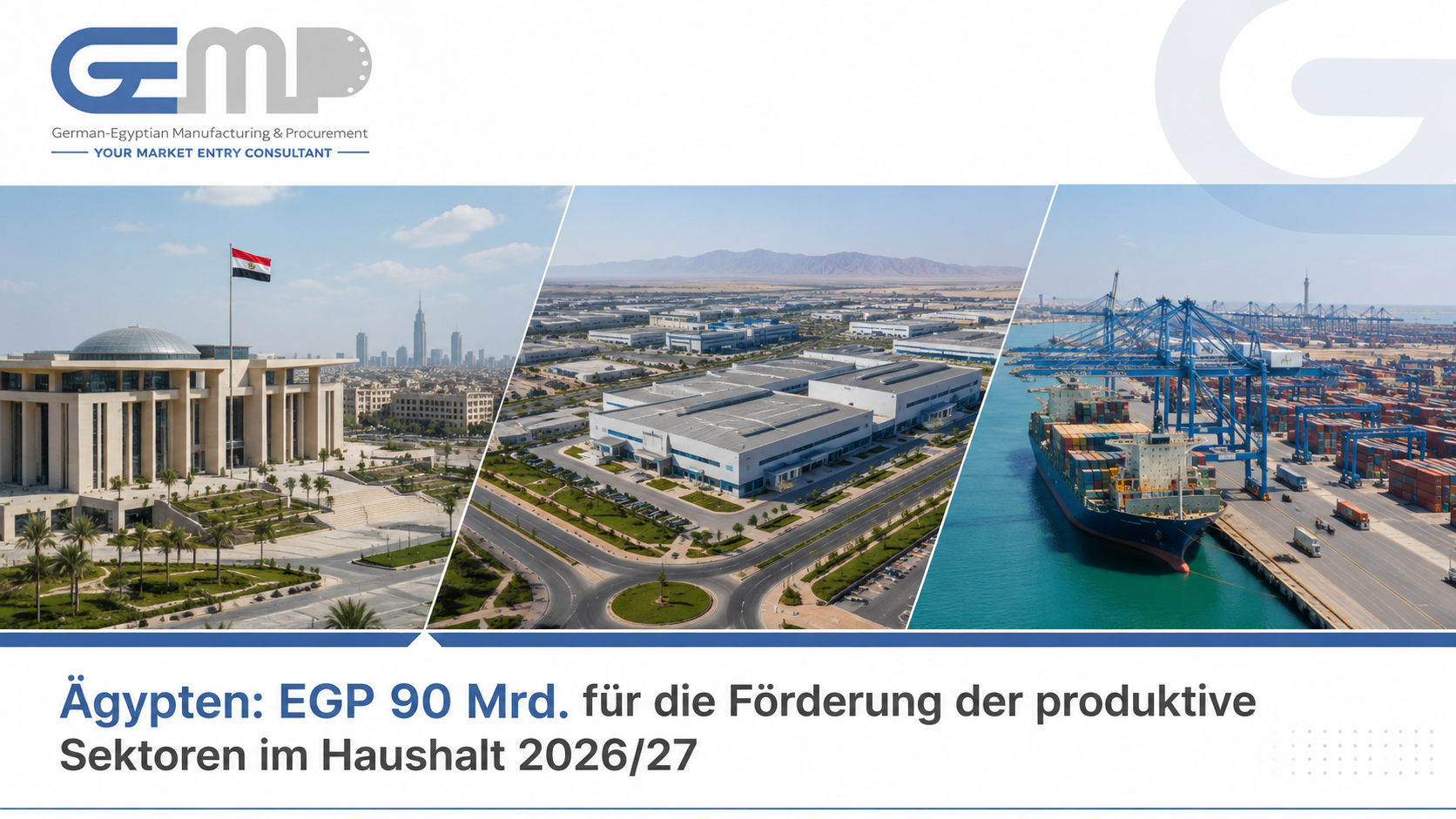
AI-generated visualization created exclusively for GEMP. The image is intended for illustrative purposes only and represents key sectors of Egypt’s economic development. All usage rights for this graphic are held by GEMP.
EGP 90 bn subsidies for productive sectors in the 2026/27 budget
The package is not a single fund with one application form. It is a budget-side bundle of several support channels. Part of it is likely to flow as direct export rebates, part as interest-rate support through banks, part as grants for tourism and industrial programmes, and part through existing programmes for SMEs, automotive and priority industries. The central policy logic is: more foreign-exchange earnings, more locally produced inputs, lower import dependence and more private investment.
Important: What is publicly confirmed is mainly the total amount, the broad sector allocation and the budget status. Detailed implementation rules for fiscal year 2026/27 - such as exact support rates, lists of eligible sectors or application deadlines - were not yet fully available in the public sources reviewed. Where this paper describes mechanisms, it distinguishes between confirmed information and plausible implementation based on existing Egyptian support instruments.
Allocation of the EGP 90 bn according to the publicly stated breakdown
- Exports: EGP 48 bn - around 53.3% of the total package.
- Tourism: EGP 7 bn - around 7.8%.
- Industry/agriculture financing: EGP 6 bn - around 6.7%.
- SMEs/entrepreneurship: EGP 5 bn - around 5.6%.
- Automotive industry: EGP 5 bn - around 5.6%.
- Priority industries: EGP 2 bn - around 2.2%.
- Not publicly itemised: EGP 17 bn - around 18.9%.
The initial report came from Ahram Online and cited Finance Minister Ahmed Kouchouk: the draft 2026/27 budget provides EGP 90 bn to strengthen economic output, including EGP 48 bn for export support, around EGP 7 bn for tourism, EGP 6 bn for financing facilities for industry and agriculture, EGP 5 bn for SMEs and entrepreneurship, around EGP 5 bn for the automotive industry and EGP 2 bn for priority industries. The draft had been approved by the cabinet and was before parliament ahead of the start of the fiscal year on 1 July 2026. [1]
1. What exactly has been announced?
The following overview is presented as bullet points. It fully replaces the table version.
Export support for goods and services
- Amount: EGP 48 bn.
- Likely function: Liquidity and cost compensation for exporters, typically as export rebates or reimbursement of export-related burdens.
- Comment: Largest single item; reflects the foreign-exchange strategy and the objective of increasing export revenues more quickly.
Tourism
- Amount: approx. EGP 7 bn.
- Likely function: Marketing, flight/charter incentives, hotel capacity, renovation and possibly interest-rate support.
- Comment: Tourism is a key source of foreign exchange and is intended to grow strongly under official targets.
Financing facilities for industry and agriculture
- Amount: EGP 6 bn.
- Likely function: Interest-rate support, credit guarantees or subsidised investment/working-capital loans through banks.
- Comment: The budget amount can cover the subsidy cost, while the credit volume triggered may be significantly larger.
SMEs and entrepreneurship
- Amount: EGP 5 bn.
- Likely function: Loans, guarantees, microfinance, technical assistance, incubators and formalisation support.
- Comment: The aim is employment, formalisation and a broader private enterprise base.
Automotive industry
- Amount: approx. EGP 5 bn.
- Likely function: Local value creation, supplier chains, assembly, component manufacturing and possibly low-emission vehicles.
- Comment: Fits the strategy of increasing local components and positioning Egypt as a regional production hub.
Priority industries
- Amount: EGP 2 bn.
- Likely function: Targeted incentives for strategic sectors, such as machinery, pharmaceuticals, food, electronics, textiles, fertilisers and renewable-energy components.
- Comment: The specific sector list for 2026/27 was not named in the Ahram report.
Remainder not publicly broken down
- Amount: approx. EGP 17 bn.
- Likely function: Presumably further support lines, reserves or programmes that were not listed individually in the brief announcement.
- Comment: Arithmetic remainder: EGP 90 bn minus EGP 73 bn. Not confirmed as a separate programme.
Budget context
The package sits within a tight fiscal environment. Reuters reported on the 2025/26 budget that Egypt continues to tighten fiscally under the IMF programme while also planning substantial funds for subsidies, grants and social benefits. For 2025/26, Reuters cited a cabinet proposal with EGP 4.6 trillion in expenditure and EGP 732.6 bn for subsidies, grants and social benefits. [2]
The IMF context matters: after the completion of the fifth and sixth reviews in February 2026, around USD 2.3 bn was unlocked. At the same time, Reuters reported that the IMF highlighted high public debt, high financing needs and slow structural reforms as constraints on policy space. [3]
2. Export support: the most important channel
What is confirmed: EGP 48 bn is intended to go into export subsidies or export support for goods and services. That is more than half of the publicly stated EGP 90 bn package. [1]
How does this typically work in Egypt?
1. Export evidence
- Mechanism: Companies submit export documents, invoices, customs papers, foreign-exchange proceeds and compliance evidence.
- Economic effect: Only goods/services that have actually been exported become eligible; abuse is meant to be reduced.
2. Eligibility
- Mechanism: Authorities check the sector, local value added, tax registration, social insurance, production licence and possibly target markets.
- Economic effect: Support can be linked to industrialisation and formalisation.
3. Calculation
- Mechanism: Support is often calculated as a percentage of export value, as reimbursement of specific costs or according to a sector/market matrix.
- Economic effect: The higher the local value added or the more strategic the market, the stronger the incentive can be.
4. Payment
- Mechanism: Payment as a cash rebate, offset against tax/customs liabilities or accelerated settlement of arrears.
- Economic effect: Improves exporters' cash flow and lowers financing costs.
5. Control
- Mechanism: Ex-post review by the Ministry of Finance, export support funds, tax and customs authorities.
- Economic effect: Limits fiscal leakage and false export declarations.
Why this channel is so large
Export support is particularly attractive for Egypt because it targets foreign-exchange inflows directly. After years of foreign-currency scarcity, each additional source of export earnings is macroeconomically important. The state can also use the support formula to push specific objectives: more local inputs, new export markets, greater manufacturing depth and formalisation of firms.
However, the mechanism is effective only if payments are reliable and predictable. Delayed export rebates function like a government loan taken at companies' expense. Export subsidies can also be sensitive under trade rules; this is why they are often structured as reimbursement of burdens, cost compensation or productivity-related support rather than open price undercutting.
In practical terms for companies: export support is not automatic money from the budget. It is a documentation- and audit-intensive process. Companies with clean customs, tax and production evidence gain access more quickly.
3. Tourism: support for foreign exchange, hotel capacity and demand
What is confirmed: the tourism sector is to receive around EGP 7 bn. [1]
Likely instruments
International marketing
- How it works: Financing of campaigns, trade-fair appearances, digital campaigns and cooperation with tour operators.
- Why it matters for Egypt: Increases demand in source markets and can rebuild trust after geopolitical shocks.
Flight and charter incentives
- How it works: Grants or marketing contributions for airlines serving specific destinations.
- Why it matters for Egypt: Tourism depends heavily on seat capacity; without flights, hotel rooms remain empty.
Hotel-room and renovation facilities
- How it works: Bank loans for new construction, expansion or renovation; the state may cover the interest spread or guarantee risk.
- Why it matters for Egypt: Egypt's target of significantly higher visitor numbers requires additional capacity and quality improvements.
Infrastructure and destination development
- How it works: Access roads, visitor guidance, airports, roads, museum and resort environments.
- Why it matters for Egypt: Increases length of stay, spending per tourist and regional distribution of demand.
Context
Reuters reported in February 2026 on a Red Sea project with a marina, hotels and residential units worth around USD 1 bn and referred to Egypt's target of raising tourist arrivals to around 30 million by 2030, from around 19 million in 2025. [5]
AP had already reported in 2023 that Egypt wanted to sharply increase tourist numbers and would need to expand the supply side, especially hotel rooms and airline capacity. [6]
Reuters reported in 2025 in connection with the Grand Egyptian Museum that the tourism sector was to be supported through better infrastructure, hotel capacity, transport and combined culture/beach programmes. [7]
This means: the EGP 7 bn is probably not the full investment in hotels or resorts. It is more likely a government lever. Budget funds finance marketing, interest subsidies, guarantees or infrastructure measures, while private investors carry most of the project costs.
4. Industry, agriculture, SMEs: financing instead of a pure grant
EGP 6 bn in financing facilities has been announced for industrial and agricultural capacity; a further EGP 5 bn has been announced for SMEs and entrepreneurship. [1]
Financing facilities - what does that mean?
A financing facility is typically not a direct grant covering the full investment amount. It often works through banks: the state covers part of the interest cost, provides guarantees or subsidises certain credit lines. This allows a limited budget amount to trigger larger credit volumes.
Interest-rate support
- Process: A company takes out a bank loan; the bank receives the market rate; the state pays the difference to a lower target rate.
- Example objective: Enable investment despite high interest rates, for example in machinery, storage or raw materials.
Credit guarantee
- Process: The state or a guarantee company takes over part of the default risk; the bank can lend more or at lower cost.
- Example objective: SMEs and agricultural businesses with limited collateral gain access to finance.
Working-capital/import lines
- Process: Short-term loans for raw materials, intermediate goods, seeds, packaging, energy or logistics.
- Example objective: Stabilise production, fulfil export orders and absorb supply-chain bottlenecks.
Investment loans
- Process: Term loans for machinery, cold chains, processing, quality control or automation.
- Example objective: Increase productivity, local value added and export capability.
SMEs and entrepreneurship
For SMEs, support usually runs through a mix of financing, formalisation and technical assistance. Typical channels include microloans, bank loans with guarantees, founder programmes, incubators, export training, digital tax/registration services and advisory support for quality assurance or certification.
Reuters reported in May 2026 on a USD 1.5 bn ITFC financing agreement for Egypt, mainly supporting food and energy security; ITFC also referred to its long-term support for SMEs under the partnership with Egypt. This shows that SME finance can run not only through national budget funds but also through multilateral and development-finance channels. [4]
What companies practically need
For such programmes, three things are usually decisive: formal registration and tax status, robust bank documentation and a credible investment or export plan. For SMEs, it also matters whether the company is already formalised or first needs to be brought into the formal sector through the programme.
5. Automotive industry and priority sectors
What is confirmed: around EGP 5 bn for the automotive industry and EGP 2 bn for priority industries. [1]
Automotive industry: likely levers
Local value added
- Possible design: Incentives increase when manufacturers source more components locally or build supplier networks in Egypt.
- Policy logic: Replace imports and deepen industrial capacity.
Production/volume incentive
- Possible design: Grant or tax advantage depending on production volume, model, emissions standard or export share.
- Policy logic: Create economies of scale and improve site attractiveness.
Supplier-chain support
- Possible design: Financing for component manufacturers, tools, quality certification and industrial zones.
- Policy logic: OEMs come only if the supplier network and quality are sufficient.
Green mobility
- Possible design: Support for electric buses, low-emission vehicles, batteries or charging infrastructure.
- Policy logic: Link industrial policy with climate and import-substitution goals.
Priority industries
The Ahram report does not name an official list of priority industries. Plausible candidates are sectors that Egypt has promoted for years to substitute imports, expand exports and localise supply chains: pharmaceuticals, medical goods, food processing, textiles and apparel, technical and electrical equipment, renewable-energy components, fertilisers/chemicals and industries in the Suez Canal Economic Zone.
The mechanisms differ by sector. Possible instruments include investment grants, discounted industrial land, faster licences, customs/tax relief for machinery, interest-rate support, access to energy or infrastructure, quality certification and export promotion. Without published guidelines, however, the EGP 2 bn should not be interpreted as a freely accessible fund.
Why this part matters
The priority industries are the interface between industrial policy and macroeconomic stabilisation. Egypt wants to become less import-dependent while also generating new export earnings. Therefore, priority is given to sectors that either earn foreign exchange, replace strategic imports or serve as a supplier base for larger export industries.
6. How does this work in budget practice?
The process can be understood in five stages:
1. Budget allocation
- What happens: The Ministry of Finance plans EGP 90 bn in the 2026/27 budget.
- What to watch: This does not yet create an automatic payment claim for companies.
2. Parliament and law
- What happens: The budget must be finally approved; the fiscal year starts on 1 July 2026.
- What to watch: Changes during the parliamentary process are possible.
3. Implementation rules
- What happens: Ministries, funds and authorities publish criteria, forms, deadlines and target sectors.
- What to watch: This determines who is actually eligible.
4. Application and review
- What happens: Companies submit documents; authorities check tax status, export evidence, local value added and investment plans.
- What to watch: Clean documentation accelerates access.
5. Payment or offsetting
- What happens: Money flows as a grant, export rebate, interest compensation, credit guarantee or offset against government claims.
- What to watch: Liquidity depends on treasury releases and prioritisation.
What to check in the coming weeks
- Final approval of the 2026/27 budget and final allocations for subsidies, grants and support funds.
- Implementation decisions by the Ministry of Finance, the Ministry of Trade/Industry, the Ministry of Tourism and, where relevant, the Central Bank or participating banks.
- New rules of the export support programme: payment speed, percentages, sectors, local value added, target markets and the process for settling arrears.
- Tourism details: whether the EGP 7 bn primarily finances marketing, flight incentives, hotel-room financing or crisis/debt support.
- Credit programmes: interest rate, maturity, maximum credit size, eligible companies, and the role of state banks and private banks.
- Transparency: publication of beneficiaries, criteria and actual payments.
Risks
The package can strengthen growth and foreign exchange, but it carries risks: fiscal burden, possible payment delays, political selection of winning sectors, competitive distortions between state-owned and private companies, and limited impact if energy prices, import costs or exchange-rate volatility absorb the support effect.
In recent reviews, the IMF has repeatedly pointed to high debt, high financing needs and the need for a smaller state role in the economy. These factors limit how generous support programmes can be. [3]
7. Written-out sources
The following sources were used for the assessment. They are written out so they can be checked directly. Access/review status: 4 June 2026.
- [1] Ahram Online: "Egypt allocates EGP 90 bln to boost economic output in 2026/27 budget", 31 May 2026. URL: https://english.ahram.org.eg/News/569900.aspx. Use: Main source for the EGP 90 bn announcement and sector allocation.
- [2] Reuters: "Egypt approves $91 billion budget for 2025/26", 26 March 2025. URL: https://www.reuters.com/world/africa/egypt-approves-91-billion-budget-202526-2025-03-26/. Use: Budget and subsidy context for 2025/26 under the IMF programme.
- [3] Reuters: "IMF completes Egypt reviews, unlocking about $2.3 billion", 26 February 2026. URL: https://www.reuters.com/world/africa/imf-completes-egypt-reviews-unlocking-about-23-billion-2026-02-26/. Use: IMF context: stabilisation and disbursements, but also high debt and slower structural reforms.
- [4] Reuters: "Egypt signs $1.5 billion loan deal with ITFC to support food, energy security", 13 May 2026. URL: https://www.reuters.com/world/africa/egypt-signs-15-bln-loan-deal-with-itfc-support-food-energy-security-2026-05-13/. Use: Example of external financing and trade-finance channels, including reference to SME support.
- [5] Reuters: "Egypt plans $1 billion Red Sea marina, hotel development", 9 February 2026. URL: https://www.reuters.com/world/africa/egypt-plans-1-billion-red-sea-marina-hotel-development-2026-02-09/. Use: Tourism investment and the target of around 30 million tourists by 2030.
- [6] Associated Press / AP News: "Egypt aims to double the number of tourists to reach 30 million by 2028, tourism minister says", 2023. URL: https://apnews.com/article/e9ccbfad85f2dbe4a3beef3d38a41ea5. Use: Tourism strategy: hotel rooms, flight capacity and private investment.
- [7] Reuters: "Egypt hopes vast new museum by the Pyramids will accelerate tourism revival", 30 October 2025. URL: https://www.reuters.com/world/africa/egypt-hopes-vast-new-museum-by-pyramids-will-accelerate-tourism-revival-2025-10-30/. Use: Tourism as a source of foreign exchange; infrastructure, hotel capacity and culture/beach programmes.
Note on source status
The Ahram report is the most important current source for the specific EGP 90 bn announcement. For the mechanisms, the analysis draws on Egypt's usual support channels and the policy goals described in publicly available reports. A final robust assessment of application requirements, support rates and sector lists will only be possible once implementation rules or budget details for 2026/27 have been published.